
High-throughput molecular detection of Fusarium graminearum on carbendazim medicament-resistant gene frequency
A Fusarium graminearum, gene frequency technology, applied in the field of high-throughput molecular detection
- Summary
- Abstract
- Description
- Claims
- Application Information
AI Technical Summary
Problems solved by technology
Method used
Image

Examples
Embodiment 1
[0057] Example 1 Cycling Probe Fluorescent Dye Quantitative PCR System Optimization
[0058] 1.1 Optimization of annealing temperature In order to ensure the stability and reliability of the detection, the experiment selected the CycleavePCR of Treasure Bioengineering (Dalian) Co., Ltd. TM Core Kit DCY501 kit.
[0059] During the PCR reaction, the annealing temperature Tm value is an important guarantee for the specificity of the reaction. If the annealing temperature is too low, non-specific products will be produced. In the present invention, due to the strong specificity of the probe, the requirement for the primer is relatively low, and it only needs to ensure a sufficiently high reaction efficiency. Referring to the Tm value of the primers, gradient PCR was carried out from 50 to 60°C, combined with the annealing temperature recommended by the kit, the optimal annealing temperature for quantitative PCR was determined to be 55°C.
[0060] 1.2 Probe Concentration Optimiz...
Embodiment 2
[0061] The sensitivity of embodiment 2Cycling Probe fluorescent dye quantitative PCR
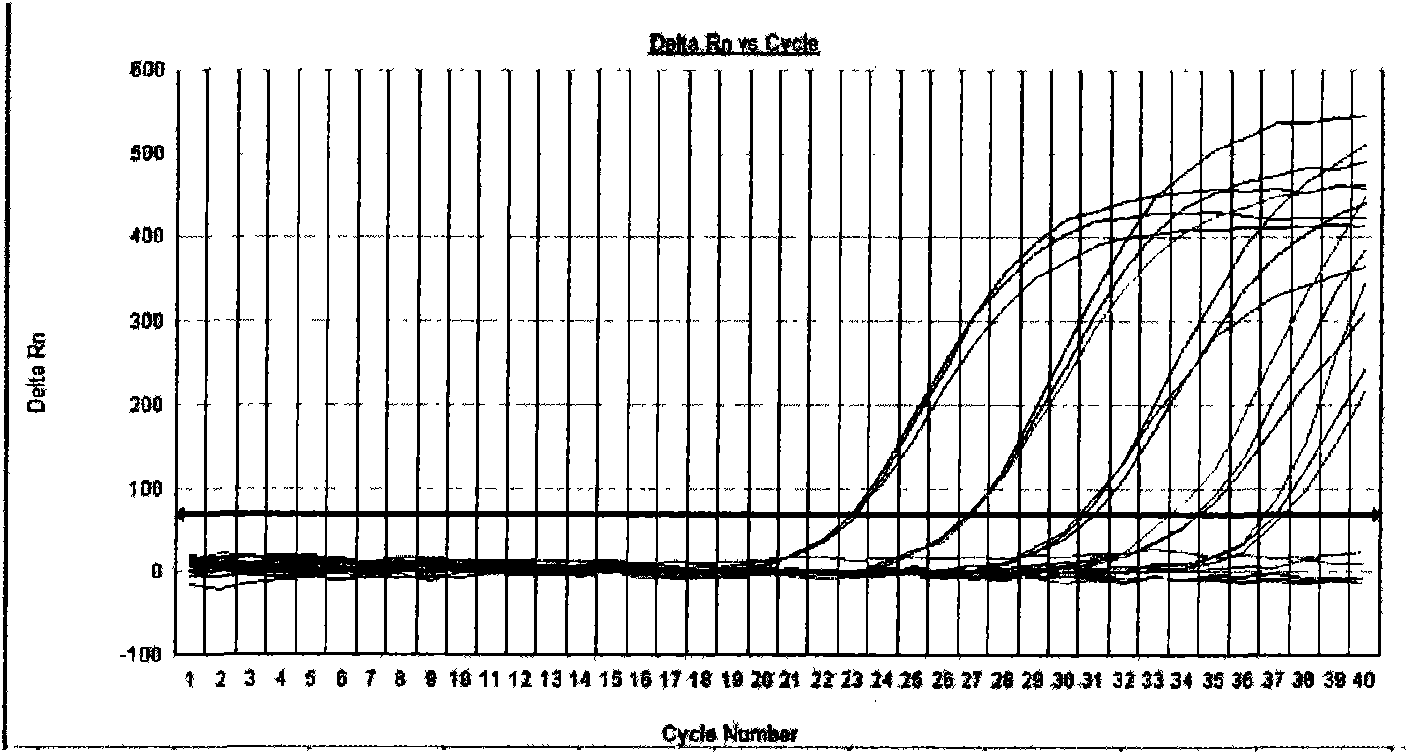
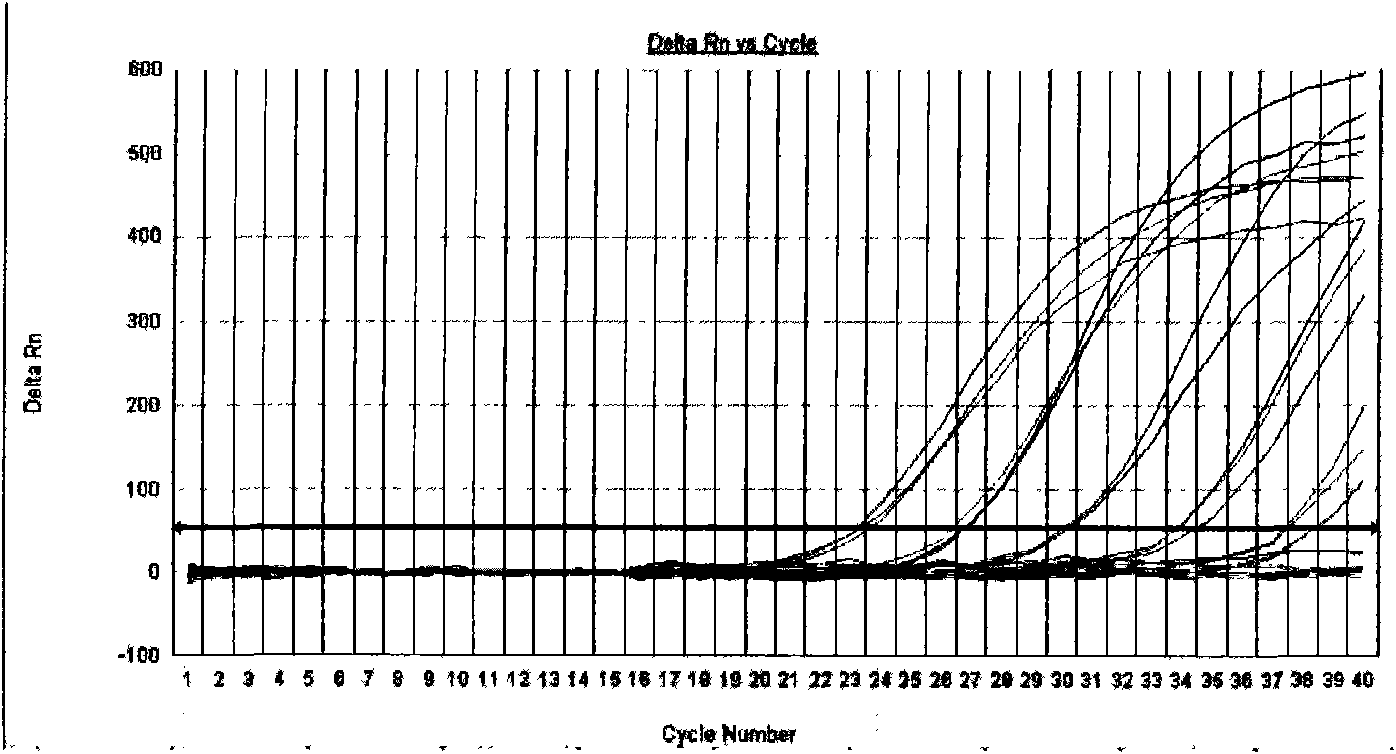
[0062] Standard products require high purity, uniformity and stability. In this experiment, the purified PCR product fragments were cloned into the vector as the standard. The copy number of the standard product of the sensitive strain ZF43 was 1.33×10 6 ~1.33×10 2 , the copy number of the resistant strain ZF52 standard was 1.78×10 6 ~1.78×10 2 All were serially diluted 10 times. The standard was amplified to obtain two sets of amplification curves ( figure 1 , figure 2 ), it can be seen that the minimum detection copy number of this technology is 10 2 The sensitivity is at least 10 to 100 times that of the common PCR detection method, and it is also more sensitive than the general SYBR GREEN I dye method.
Embodiment 3
[0063] Example 3 The specificity verification of Cycling Probe fluorescent dye quantitative PCR
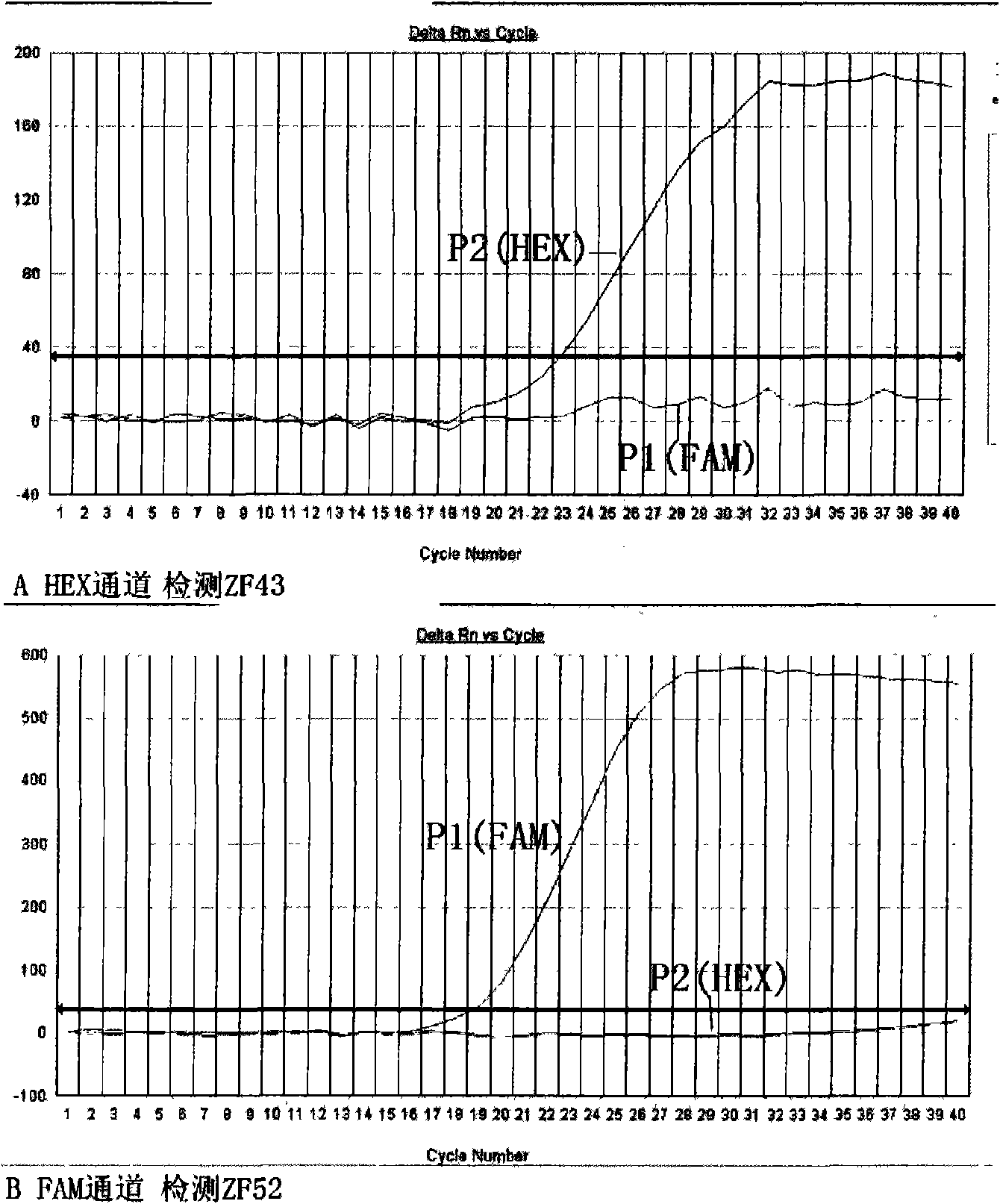
[0064] The sensitive strain ZF43 and the resistant strain ZF52 were used as templates for quantitative PCR detection respectively, and the reactions had good specificity. When the template is ZF43, under the HEX channel, the P2 probe has a signal, and the sensitive strain ZF43 is detected, while the P1 probe has no signal ( image 3 A); At this time, there is no signal from the two probes under the FAM channel. When the template is ZF52, the signal can only be detected in the FAM channel ( image 3 B).
PUM
 Login to View More
 Abstract
Description
Claims
Application Information
 Login to View More