

Phytoene dehydrogenase gene and application thereof
A technology of phytoene and lycopene, which is applied in the field of genetic engineering and can solve problems such as limited sources of phytoene dehydrogenase
- Summary
- Abstract
- Description
- Claims
- Application Information
AI Technical Summary
Problems solved by technology
Method used
Image

Examples
Embodiment 1
[0023] Example 1: PCR amplification of phytoene dehydrogenase gene of Rhodobacter azotoformans KA25
[0024] Take 5 mL of Rhodobacter azotoformans KA25 culture solution purchased from Japan's NITE Biological Resource Center (NBRC) with a preservation number of 16436, and use the bacterial genome extraction kit to extract the genome. The extraction steps refer to the instructions of the bacterial genome extraction kit from Qiagen. .
[0025] The nucleotide sequences of phytoene dehydrogenase genes of different strains of the same genus were retrieved from GenBank, and a pair of primers F-I and R-I were designed. The primer sequences are as follows:
[0026] F-I: 5'-ATGCCCGCGACCAAGCATGT-3'SEQ ID NO.3
[0027] R-I: 5'-TCATTCCgCggCCAgCCTTT-3'SEQ ID NO.4
[0028] Genomic DNA is used as a template for amplification, and the above primers are used for amplification. The total volume is 50 μL, 18 μL of ultrapure water, 2×GC buffer I (containing MgCl 2 ) 25 μL, dNTP (2.5 mmol / L ea...
Embodiment 2
[0030] Example 2: Expression and purification of Rhodobacter azotoformans KA25 phytoene dehydrogenase gene in Escherichia coli BL21 (DE3)
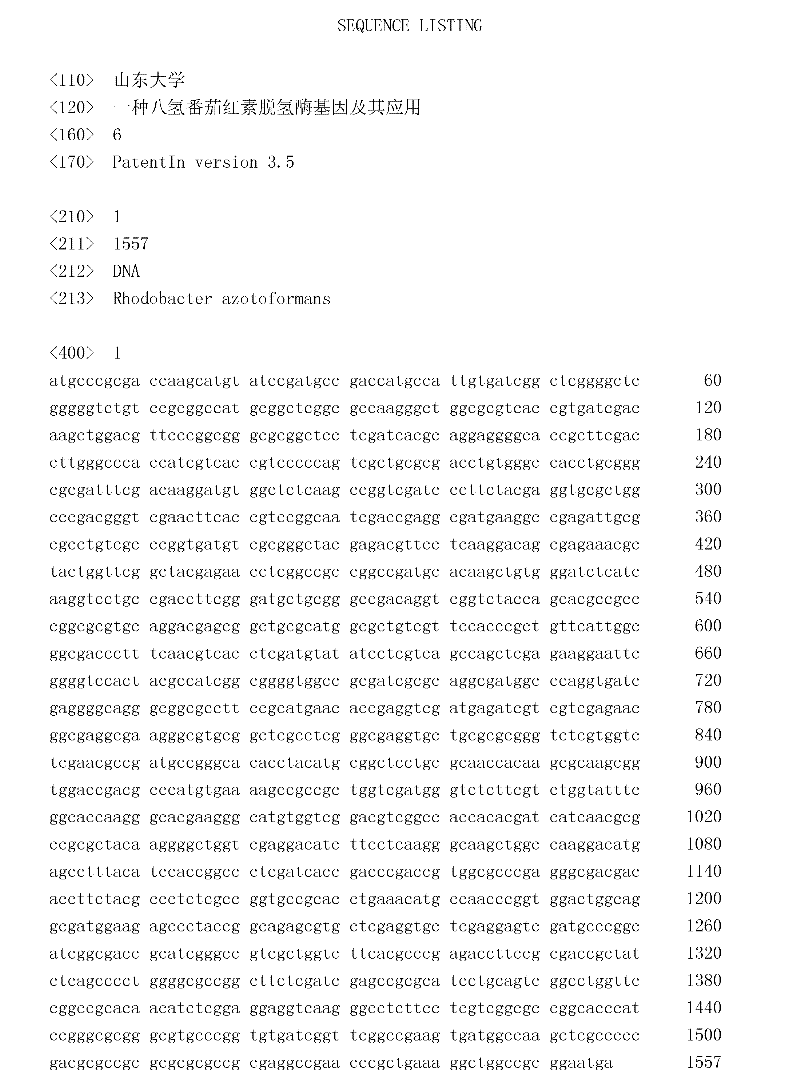
[0031] Design primers F-I-22b and R-I-22b according to the sequence shown in SEQ ID No.1, respectively introduce the NdeI and SalI restriction sites (shown underlined) that can be inserted into the pET-22b plasmid, and the sequences are as follows
[0032] F-I-22b: 5'-GCG CATATG CCCGCGACCAAGCATGT-3' SEQ ID NO.5
[0033] R-I-22b: 5'-GCG GTC GAC TTCCgCggCCAgCCTTTCA-3' SEQ ID NO.6
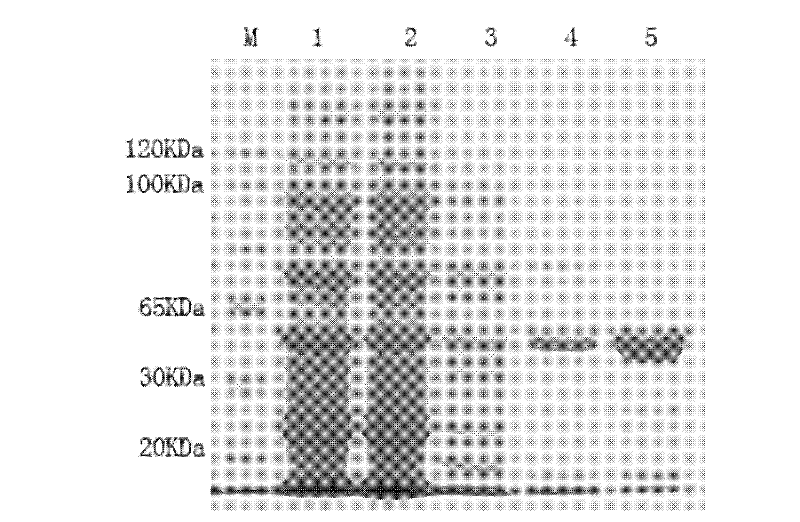
[0034] Using the extracted Rhodobacter nitrogen-fixing genomic DNA as a template, PCR amplification was carried out using the above primers. PCR amplification conditions and PCR product recovery method were the same as in Example 1. After recovery of the PCR product, NdeI and SalI (NEB, USA) were added to digest at 37°C for 1 hour for DNA purification, and the pET-22b plasmid vector was treated with the same digestion method. The prepared enzyme gene fragme...
Embodiment 3
[0042] Example 3: Co-expression of Rhodobacter azotoformans KA25 phytoene dehydrogenase gene and plasmid pACCRT-EB in Escherichia coli BL21
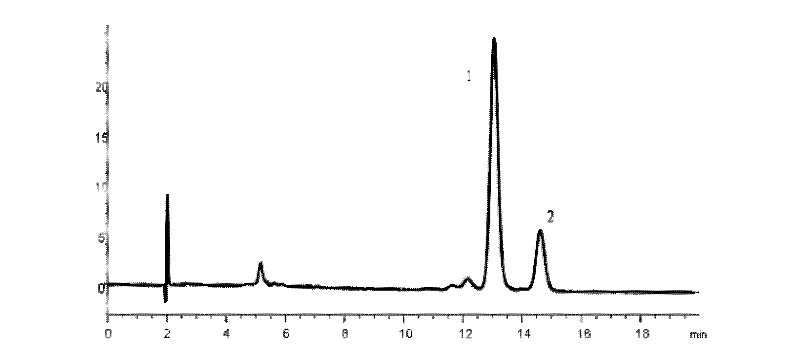
[0043] The nitrogen-fixing Rhodobacter phytoene dehydrogenase recombinant plasmid obtained in Example 2 and the plasmid pACCRT-EB were co-transformed into the host strain Escherichia coli BL21 (DE3), and the transformation and induction methods were the same as in Example 2. After centrifugation of the induced recombinant Escherichia coli, the carotenoids were extracted with acetone and detected by HPLC. The chromatographic column was TC-C18 (Agilent, USA), and the mobile phase was methanol / acetonitrile (4 / 6). The flow rate was 1 mL / min. The temperature is 30°C, and the detection wavelength is 474nm.
[0044] figure 2 It shows that the above-mentioned double-plasmid co-expression E. coli strain products mainly contain two kinds of carotenoids. By comparing the mass spectrometry data and the retention time of the standard, the two kinds...
PUM
| Property | Measurement | Unit |
|---|---|---|
| molecular weight | aaaaa | aaaaa |
Abstract
Description
Claims
Application Information
 Login to View More