
Custom language models
A language model, a specific technology, applied in natural language data processing, instruments, calculations, etc., can solve problems such as the input method is not optimal, and achieve the effect of reducing user errors and user intervention
- Summary
- Abstract
- Description
- Claims
- Application Information
AI Technical Summary
Problems solved by technology
Method used
Image

Examples
Embodiment Construction
[0029] review
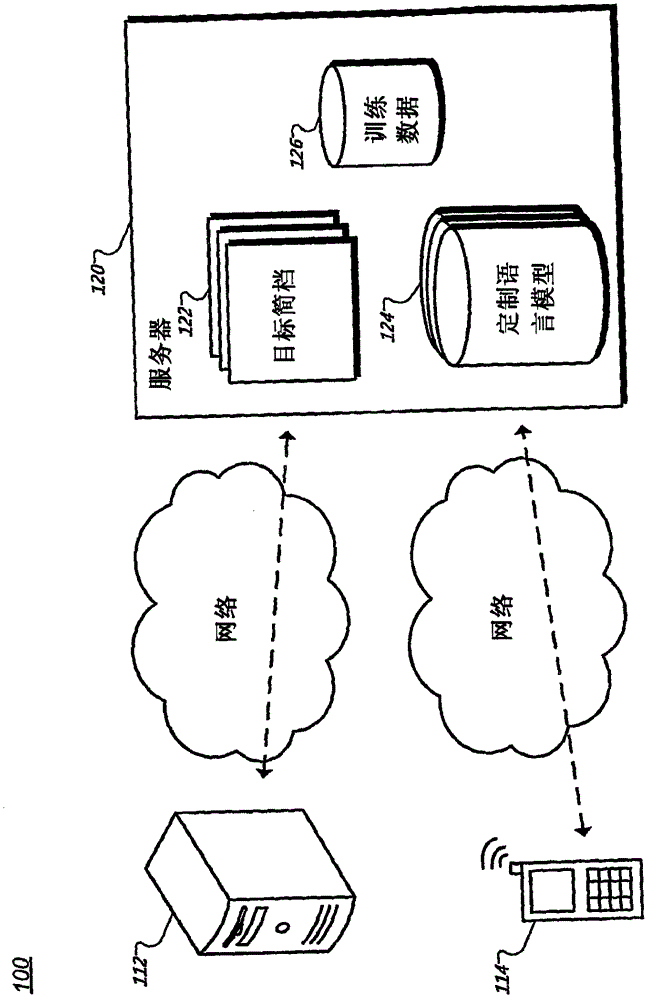
[0030] figure 1 is a diagram illustrating an example system 100 for generating a custom language model 124 . System 100 includes a first client 112 (eg, a desktop computer), a second client 114 (eg, a cell phone), and a server 120 . Server 120 may include a target profile 122, a custom language model 124, and training data 126 (eg, an unannotated corpus).
[0031] As an overview for generating custom language models, training data 126 may be classified into sets of training data 126 (eg, one or more sets of documents). Server 120 may receive user input identifying a user (eg, a first user on first client 112 , a second user on first client 112 , a first user on second client 114 ). For example, server 120 may use a user login or a cookie to identify a user. The server 120 may generate a target profile 122 (eg, a user profile) corresponding to each user.
[0032]In some implementations, target profile 122 may be predetermined. For example, server 120 may i...
PUM
 Login to View More
 Abstract
Description
Claims
Application Information
 Login to View More