Lithium ion battery anode material LiCoPO4/Al2O3 and preparation method thereof

A technology for lithium-ion batteries and positive electrode materials, applied in battery electrodes, circuits, electrical components, etc., can solve problems such as the inability to guarantee the stability of the electrolyte system, achieve the effects of suppressing adverse reactions, simple process, and improving electrochemical performance

CN102437337AInactive Publication Date: 2012-05-02MCNAIR TECH +2
7 Cites 8 Cited by

Patent Information

Authority / Receiving Office
CN · China
Patent Type
Applications(China)
Current Assignee / Owner
Publication Date
2012-05-02
Estimated Expiration
Not applicable · inactive patent

Smart Images

  • Figure 1
    Figure 1
  • Figure 2
    Figure 2
  • Figure 3
    Figure 3
Patent Text Reader

Abstract

The invention relates to the technical field of battery materials, in particular to a lithium ion battery anode material LiCoPO4 / Al2O3 and a preparation method thereof. The material consists of an olivine LiCoPO4 material and aluminum salt, and the preparation method comprises the following step of adopting a surface coating technology to coat a layer of metal oxide film on surface of lithium ion battery anode active substance so as to prepare the lithium ion battery anode compound material with high voltage and high cyclical stability. As the special method is adopted in the invention to prepare the LiCoPO4 material, the reduction for particle size and uniformity of a product can be favored; interface situation of electrolyte and the anode active substance can be improved, adverse reaction between the electrolyte and the anode active substance can be inhibited, so that the purpose of improving cyclical stability of the active substance can be achieved; according to the material and the method provided by the invention, the technique is simple the industrialization is easy to realize, and moreover, the electrochemical property of the high voltage lithium ion battery is improved through the modification of the anode material, thus, the material has a wide application prospect in the field of power type lithium ion battery.
Need to check novelty before this filing date? Find Prior Art

Description

technical field

[0001] The invention relates to the technical field of battery materials, in particular to LiCoPO, a cathode material for lithium-ion batteries. 4 / Al 2 o 3 and its preparation method. Background technique

[0002] Lithium-ion secondary batteries have higher energy density than other rechargeable battery systems, and lithium-ion cathode materials are the key factors that limit the development of lithium-ion batteries, and also directly affect the energy density and specific power of batteries. In order to obtain lithium-ion batteries with higher energy density and specific power, LiNi with a higher discharge platform x mn 2-x o 4 、LiCoPO 4 , Li 3 V 2 (PO4) 3 , LiNiPO 4 Positive electrode materials such as these are expected to become a new generation of high-voltage lithium-ion battery positive electrode materials. However, the current electrolytes are mainly some conventional organic electrolytes, which are easy to decompose under high voltage, an...

Examples

Embodiment 1

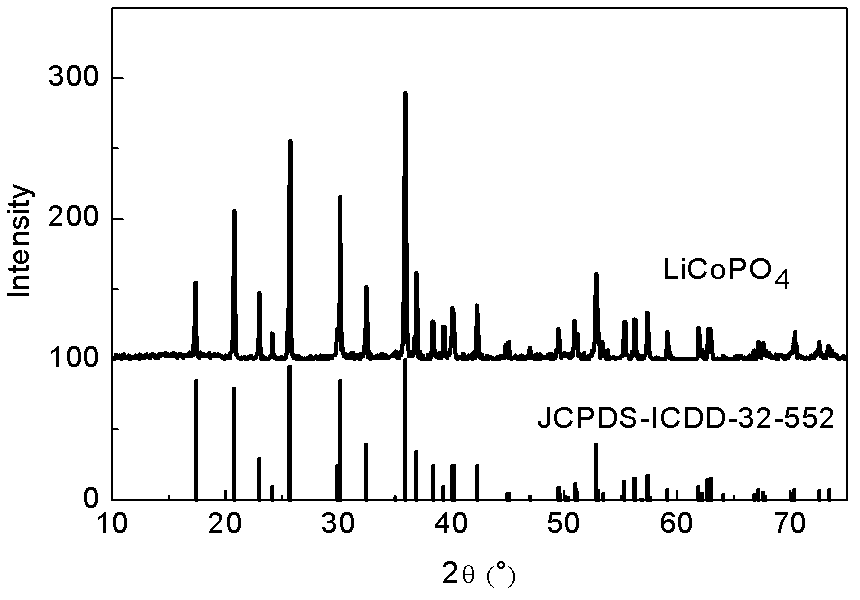
[0025] Dissolve 0.01mol of lithium acetate and ammonium dihydrogen phosphate in deionized water respectively to prepare a solution; dissolve 0.01mol of cobalt acetate and 0.02mol of citric acid in deionized water respectively; add cobalt acetate and citric acid dropwise to the above-mentioned Mix the solution, stir for 4 hours to mix evenly, then stir in a water bath at 75°C until it becomes a gel, then vacuum-dry it at 120°C to form a gel, calcinate at 350°C in air for 6 hours, cool and grind, and then calcinate at 650°C in air for 12 hours. The resulting product was analyzed by X-ray diffraction, and the product was olivine-type LiCoPO 4 .

Embodiment 2

[0027] Lithium nitrate and cobalt nitrate were used to replace lithium acetate and cobalt acetate respectively and dissolve them in deionized water. Other conditions were the same as in Example 1 to obtain olivine-type LiCoPO 4 .

Embodiment 3

[0029] Dissolved in deionized water with tartaric acid instead of citric acid, and other conditions were the same as in Example 1 to obtain olivine-type LiCoPO 4 .

[0030] 2. Coated Al 2 o 3 film