Unlock instant, AI-driven research and patent intelligence for your innovation.

Coordinated multi-point reception method and network node with reduced complexity

A technology of network nodes and wireless communication networks, applied in the field of cooperative multi-point reception, which can solve the problems of increasing computational complexity of multi-antenna G rake receivers

Active Publication Date: 2016-02-24
TELEFON AB LM ERICSSON (PUBL)
View PDF3 Cites 0 Cited by
  • Summary
  • Abstract
  • Description
  • Claims
  • Application Information

AI Technical Summary

Problems solved by technology

However, the computational complexity of a multi-antenna G rake receiver grows with the number of antennas used for CoMP reception and the number of rakes allocated to each antenna
Computational complexity is an important limiting factor in the performance of CoMP reception when CoMP reception is most efficient with a large number of antennas and with a large number of fingers assigned to each antenna

Method used

the structure of the environmentally friendly knitted fabric provided by the present invention; figure 2 Flow chart of the yarn wrapping machine for environmentally friendly knitted fabrics and storage devices; image 3 Is the parameter map of the yarn covering machine
View more

Image

Smart Image Click on the blue labels to locate them in the text.
Viewing Examples
Smart Image
  • Coordinated multi-point reception method and network node with reduced complexity
  • Coordinated multi-point reception method and network node with reduced complexity
  • Coordinated multi-point reception method and network node with reduced complexity

Examples

Experimental program
Comparison scheme
Effect test

Embodiment Construction

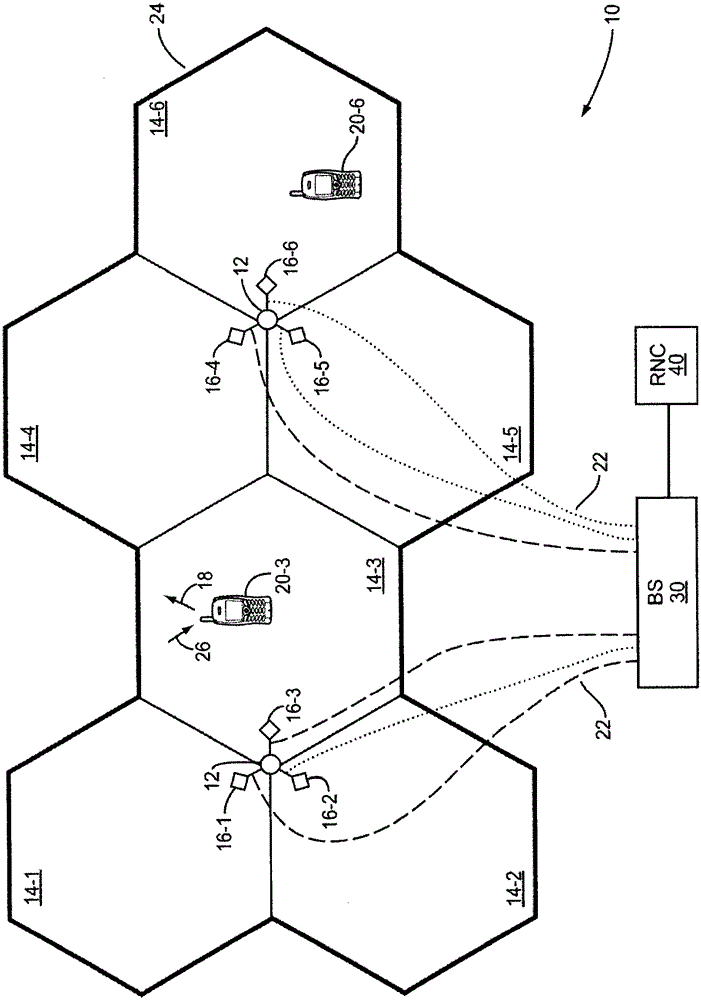
[0017] figure 1 A wireless communication network 10 according to one embodiment of the invention is illustrated. A wireless communication network 10 includes radio access points 12 distributed over the coverage area of ​​the network to serve different sectors 14 of that coverage area. As shown, each radio access point 12 is located near the edges of several sectors 14 and has at least a number of sector antennas 16 deployed. Each sector antenna 16-x serves the associated sector 14-x, such as by receiving uplink signals from mobile terminals 20-x in that sector 14-x (note that sector antennas 16-x also The associated sector 14-x may be served by transmitting one or more downlink signals to the mobile terminals 20-x in that sector 14-x, or the sector 14-x may have figure 1 Another separate sector antenna not shown in the downlink transmission).

[0018] Of course, a sector antenna 16-x associated with a given sector 14-x may still receive uplink signals transmitted by a mob...

the structure of the environmentally friendly knitted fabric provided by the present invention; figure 2 Flow chart of the yarn wrapping machine for environmentally friendly knitted fabrics and storage devices; image 3 Is the parameter map of the yarn covering machine
Login to View More

PUM

No PUM Login to View More

Abstract

The teach-in of this document provides a collaborative multipoint (CoMP) reception of uplink signals transmitted by a mobile terminal with reduced complexity. Teach-in for each sector antenna deployed in the CoMP cell in the sector antenna set to obtain a signal strength measurement of one or more downlink signals received by the mobile terminal from the sector associated with that sector antenna. Teach-in compares signal strength measurements, and then based on that comparison, selects a subset of sector antennas from the set for CoMP reception of uplink signal B, and a subset of sector antennas for CoMP reception instead of using all sector antennas in the set, teaching reduces the computational complexity of CoMP reception. Further, the teach-in some embodiments by selecting a subset to contain a sector antenna having the strongest signal strength measurement to minimize any performance degradation that may be generated by performing CoMP reception with a reduced number of antennas.

Description

[0001] related application [0002] This application claims priority under 35 U.S.C. §119(e) from U.S. Provisional Patent Application Serial No. 61 / 249,392 filed October 7, 2009 and entitled "Antenna Site Selection for Uplink CoMP." technical field [0003] The present invention relates generally to coordinated multipoint (CoMP) reception of uplink signals in wireless communication networks, and more particularly to methods and apparatus for reducing the complexity of CoMP reception of uplink signals. Background technique [0004] The dramatic increase in demand for wireless communications has put continuous pressure on wireless network operators to improve the capacity of their communications networks. In order to improve the spectral efficiency of these networks, scarce radio resources must be actively reused in neighboring cells. Consequently, inter-cell interference has become a major source of signal disturbance, limiting not only the quality of service to users at th...

Claims

the structure of the environmentally friendly knitted fabric provided by the present invention; figure 2 Flow chart of the yarn wrapping machine for environmentally friendly knitted fabrics and storage devices; image 3 Is the parameter map of the yarn covering machine
Login to View More

Application Information

Patent Timeline
no application Login to View More
Patent Type & Authority Patents(China)
IPC IPC(8): H04B7/08H04B7/02
CPCH04B1/7115H04B7/024H04B7/0495H04B7/0848H04B7/0854H04B7/0874H04B7/0828H04B7/0845H04L25/0224
Inventor S·格兰特
Owner TELEFON AB LM ERICSSON (PUBL)