Testing apparatus and method for simulating liquefied particle motion characteristics

A particle movement and test device technology, applied in the field of geotechnical earthquake engineering, can solve the problems of poor stability, high cost, low precision, etc., to avoid boundary effects and local effects, and improve test efficiency.

CN102735594AActive Publication Date: 2012-10-17HOHAI UNIV
9 Cites 9 Cited by

Patent Information

Authority / Receiving Office
CN · China
Patent Type
Applications(China)
Current Assignee / Owner
Publication Date
2012-10-17

Smart Images

  • Figure 1
    Figure 1
  • Figure 2
    Figure 2
  • Figure 3
    Figure 3
Patent Text Reader

Abstract

The invention discloses a testing apparatus and a testing method for simulating liquefied particle motion characteristics. The apparatus comprises: a model box, a model box sealing cap, a workbench, and a PIV optical testing platform. The model box is prepared from a transparent plexiglass material. A water injection hole is arranged on the side of the model box. A vacuum pumping hole is arranged on the sealing cap. Two rails are arranged inside the model box. A fixed pulley assembly and a forward and reverse motor are connected outside the model box. The testing method comprises that: liquefied sands are simulated by using suspending plastic sands in a sodium chloride solution with a certain density; a steel wire is drawn by the motor, such that a solid cylinder moves horizontally on the rails; the motion states of the plastic sands around the cylinder during the movement is measured by using the PIV optical testing platform; and the horizontal tensile force on the cylinder during the movement is measured by using a tension sensor. The apparatus and the method provided by the invention are advantaged in high precision, simple operation, stable state after liquefaction simulation, and the like.
Need to check novelty before this filing date? Find Prior Art

Description

technical field

[0001] The invention belongs to the technical field of geotechnical earthquake engineering, in particular to a test device and method for simulating the movement characteristics of particles after liquefaction.

[0002] Background technique

[0003] Earthquake is one of the major disasters faced by human beings. Saturated sandy soil will liquefy under the action of earthquake, which will cause the damage of rock and soil structures. Caused by weakening of cohesive soil. In recent years, there have been frequent earthquakes around the world, especially in the "5.12" Wenchuan Earthquake in China in 2008 and the "3.11" Earthquake in Japan in 2011, both of which caused earthquake damage due to sand liquefaction.

[0004] The total stress of saturated sand is composed of effective stress and pore water pressure. In general, the load of the foundation is mainly borne by the effective stress in the total stress. However, when an earthquake occurs, the pore water i...

Examples

Embodiment Construction

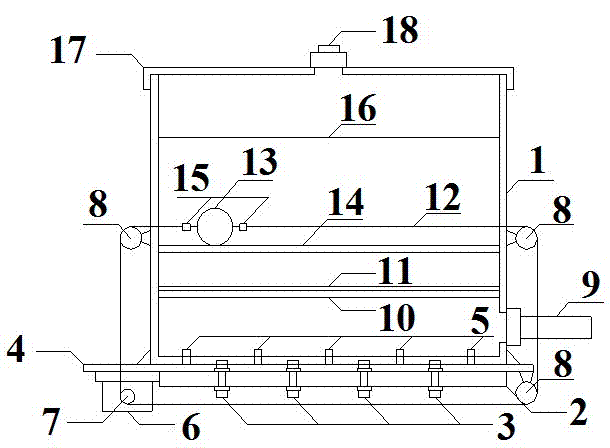
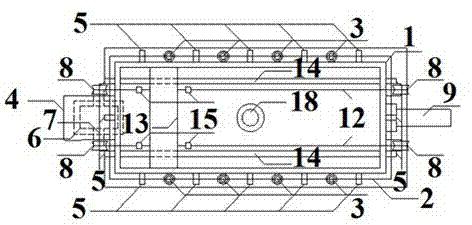
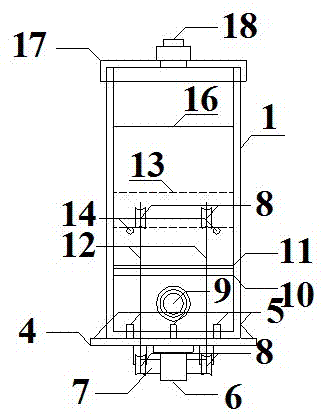
[0055] Such as figure 1 , figure 2 and image 3 As shown, a test device for simulating the movement characteristics of particles after liquefaction, including a model box (1) a workbench (2) a bolt (3) a base (4) a connecting block (5) a forward and reverse motor (6) a shaft (7 ) fixed pulley (8) water injection hole (9) permeable plate (10) permeable material (11) steel wire rope (12) solid cylinder (13) track (14) tension sensor (15) plastic sand (16) model box sealing cover ( 17) Vacuum hole (18) and PIV optical test platform.

[0056] The model box (1) is made of a transparent plexiglass panel, and a sealing ring is wrapped around the model box sealing cover (17), and a vacuum hole (18) is opened in the middle of the model box sealing cover (17), and the model box (1 ) is provided with a water injection hole (9) on one side of the bottom, and the cover of the water injection hole (9) is also designed to be sealed, and a piece of plexiglass panel is set at a certain dis...