
Preparation method of localized surface plasmon resonance (LSPR) microfluidic chip
A microfluidic chip and plasmon resonance technology, which is applied in the field of analytical chemistry, can solve the problems of the development and application of microfluidic chip detection technology, such as lag, reporting, and lack of commercialized instruments, and achieves low cost, good corrosion resistance, and modification. simple method effect
- Summary
- Abstract
- Description
- Claims
- Application Information
AI Technical Summary
Problems solved by technology
Method used
Image

Examples
specific Embodiment approach
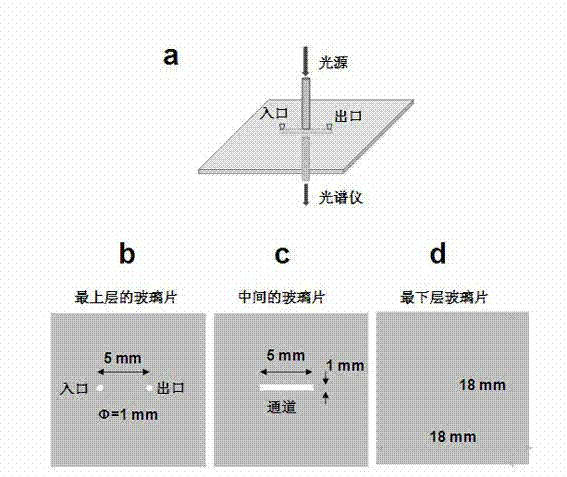
[0027] (1) First, prepare three pieces of square borate glass sheets with a side length of 18 mm according to the experimental procedure described in the present invention, wherein the thickness of two pieces of glass is 0.15±0.02mm, and the thickness of the other piece is 1.0±0.1mm;
[0028] (2) Prepare glass etching solution (mixed aqueous solution of hydrofluoric acid and ammonium fluoride, wherein the concentration of hydrofluoric acid is 4.5 M, and the concentration of ammonium fluoride is 2.5 M). Two small holes with a diameter of 1.0±0.2 mm are etched on one of the glasses with a thickness of 0.15±0.02 mm, which are used as the entrance and exit of the chip channel respectively (such as figure 1 As shown in b); etch a rectangular through hole (1.0±0.2 mm)×(5.0±0.2 mm) on another piece of glass with a thickness of 0.15±0.02 mm, as the channel of the chip (such as figure 1 as shown in c);
[0029] (3) Three pieces of glass according to figure 1 The order is stacked...
Embodiment 1
[0035] The following examples illustrate the operation process of applying the microfluidic chip prepared by the present invention to carry out actual sample analysis in conjunction with the accompanying drawings:
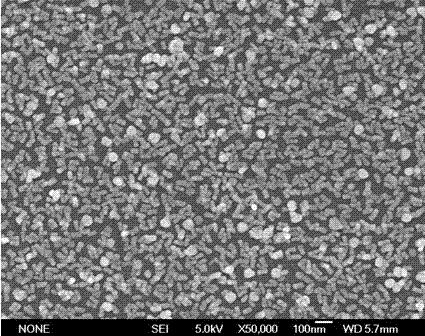
[0036] Firstly, the LSPR microfluidic chip is prepared according to the method of the present invention, and gold nanorods are fixed in the channel of the chip. attached figure 2 It is a characterization diagram of the modified gold nanorods in the channel of the chip.
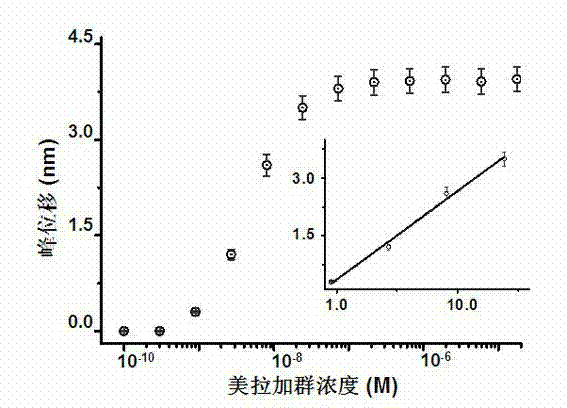
[0037] Before the chip is applied to actual sample detection, it is necessary to modify the capture molecules that have a specific response to the analyte on the gold nanorods. In this example, the target molecule to be detected is the anticoagulant drug melagatran in the human serum of the clinical sample, so it is necessary to modify the capture molecules of melagatran on the gold nanorods, the specific modification method is as follows: first 5.0 mg / mL of SH(CH 2 ) 2 (OCH 2 CH 2 ) 7 O(CH...
PUM
| Property | Measurement | Unit |
|---|---|---|
| thickness | aaaaa | aaaaa |
| length | aaaaa | aaaaa |
| thickness | aaaaa | aaaaa |
Abstract
Description
Claims
Application Information
 Login to View More