Breeding and cultivating method for early-matured and disease-resistant brassica oleracea

A kohlrabi, early-maturing technology, applied in plant breeding and cultivation, in the field of breeding and cultivation of purple kohlrabi, can solve the problems such as the hybridization rate of hybrids is difficult to reach 100%, the promotion area is restricted by the amount of seed production, and the vitality is degraded. , to achieve the effect of overcoming low temperature yellowing at seedling stage, well-developed flower organs, and well-developed nectaries

CN103975848AInactive Publication Date: 2014-08-13ZHENJIANG SUIHAN AGRI
1 Cites 7 Cited by

Patent Information

Authority / Receiving Office
CN · China
Patent Type
Applications(China)
Current Assignee / Owner
Publication Date
2014-08-13
Estimated Expiration
Not applicable · inactive patent

Smart Images

  • Figure 1
    Figure 1
  • Figure 2
    Figure 2
  • Figure 3
    Figure 3
Patent Text Reader

Abstract

The invention relates to a breeding and cultivating method for a plant, in particular relates to a breeding and cultivating method for brassica oleracea, and belongs to the technical field of plant cultivation. Compared with a previous sterile line, a cytoplasmic male sterile line adopted in the breeding and cultivating method has the advantages that the male sterility is thorough, the sterile plant rate and the sterility are respectively 100 percent, the phenomena of low-temperature yellowing and abnormal development of flower organs in a seedling stage are avoided, and the resulting rate is high, and the early-matured and disease-resistant brassica oleracea also has the characteristics of high stress resistance and disease resistance; when a vegetative mass harvested from the brassica oleracea is used for preparing hybrid seeds through the cytoplasmic male sterile line, a recovery line is not required, and only a parent line is required. The method for obtaining the early-matured and disease-resistant brassica oleracea is simple, low in cost and convenient to popularize and has a large market prospect.
Need to check novelty before this filing date? Find Prior Art

Description

technical field

[0001] The invention relates to a plant breeding and cultivation method, in particular to a purple kohlrabi breeding and cultivation method, and belongs to the technical field of plant cultivation. Background technique

[0002] Purple kohlrabi (Brassica oleracea L.var.caulorapa DC) is a biennial vegetable crop of the genus Brassica Brassica in the family Brassicaceae. vegetable. The edible part of purple kohlrabi is the enlarged fleshy stem, the flesh is white, it can be eaten cooked or as raw fruit, purple kohlrabi is rich in nutrition, contains high anthocyanins, Vc, protein, crude fiber and minerals, etc. Crisp, tender and refreshing, it has been welcomed by consumers in recent years. In addition, purple kohlrabi is also good for the stomach and digestion, and is rich in anthocyanins and anti-cancer substances, among which the anti-cancer substances are high. It is a high-quality, high-grade functional green vegetable that perfectly combines deliciousnes...

Examples

Embodiment Construction

[0032]In this example, the standard code of purple cabbage cytoplasmic male sterile line used as female parent for the first time is CMS038, the standard code of excellent and stable purple kohlrabi DH strain is 0202-6, and the standard code of purple kohlrabi cytoplasmic male sterile line CMS066, excellent and stable purple kohlrabi DH strain standard code 0202-8, can be purchased in the market according to needs (for example, purchase from Zhenjiang Ruifan Agronomy Co., Ltd., address No. 112, Ninghang Road, Jurong City, Jiangsu Province), The present invention is feasible.

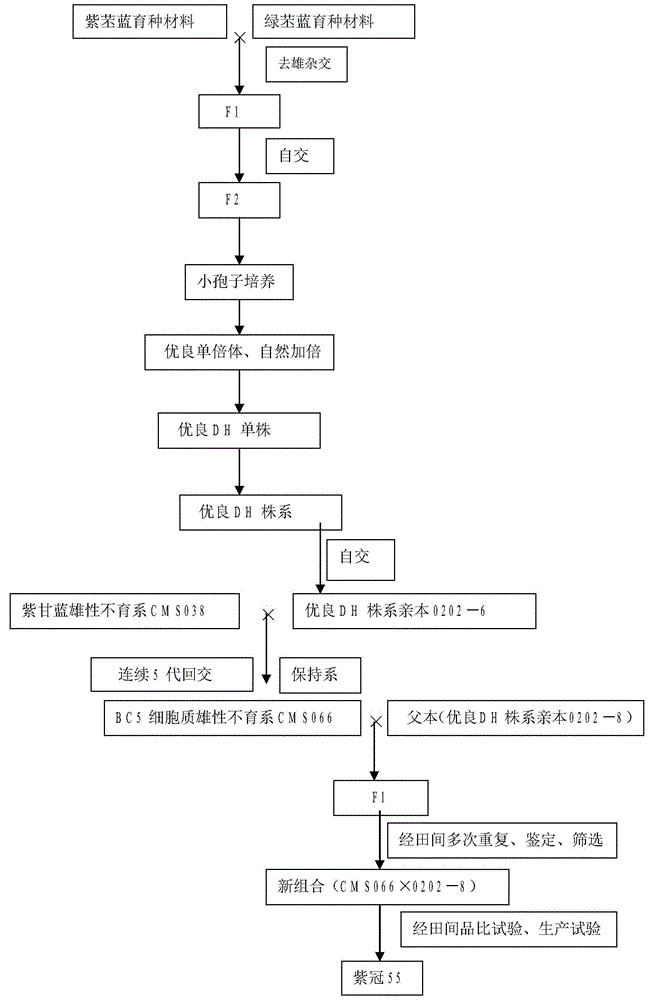
[0033] Such as figure 1 As shown, the breeding process of this example is as follows: before breeding, the purple kohlrabi plant is selected to be erect, precocious, with round or oblate bulbs, dark purple skin, dark green leaves, dark red veins, white flesh, and a single bulb weight of 500- 600g, normal development of flower organs, thick yellow petals, erect stigma, large nectaries, abundant nectar, g...