
Beaueria bassaria (Balsamo) Vuillemin bacterial strain GZGY-1-3 and application thereof
A technology of Beauveria bassiana and strains, applied in the field of agricultural biology, to achieve the effects of high infection rate, good heat resistance and strong pathogenicity
- Summary
- Abstract
- Description
- Claims
- Application Information
AI Technical Summary
Problems solved by technology
Method used
Image

Examples
Embodiment 1
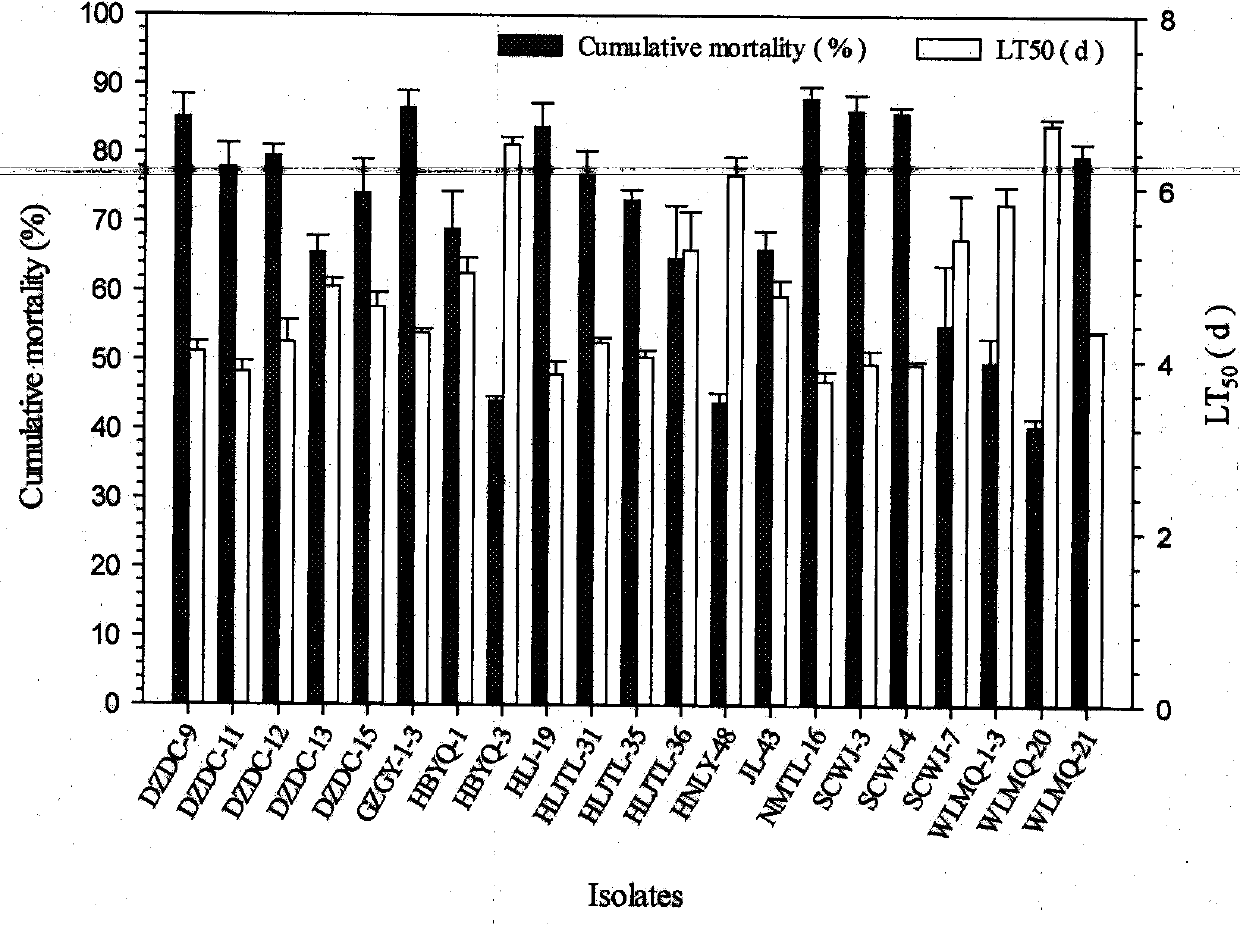
[0029] Example 1 Screening for strains with high virulence
[0030] 1.1 Insect populations
[0031]Bemisia tabaci was collected from tobacco in the greenhouse of the Langfang Research Base of the Chinese Academy of Agricultural Sciences in 2013, and was raised with cabbage seedlings for 2-3 generations in this laboratory. Cabbage seedlings were placed in insect cages (40×40×30 cm), the feeding conditions were 26±2°C, and the photoperiod was 12:12 (L:D). In order to make enough and uniform Bemisia tabaci nymphs on the cabbage leaves for the toxicity test of Beauveria bassiana, the cabbage seedlings with a height of about 25 cm and 5-6 young leaves were selected during the test and placed in pitchers. After 48 hours, take out and drive away all adults, so that there are about 100-150 eggs on each leaf. The taken out seedlings were placed in a light incubator under the conditions of 26±1°C, 12:12 (L:D), and the leaves were cut off when the eggs of Bemisia tabaci developed into ...
Embodiment 2
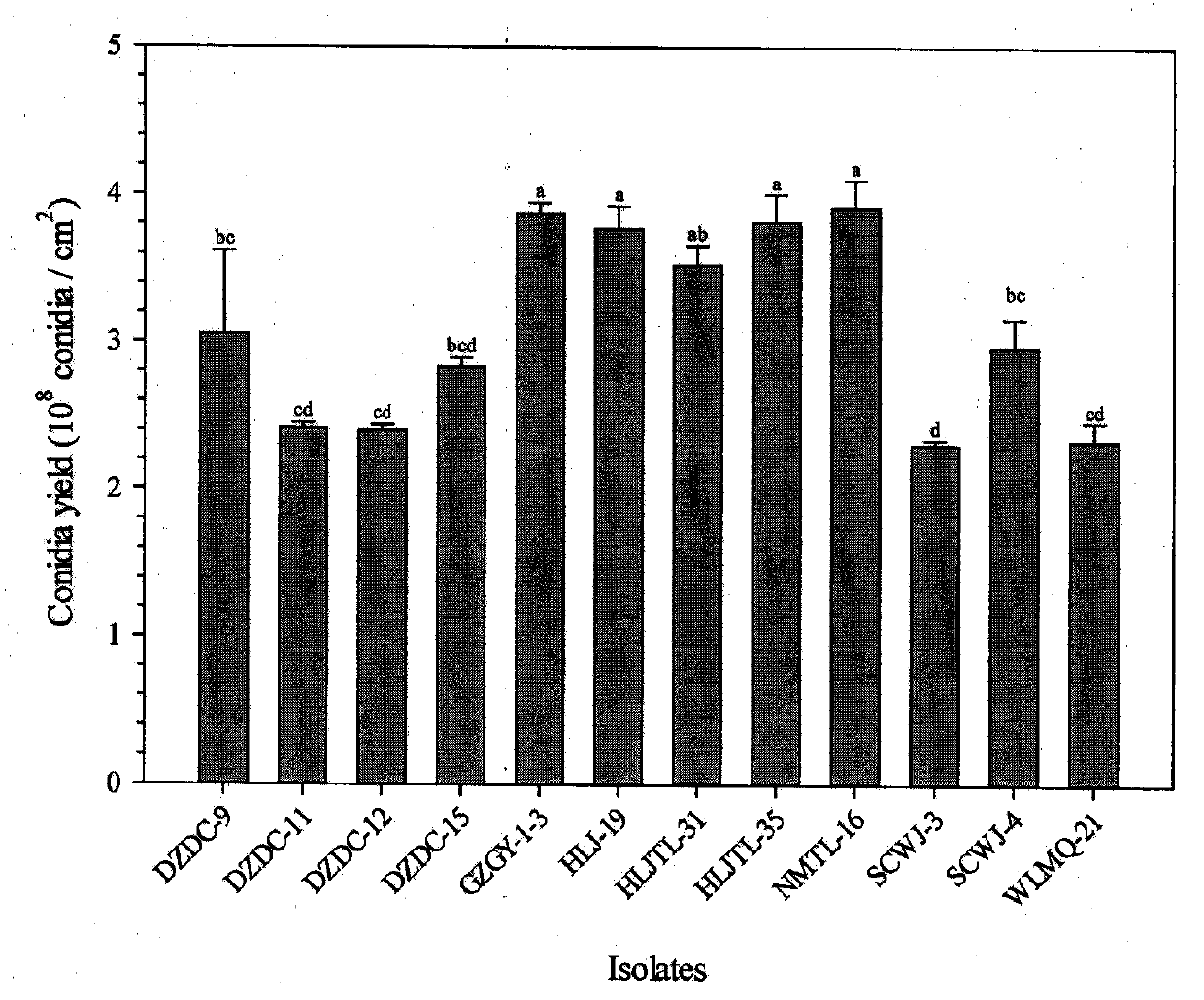
[0049] Example 2 Screening the strains with high spore production
[0050] 2.1 Strain cultivation
[0051] The spores of 12 strains of highly virulent strains screened in the above-mentioned embodiment 1 were formulated with 0.05% Tween-80 solution into 1 × 10 6 Conidia / ml of suspension. Take 0.1ml of the suspension on the 90mm SDAY medium and spread it evenly with a sterile triangular glass rod. Each strain was replicated 4 times. The culture medium was cultured in the dark at 26±1°C for 15 days, and 5 points were randomly taken from the culture medium with a sterile puncher with a diameter of 4 mm and put into 5 ml of 0.05% Tween-80 solution. The suspension was sonicated in an ultrasonic cleaner for 15 minutes to destroy the structure of the spore block, and then vibrated with a vortex oscillator for 10 minutes to obtain a uniformly dispersed spore suspension. After the suspension was diluted 10 times, the number of spores was measured with a hemocytometer, each count wa...
Embodiment 3
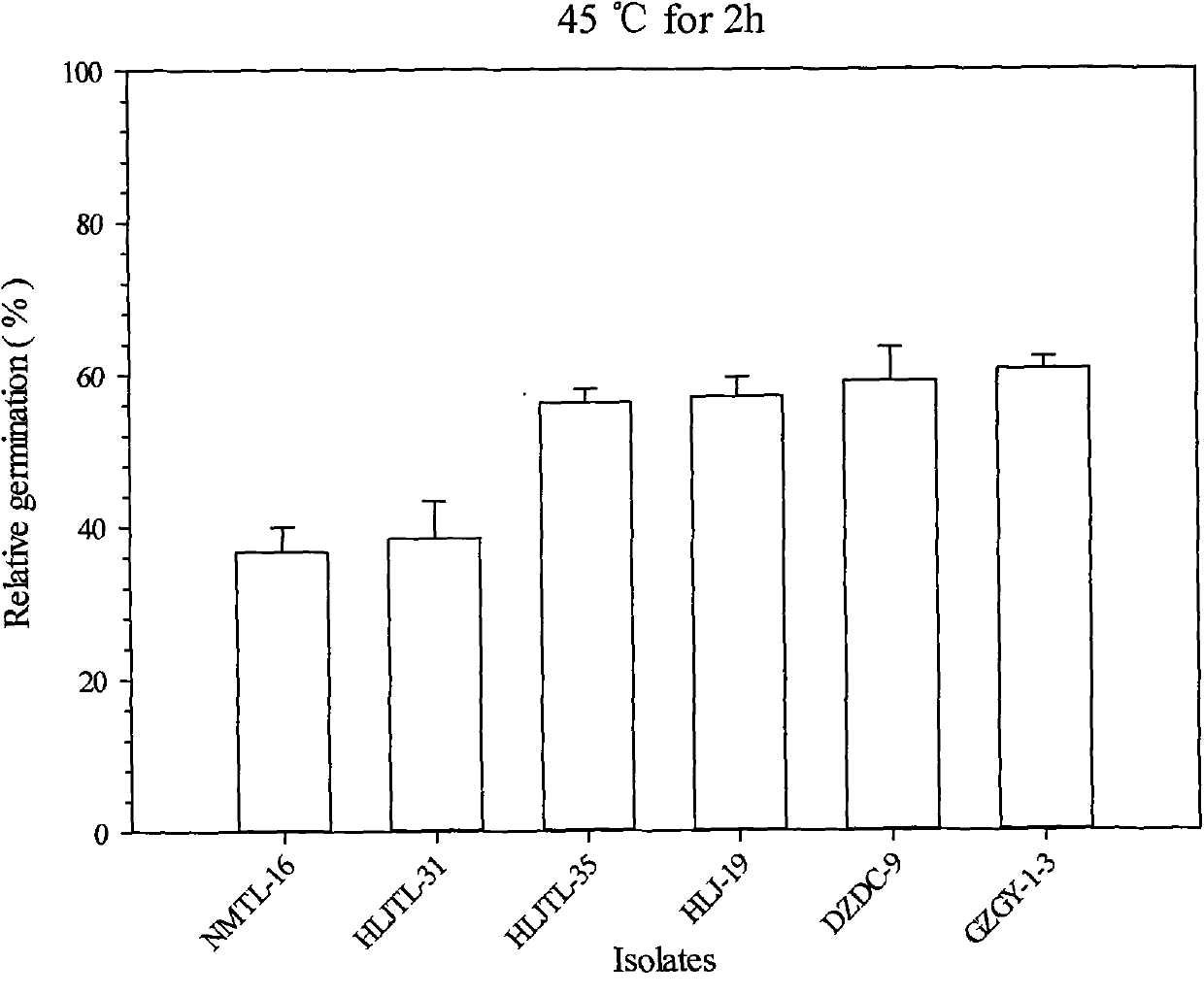
[0055] Example 3 Screening for heat-tolerant bacterial strains
[0056] 3.1 Screening of heat-tolerant strains
[0057] This example refers to the method of Everton K.K et al (2008). The 6 strains with high toxicity to whitefly in the above-mentioned Example 2 were selected, inoculated on SDA medium, and cultured at 26±1° C. for 15 days in the dark. The harvested spores were prepared into a suspension with 0.05% Tween-80 solution, the suspension was vigorously shaken and filtered, and then diluted to 10 5 spores / mi. Take 2ml of the suspension in a 5ml centrifuge tube and immediately place it in a water bath at 45±0.1°C. After heat shock for 1h or 2h, take 20μl and drop it in the center of 4ml SDAY medium, the SDAY medium is SDA medium with 1% yeast extract, the diameter of the petri dish is 35mm, the SDAY medium has been high-temperature sterilized in advance and contains the concentration Benomyl is 0.002% (w / v), active ingredient 25%. Low concentrations of benomyl will ...
PUM
| Property | Measurement | Unit |
|---|---|---|
| diameter | aaaaa | aaaaa |
Abstract
Description
Claims
Application Information
 Login to View More