
A Human Behavior Recognition Method Based on Depth Video Sequence
A deep video sequence and recognition method technology, applied in the field of computer pattern recognition, can solve the problems of reducing the recognition rate, misrepresenting coefficients, and not being able to more accurately represent the detailed information of local descriptors, so as to achieve strong dictionary expression ability and improve recognition rate Effect
- Summary
- Abstract
- Description
- Claims
- Application Information
AI Technical Summary
Problems solved by technology
Method used
Image



Examples
Embodiment Construction
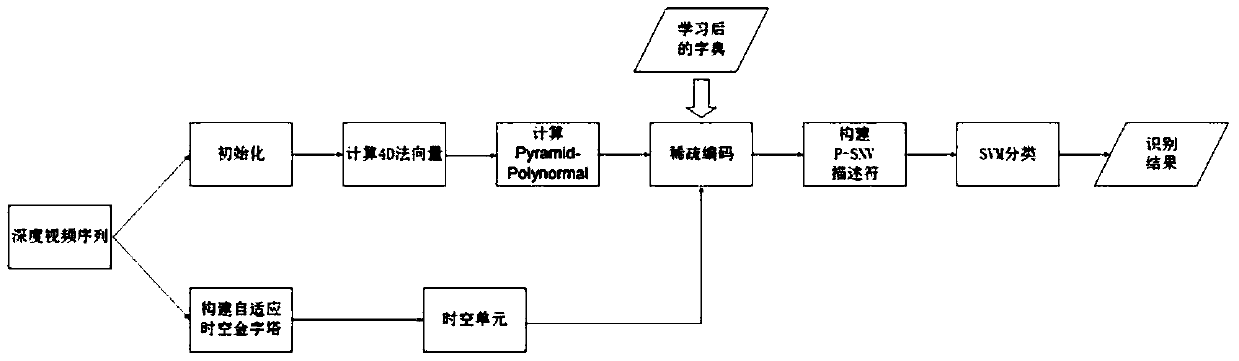
[0011] like figure 1 As shown, this human behavior recognition method based on depth video sequence, the method calculates the four-dimensional normal vector of all pixels in the video sequence, and extracts the pixel points in different layers by constructing the space-time pyramid model of the behavior sequence in different space-time domains. Low-level features, learn group sparse dictionary based on low-level features, obtain sparse coding of low-level features, use spatial average pooling and temporal maximum pooling to integrate coding, and obtain high-level features as the descriptor of the final behavior sequence.
[0012] The present invention constructs a space-time pyramid model, and retains information in the multi-layer space-time field of local descriptors in a targeted manner. At the same time, due to the use of a group sparse dictionary to encode the underlying features, it avoids the interference of different categories containing similar information, making th...
PUM
 Login to View More
 Abstract
Description
Claims
Application Information
 Login to View More