
H9N2 avian influenza virus strain, and prepared inactivated vaccine and application thereof
A bird flu virus and bird flu technology, applied in antiviral agents, viruses/bacteriophages, biochemical equipment and methods, etc., can solve problems such as high cost, chicken-derived potential disease infection, large batch-to-batch difference in product quality, etc., to achieve High adaptability, rapid increase in antibody levels, and the effect of preventing infection
- Summary
- Abstract
- Description
- Claims
- Application Information
AI Technical Summary
Problems solved by technology
Method used
Image



Examples
Embodiment 1
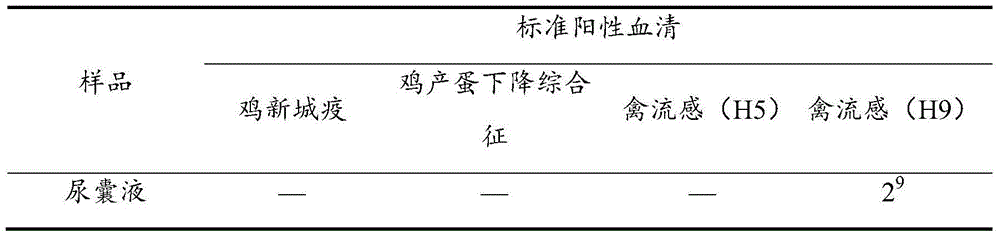
[0036] Example 1 Isolation and Identification of H9N2 Subtype Avian Influenza Virus NJ13-8 Strain
[0037] 1. Experimental method
[0038] 1.1 Isolation of virus
[0039] In 2013, the lungs and livers were collected from a chicken farm in Nanjing, Jiangsu Province, and sent for inspection. The lungs and livers were cut into pieces, added with sterilized saline at a ratio of 1:5, ground in a sterile mortar, frozen and thawed three times repeatedly, and subjected to 3000r / min centrifuged for 15min, and the supernatant was taken for later use.
[0040] The supernatant of the above-mentioned disease material was sterilized through a 0.22 μm disposable filter, and inoculated with 10-day-old SPF chicken embryos through the allantoic cavity, with 0.1 ml for each chicken embryo, and a total of 5 chicken embryos were inoculated. Incubate at 37°C; discard dead embryos within 24 hours, aseptically collect the allantoic fluid of chicken embryos that died within 24-120 hours, and store ...
experiment example 1
[0067] Experimental example 1 Pathogenicity assay of isolated virus NJ13-8 strain and its proliferation in MDCK cells 1, experimental method
[0068] 1.1 Pathogenicity determination of isolated virus NJ13-8 strain
[0069] Embryo median infectious dose (EID) 50 ), intracerebral pathogenicity index (ICPI) and intravenous inoculation index (IVPI) test to detect the pathogenicity of the virus NJ13-8 strain that embodiment 1 isolates.
[0070] 1.1.1 Virus EIDs 50 determination
[0071] Make the isolated virus with sterilized saline for 10 -6 ~10 -9 Dilution, and set up a blank control group, inoculate 5 10-day-old SPF chicken embryos at each dilution, discard 24h dead embryos, freeze the chicken embryos overnight at 4°C 120h after inoculation, harvest chicken embryo allantoic fluid, and measure its HA efficacy Valence, and refer to the Reed-Muench method to calculate the virus EID 50 .
[0072] 1.1.2 Determination of intracerebral pathogenicity index (ICPI)
[0073] Take 1...
experiment example 2
[0110] Preparation of experimental example 2 inactivated vaccine and immune protection test
[0111] 1. Experimental method
[0112] 1.1 Amplification of virus
[0113] The virus NJ13-8 strain that embodiment 1 isolates is respectively through MDCK cell culture amplification (collecting cell culture supernatant) and inoculation SPF chicken embryo amplification (collecting allantoic fluid), after the virus liquid collection of above amplification is evenly packed , stored at -70°C for later use.
[0114] 1.2 Preparation of inactivated vaccine
[0115] Take the two virus liquids amplified by MDCK cells and chicken embryos, centrifuge at 5000r / min for 30min, take the supernatant, add formalin solution to the final concentration of 0.2% of the total amount of the virus liquid supernatant, and store at 37°C After 24 hours of inactivation, after the sterility test, the inactivated virus was mixed with imported white oil adjuvant according to the volume ratio (1:3), emulsified and...
PUM
 Login to View More
 Abstract
Description
Claims
Application Information
 Login to View More