
Double-layered cavity type liquid color-change glasses
A technology of color-changing glasses and cavity, applied in glasses/goggles, optics, instruments, etc., can solve the problems of cumbersome production process, large flow resistance and high cost, and achieve the effect of reducing cost, strong controllability and reducing residue.
- Summary
- Abstract
- Description
- Claims
- Application Information
AI Technical Summary
Problems solved by technology
Method used
Image

Examples
specific Embodiment approach 1
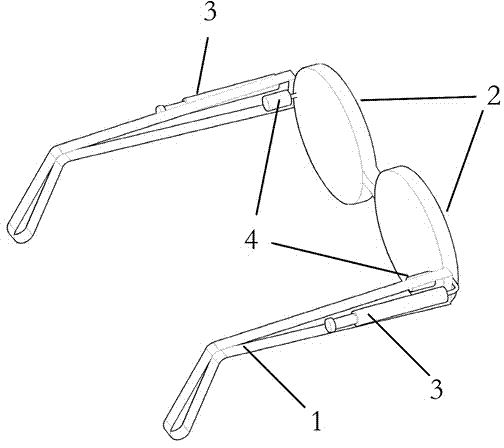
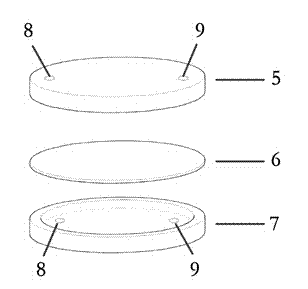
[0024] Specific implementation mode one: combine figure 1 and image 3 Explain that the color-changing glasses include a frame 1, two lenses 2, two colorless fluid (liquid / gas) actuators 3, two elastic colored fluid storage chambers 4, colorless fluid chambers 5, elastic films 6 and colored The fluid chamber 7 is composed. Two lenses 2 are arranged in the frame 1, two colorless fluid actuators 3 are installed on the outside of the two temples of the frame 3, and two colored fluid storage chambers 4 are installed on the inside of the two temples. The colorless fluid actuator 3 is two manual pistons, the cavity is filled with colorless fluid (liquid / gas), and the elastic colored fluid storage chamber 4 stores colored fluid. The inside of the lens 2 is composed of a colorless fluid chamber 5, a colored fluid chamber 7 and an elastic film 6, and the three parts are assembled together to form an eyeglass. The colorless fluid actuator 3 is connected to the colorless fluid chamber...
specific Embodiment approach 2
[0025] Specific implementation mode two: combination figure 1 Note that the depth of the colorless fluid chamber 5 is 1-2 mm, and the depth of the colored fluid chamber 7 is 0.05-1 mm. Other components and connections are the same as those in the first embodiment.
specific Embodiment approach 3
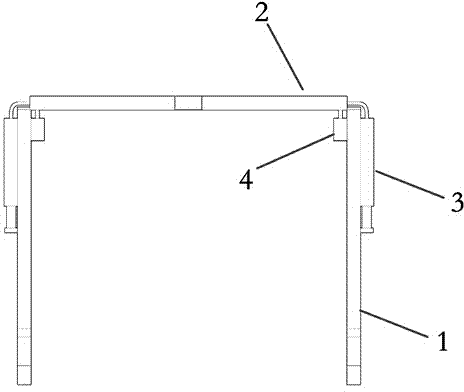
[0026] Specific implementation mode three: combination figure 2 Explain that the colorless fluid actuator 3 is two diaphragm chambers, which are installed on the two corners of the mirror frame 1 . The diaphragm cavity is connected with the colorless fluid cavity 5 in the lens 2 . When the diaphragm is pressed, the colorless fluid in the diaphragm chamber is pushed into the colorless fluid chamber 5 on the lens 2 . Other components and connections are the same as those in the first embodiment.
PUM
 Login to View More
 Abstract
Description
Claims
Application Information
 Login to View More