
Low-formaldehyde-content medium-density fiberboard
A medium-density, fiberboard technology, applied in the field of fiberboard, can solve problems such as low bonding strength, high cost, and secondary pollution
- Summary
- Abstract
- Description
- Claims
- Application Information
AI Technical Summary
Problems solved by technology
Method used
Image

Examples
Embodiment 1
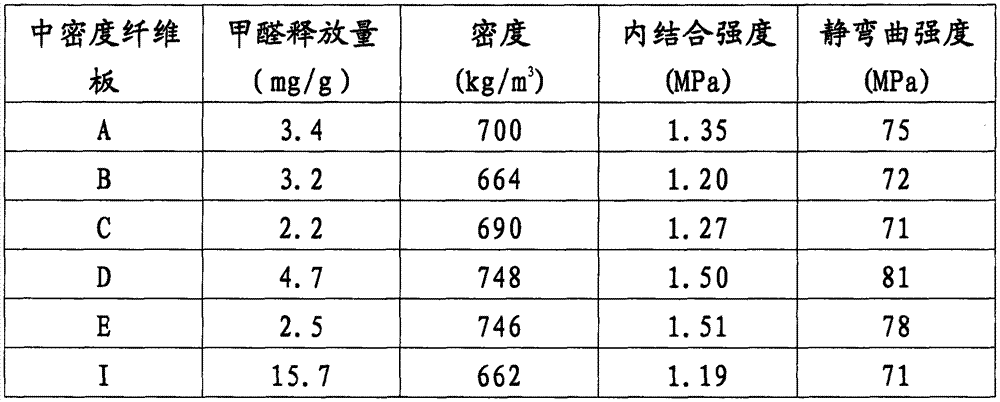
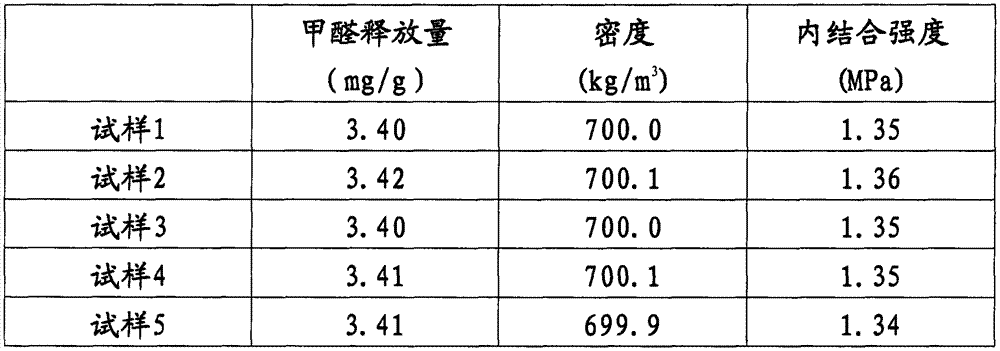
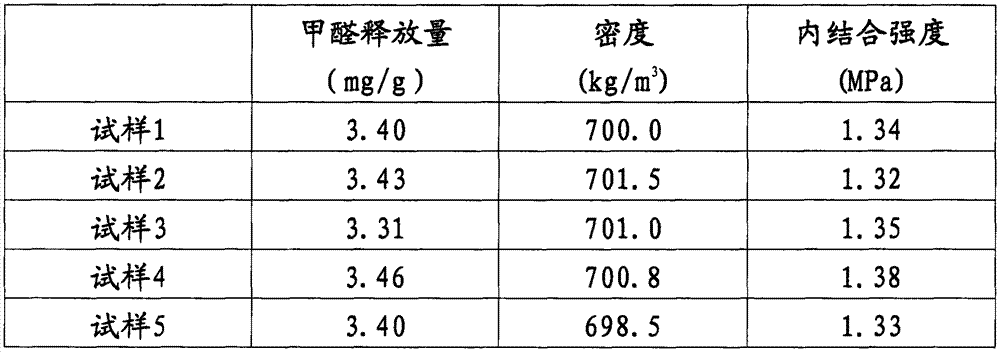
[0059] 125 parts by weight of fiber slurry, 10 parts by weight of urea-formaldehyde resin, and 6.5 parts by weight of propyl benzoate are uniformly mixed in a stirring tank, and the mixture is dried at 50-70°C until the water content is 15 wt%, to obtain a mixture. The mixture was pre-pressed at 4-5MPa for 30s to form a blank, and the blank was isostatically pressed at 8MPa and 70°C for 1min to form a slab. The slab is hot-pressed, and the hot-pressing conditions are: temperature 150-160°C; rise to 13.5-19MPa within 20-30s, hold pressure for 60-120s; decompress to 3.5-5.5MPa within 10-15s, hold Press for 65-135s; then rise to 6-8.5MPa within 10-15s, hold the pressure for 50-75s; finally depressurize uniformly to 0MPa within 30-45s. The hot-pressed plate was cooled to normal temperature, tempered and sanded to obtain medium density fiberboard A with a thickness of 25 mm.
[0060] It has been determined that the composition of the medium density fiberboard A is 85wt% fiber, 10w...
Embodiment 2
[0062] 167 parts by weight of fiber slurry, 20 parts by weight of urea-formaldehyde resin, and 11 parts by weight of propyl benzoate are uniformly mixed in a stirring tank, and the mixture is dried at 60-70°C until the water content is 10 wt%, to obtain a mixture. The mixture was pre-pressed at 4-5MPa for 40s to form a blank, and the blank was isostatically pressed at 7MPa and 70°C for 50s to form a slab. The slab is hot-pressed, and the hot-pressing conditions are: temperature 150-160°C; rise to 13.5-19MPa within 20-30s, hold pressure for 60-120s; decompress to 3.5-5.5MPa within 10-15s, hold Press for 65-135s; then rise to 6-8.5MPa within 10-15s, hold the pressure for 50-75s; finally depressurize uniformly to 0MPa within 30-45s. The hot-pressed plate was cooled to normal temperature, tempered and sanded to obtain medium density fiberboard B with a thickness of 25 mm.
[0063] It has been determined that the composition of the medium density fiberboard B is 76wt% fiber, 15wt%...
Embodiment 3
[0065] 140 parts by weight of fiber slurry, 15 parts by weight of modified urea-formaldehyde resin, and 4.5 parts by weight of propyl benzoate were uniformly mixed in a stirring tank, and the mixture was dried at 80° C. until the moisture content was 10 wt % to obtain a mixture. The mixture is pre-pressed at 4-5MPa for 1min to form a blank, and the blank is isostatically pressed at 7-8MPa and 60-70°C for 50s to form a slab. The slab is hot-pressed, and the hot-pressing conditions are: temperature 150-160°C; rise to 13.5-19MPa within 20-30s, hold pressure for 60-120s; decompress to 3.5-5.5MPa within 10-15s, hold Press for 65-135s; then rise to 6-8.5MPa within 10-15s, hold the pressure for 50-75s; finally depressurize uniformly to 0MPa within 30-45s. The hot-pressed plate was cooled to normal temperature, tempered and sanded to obtain a medium density fiberboard C with a thickness of 25 mm.
[0066] It has been determined that the composition of the medium density fiberboard C ...
PUM
| Property | Measurement | Unit |
|---|---|---|
| density | aaaaa | aaaaa |
| strength | aaaaa | aaaaa |
| density | aaaaa | aaaaa |
Abstract
Description
Claims
Application Information
 Login to View More