Positive electrode material of lithium ion battery and preparation method thereof

A lithium-ion battery, cathode material technology, applied in battery electrodes, secondary batteries, circuits, etc., can solve problems such as safety hazards, cycle life, etc., and achieve the effects of inhibiting battery flatulence, improving electronic conductivity, and stabilizing lattice structure

CN104953118AActive Publication Date: 2015-09-30QINGHAI CONTEMPORARY AMPEREX TECH
3 Cites 2 Cited by

Patent Information

Authority / Receiving Office
CN · China
Current Assignee / Owner
Publication Date
2015-09-30

Smart Images

  • Figure 1
    Figure 1
  • Figure 2
    Figure 2
  • Figure 3
    Figure 3
Patent Text Reader

Abstract

The invention provides a positive electrode material of a lithium ion battery. The chemical formula of the positive electrode material is Li(1-a)NaaMnxFe(1-x)PO4(MeFy)b(C)c, wherein a is more than 0 and smaller than or equal to 0.08, b is more than 0 and smaller than 0.15, c is more than 0 and smaller than 1.5, b+c is smaller than 1.5, x is more than or equal to 0.1 and smaller than or equal to 0.9, MeFy is at least one of AlF3, TiF4, MgF2, ZrF4, MoF6 and NbF4; the positive electrode material is of a core-shell structure, and sequentially comprises a Na<+> bulk phase doped Li(1-a)NaaMnxFe(1-x)PO4 inner core layer, a middle transitional layer containing metal fluoride MeFy, and a carbon coverage layer positioned on the surface. The invention also provides a preparation method of the positive electrode material. According to the positive electrode material, the electric conductivity is improved, the bloating of the positive electrode material is effectively inhibited, the cycle life of the battery is prolonged, and the high-temperature storage property of the battery is improved.
Need to check novelty before this filing date? Find Prior Art

Description

technical field

[0001] The invention belongs to the technical field of lithium ion batteries, and in particular relates to a lithium ion battery cathode material modified lithium manganese iron phosphate and a preparation method thereof. Background technique

[0002] Lithium iron manganese phosphate (LiMn x Fe 1-x PO 4 ), as a cathode material for lithium-ion batteries, has a wide range of applications in the electric vehicle (EV) and energy storage system (ESS) markets. LiMn x Fe 1-x PO 4 It can provide higher working potential and higher discharge capacity, and has the advantages of low price, environmental friendliness, abundant raw materials, good thermal stability, and high safety, and has been recognized by the market. But LiMn x Fe 1-x PO 4 The extremely low intrinsic electronic conductivity and lithium ion diffusion rate affect its electrochemical performance, which hinders its commercial application. Therefore, increasing the LiMn x Fe 1-x PO 4 The elec...

Examples

Embodiment 1

[0027] In the first step, Lithium hydroxide, manganese sulfate, ferrous sulfate, phosphoric acid, cetyltrimethyl Ammonium bromide, use deionized water to dissolve lithium hydroxide and prepare a 2.5mol / L aqueous solution, add manganese sulfate, ferrous sulfate, and phosphoric acid to the reactor with a reflux device, then add deionized water to the reactor and stir Dissolve to form solution I, keep the total concentration of Mn and Fe in solution I at 1.8mol / L, add ethylene glycol into the reactor according to the total volume of deionized water in solution I: the total volume of ethylene glycol is 1:1, Then add cetyltrimethylammonium bromide, slowly add lithium hydroxide solution in the reactor under continuous stirring, then add 2.5mol / L NaOH solution in the mixture until the pH value of the mixed solution is adjusted to 8.0, Formation of mixture II;

[0028] In the second step, place the reactor in an oil bath at a temperature of 160°C and turn on the condensing reflux dev...

Embodiment 2~23

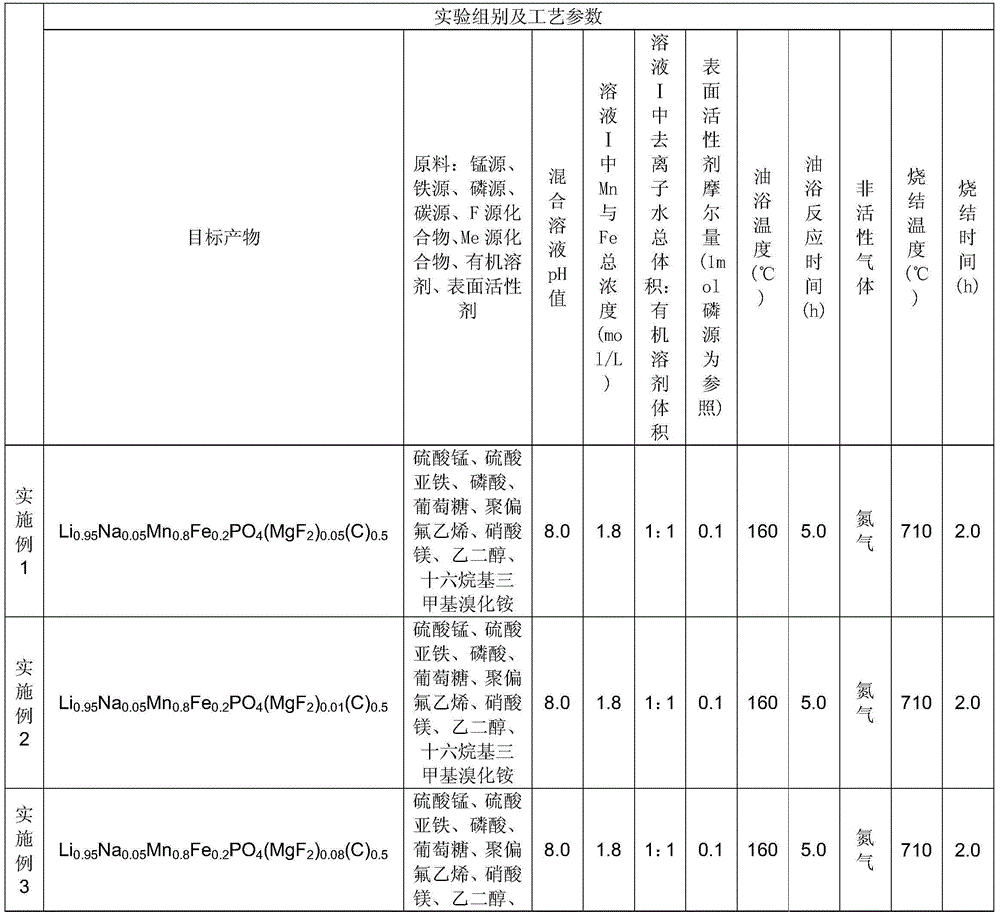
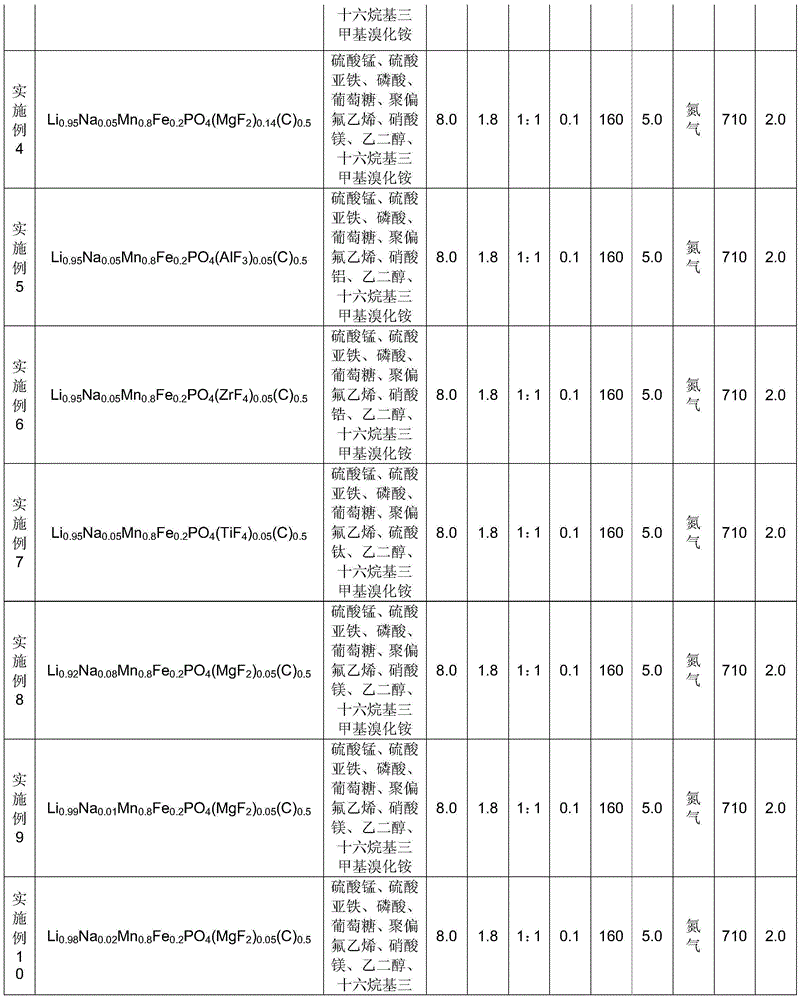
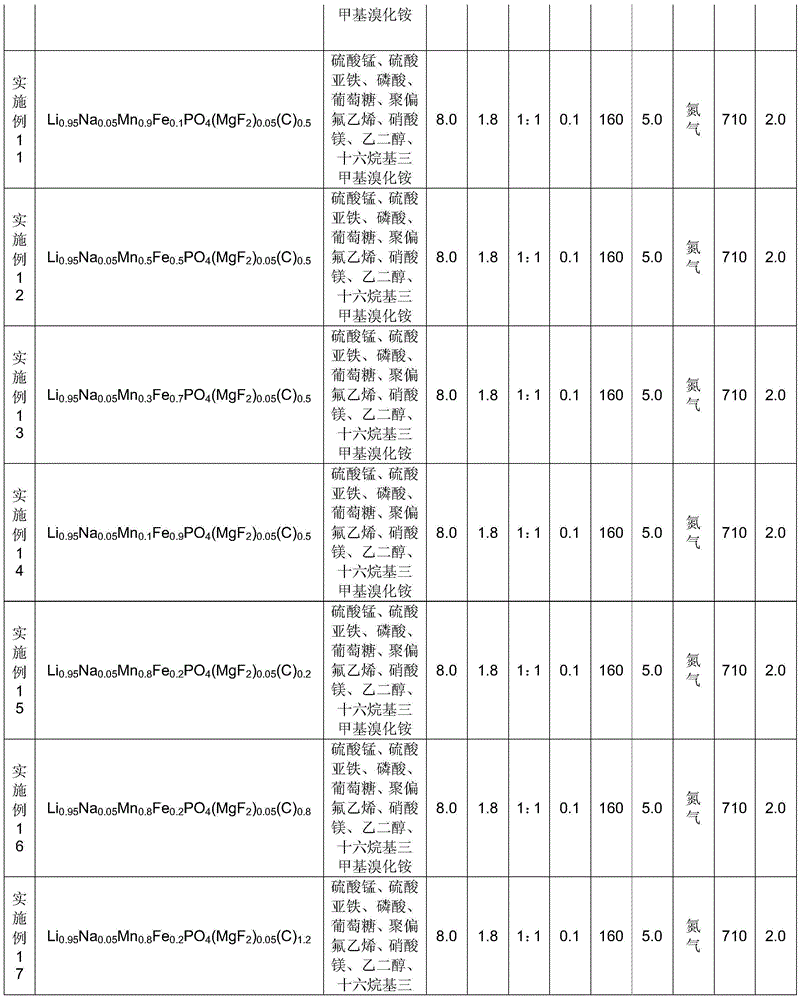
[0031] The chemical formula of the obtained target product, the type of raw material, the pH value of the liquid phase system, the calcination temperature and time and other process parameters are shown in Table 1.