
Method for calculating formation pressure based on petrophysical parameters
A technique of petrophysics and formation pressure, applied in the field of exploration geophysical data processing
Patent Information
- Authority / Receiving Office
- CN · China
- Patent Type
- Applications(China)
- Current Assignee / Owner
- Publication Date
- 2016-04-06
Smart Images
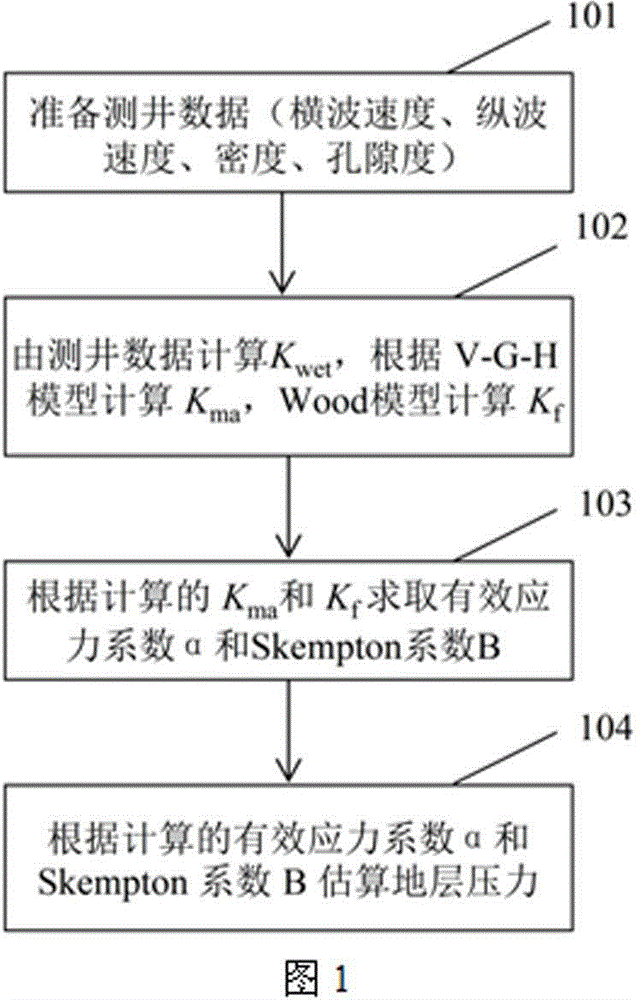
Figure 1 
Figure 2 
Figure 3
Abstract
Description
Technical field
[0001] The invention relates to the technical field of exploration geophysical data processing, in particular to a method for calculating formation pressure based on petrophysical parameters in petrophysical. Background technique
[0002] At present, the application of formation pressure (formation pore fluid pressure) prediction is mainly divided into two aspects. The first is to use seismic velocity to predict formation pressure before drilling to serve the drilling engineering. It mainly predicts the abnormal high pressure that may exist in the formation to prevent When a drilling accident occurs, the proportion of drilling mud is generally between the normal pressure of the formation and the pressure of the formation fracture. The second is to use logging data to estimate the formation pressure of the wells that have been drilled, and to further predict the stress, fracture pressure and collapse pressure of the formation in order to fracturing the reservoir an...
Examples
Embodiment Construction
[0072] In order to make the above-mentioned and other objects, features and advantages of the present invention more obvious and understandable, preferred embodiments are listed below in conjunction with the accompanying drawings, which are described in detail as follows.
[0073] Such as figure 1 As shown, figure 1 It is a flowchart of the method for calculating formation pressure based on petrophysical parameters of the present invention. In step 101, prepare the required logging data (including the longitudinal wave velocity V of the formation) P , Transverse wave velocity V S , Density ρ and porosity φ logging data. The flow proceeds to step 102.
[0074] In step 102, the bulk modulus K of the saturated rock (wet rock) is calculated from the logging data wet ,Calculate the effective bulk modulus K of mineral (particle) composition according to the V-G-H model ma , Wood model calculates the bulk modulus K of pore fluid f . The process goes to step 103.
[0075] In step 103, ...