This helps you quickly interpret patents by identifying the three key elements:
Problems solved by technology
Method used
Benefits of technology
Problems solved by technology
However, artificial tears can only relieve local dryness and astringency symptoms, and cannot achieve a radical effect. It is very easy to relapse after stopping the drug, so the curative effect is not ideal.
Method used
the structure of the environmentally friendly knitted fabric provided by the present invention; figure 2 Flow chart of the yarn wrapping machine for environmentally friendly knitted fabrics and storage devices; image 3 Is the parameter map of the yarn covering machine
View more
Image
Smart Image Click on the blue labels to locate them in the text.
Viewing Examples
Smart Image
Click on the blue label to locate the original text in one second.
Reading with bidirectional positioning of images and text.
Smart Image
Examples
Experimental program
Comparison scheme
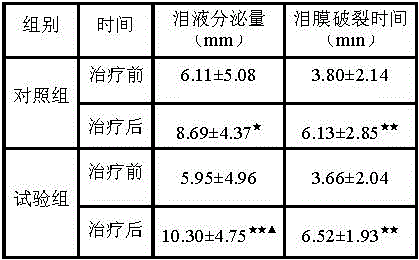
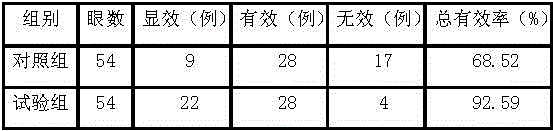
Effect test
Embodiment 1
[0017] Weigh 250g of ginkgo leaves, 250g of ghost needle grass, 380g of emblica, 250g of mulberry leaves, and 100g of golden cherry seeds and combine them. Add water to be 8 times the weight of the medicinal materials, decoct for 1.5 hours, combine the decoctions, concentrate under reduced pressure at 0.08MPa and 70°C until the relative density is 1.15 at 70°C, add 95% (v / v) ethanol to make the alcohol content reach 75% (v / v), stirred, stood overnight, filtered, and the filtrate was concentrated under reduced pressure at 0.08MPa and 65°C to contain 3.5g / mL of the original drug, and 0.25% preservative potassium sorbate was added. Bottled.
Embodiment 2
[0019] Weigh 285g of ginkgo leaves, 210g of ghost needle grass, 350g of emblica, 220g of mulberry leaves, and 130g of golden cherry seeds and combine them, add water to decoct twice, add water for the first time to 10 times the weight of the medicinal materials, decoct for 2 hours, and decoct for the second time Add water to be 8 times the weight of the medicinal materials, decoct for 1.5 hours, combine the decoctions, concentrate under reduced pressure at 0.08MPa and 70°C until the relative density is 1.15 at 70°C, add 95% (v / v) ethanol to make the alcohol content reach 85% (v / v), stirred, left standing overnight, filtered, and the filtrate was concentrated under reduced pressure at 0.08MPa and 65°C to contain 3.5g / mL of the crude drug, and 0.25% by weight of preservative potassium sorbate was added. 20mL / bottle.
Embodiment 3
[0021] Weigh 220g of ginkgo leaves, 250g of ghost needle grass, 460g of emblica, 300g of mulberry leaves, and 80g of golden cherry seeds and combine them, add water to decoct twice, add water for the first time to 10 times the weight of the medicinal materials, decoct for 2 hours, and decoct for the second time Add water to be 8 times the weight of the medicinal materials, decoct for 1.5 hours, combine the decoctions, concentrate under reduced pressure at 0.08MPa and 70°C until the relative density is 1.20 at 70°C, add 95% (v / v) ethanol to make the alcohol content reach 80% (v / v), stirred, stood overnight, filtered, and the filtrate was concentrated under reduced pressure at 0.08MPa and 65°C to contain 3.5g / mL of the crude drug, and 0.25% preservative potassium sorbate was added. Bottled.
the structure of the environmentally friendly knitted fabric provided by the present invention; figure 2 Flow chart of the yarn wrapping machine for environmentally friendly knitted fabrics and storage devices; image 3 Is the parameter map of the yarn covering machine
Login to View More
PUM
Login to View More
Abstract
The invention discloses a method for preparing a medicine composition for treating xerophthalmia. According to the method, folium ginkgo, spanishneedles herb, fruits of emblic leafflower, folium mori and cherokee rose fruits serve as raw materials for preparing the medicine composition. The medicine composition prepared through the method has the functions of nourishing yin for moistening dryness and nourishing blood for improving eyesight, divine water is produced, the eyes are moistened and nourished, and the eyeballs are lubricated.
Description
[0001] This application is a divisional case of the invention patent application proposed by the applicant Cui Yinfang (the name of the invention is: a pharmaceutical composition for the treatment of dry eye and its application, the application number is: 2014104125453, and the application date is: August 21, 2014) Application. technical field [0002] The invention belongs to the technical field of traditional Chinese medicine, and in particular relates to a method for preparing a pharmaceutical composition for treating dry eye. Background technique [0003] Dry eye, also known as xerophthalmia, refers to the lack or abnormal distribution of tears in front of the cornea, which leads to a decrease in tears and dryness of the eyeball surface. This can lead to abrasion, inflammation and even ulceration of the corneal surface, ultimately affecting vision. [0004] Western medicine believes that xerophthalmia is mainly related to factors such as excessive eye use, immune inflam...
Claims
the structure of the environmentally friendly knitted fabric provided by the present invention; figure 2 Flow chart of the yarn wrapping machine for environmentally friendly knitted fabrics and storage devices; image 3 Is the parameter map of the yarn covering machine
Login to View More
Application Information
Patent Timeline
Application Date:The date an application was filed.
Publication Date:The date a patent or application was officially published.
First Publication Date:The earliest publication date of a patent with the same application number.
Issue Date:Publication date of the patent grant document.
PCT Entry Date:The Entry date of PCT National Phase.
Estimated Expiry Date:The statutory expiry date of a patent right according to the Patent Law, and it is the longest term of protection that the patent right can achieve without the termination of the patent right due to other reasons(Term extension factor has been taken into account ).
Invalid Date:Actual expiry date is based on effective date or publication date of legal transaction data of invalid patent.


 Login to View More
  Login to View More