
Method for preparing platinum nano particle supported nitrogen-doped three-dimensional graphene aerogel via one-step method
A graphene aerogel, platinum nanotechnology, applied in chemical instruments and methods, electrical components, colloid chemistry, etc., can solve the problems of high price, low emission, slow methanol oxidation reaction, etc., to reduce the amount of platinum metal, Effective catalytic effect
- Summary
- Abstract
- Description
- Claims
- Application Information
AI Technical Summary
Problems solved by technology
Method used
Image

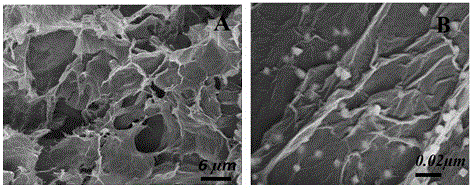
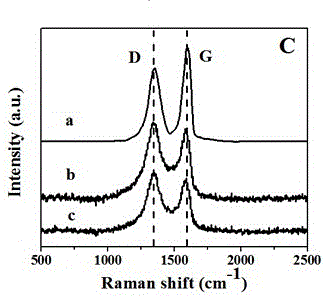
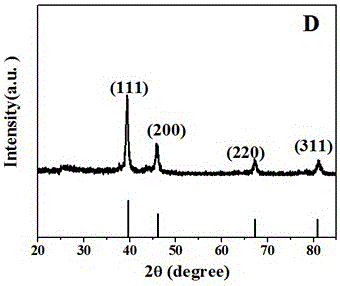
Examples
Embodiment 1
[0034] 1) Preparation of graphene oxide (GO)
[0035] First, natural flake graphite powder and potassium nitrate are added to concentrated sulfuric acid in a mass ratio (2:1) and cooled to about 0°C. The amount of concentrated sulfuric acid is added according to the ratio of natural flake graphite powder: concentrated sulfuric acid = 1.0 (g): 50.0 (mL) Secondly, the amount of potassium permanganate is added according to the mass ratio of natural flake graphite powder: potassium permanganate = 6 The reaction system was reacted for 3-4 hours (in an ice bath at 0°C); then in a water bath at 30°C for 1 hour, the reactant was muddy; then the above reactant was stirred in an ice-water bath for 5 minutes, and then double distilled water was added 100mL; then stirred at 70°C for 3 hours, the reactant was brownish-yellow mud; finally, 300mL hydrogen peroxide (5%) was added slowly and then quickly to the reaction system to react for 5-30min. Then 500mL of concentrated hydrochloric acid...
Embodiment 2
[0042] 1) Preparation of graphene oxide (GO)
[0043]First, natural flake graphite powder and potassium nitrate are added to concentrated sulfuric acid in a mass ratio (2:1) and cooled to about 0°C. The amount of concentrated sulfuric acid is added according to the ratio of natural flake graphite powder: concentrated sulfuric acid = 1.0 (g): 50.0 (mL) Secondly, the amount of potassium permanganate is added according to the mass ratio of natural flake graphite powder: potassium permanganate = 6 The reaction system was reacted for 3-4 hours (in an ice bath at 0°C); after that, in a water bath at 30°C for 1 hour, the reactant was muddy; then the above reactant was stirred in an ice-water bath for 5 minutes, and then double distilled water was added 100mL; then stirred at 70°C for 3 hours, the reactant was brownish-yellow mud; finally, 300mL hydrogen peroxide (5%) was added slowly and then quickly to the reaction system to react for 5-30min. Then 500mL of concentrated hydrochlori...
Embodiment 3
[0050] 1) Preparation of graphene oxide (GO)
[0051] First, natural flake graphite powder and potassium nitrate are added to concentrated sulfuric acid in a mass ratio (2:1) and cooled to about 0°C. The amount of concentrated sulfuric acid is added according to the ratio of natural flake graphite powder: concentrated sulfuric acid = 1.0 (g): 50.0 (mL) Secondly, the amount of potassium permanganate is added according to the mass ratio of natural flake graphite powder: potassium permanganate = 6 The reaction system was reacted for 3-4 hours (in an ice bath at 0°C; then in a water bath at 30°C for 1 hour, and the reactant was muddy; then the above reactant was stirred in an ice-water bath for 5 minutes, and then 100 mL of twice distilled water was added ; Then stirred at 70°C for 3 hours, the reactant was brownish-yellow mud; finally, 300mL hydrogen peroxide (5%) was added slowly and then quickly to the reaction system to react for 5-30min. After that, 500mL concentrated hydroch...
PUM
 Login to View More
 Abstract
Description
Claims
Application Information
 Login to View More