This helps you quickly interpret patents by identifying the three key elements:
Problems solved by technology
Method used
Benefits of technology
Problems solved by technology
This in turn leads to increased costs and can also result in longer processing times
Method used
the structure of the environmentally friendly knitted fabric provided by the present invention; figure 2 Flow chart of the yarn wrapping machine for environmentally friendly knitted fabrics and storage devices; image 3 Is the parameter map of the yarn covering machine
View more
Image
Smart Image Click on the blue labels to locate them in the text.
Viewing Examples
Smart Image
Click on the blue label to locate the original text in one second.
Reading with bidirectional positioning of images and text.
Smart Image
Examples
Experimental program
Comparison scheme
Effect test
Embodiment 1
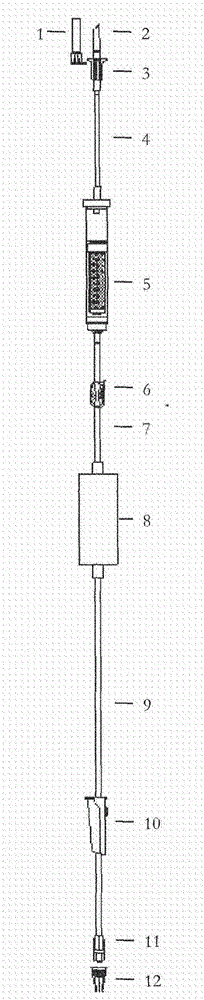
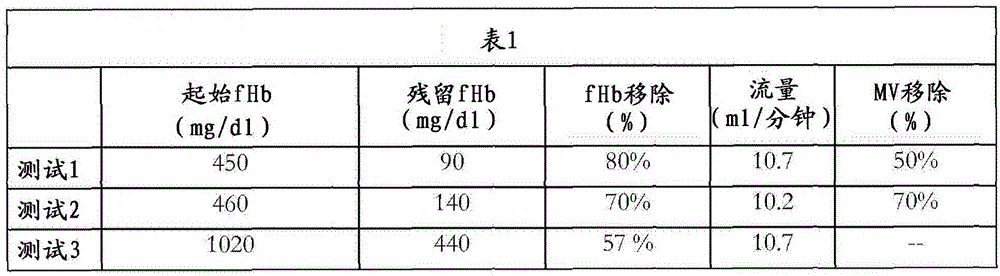
[0188] The removal of fHb and fHb from stored red blood cell concentrate (RCC) according to the filtration device (8) and transfusion system of the present invention was tested under controlled conditions with known starting concentrations of free hemoglobin (fHb) and microvesicles (MV). MV capabilities.
[0189] The filter device ( 8 ) used comprised a housing with the following dimensions: length 8 cm and diameter 2.6 cm (length: diameter ratio about 3). Polymethacrylate-based beads (bead size 100 μm to 200 μm, pore size 50 nm to 90 nm) coupled to polyacrylic acid were located within the housing for removal of fHb from stored RCC. In addition, with the general formula R-NH 2(where R is (-CH 2 -) n, and n = 1 to 2) short-chain amino-coupled methacrylate-based surface beads (bead size 100 μm to 400 μm; pore size 55 nm to 100 nm; surface area: 70 m 2 / g to 100m 2 / g; 0.3meq / ml to 0.4meq / ml) are located within the housing and are used to remove MVs from stored RCC.
[0190]...
Embodiment 2
[0201] The experiment was performed as described above for Example 1, but the system was not initially primed with saline solution. Alternatively, fill the conduit parts (4, 7) located upstream of the filter device (8) (i.e. between the filter device (8) and the spike for connection to the vessel with RCC) with RCC to remove air , and then connect the conduit parts (4, 7) to the filter device (8). Filtration was performed as in Example 1. The results are shown in Table 2.
[0202]
[0203] Thus, fHb and MVs were effectively removed even without priming the system with saline solution.
Embodiment 3
[0205] The effect of different sorbent materials coupled with linkers on the removal of MVs from stored blood components (RCC) was evaluated.
[0206] The sorbent material tested coupled with the linker was a cross-linked copolymer of methacrylate-based beads, which were surface-modified by coupling with amino groups with different chain lengths.
[0207] The amino group coupled to the adsorbent material has the general formula R-NH 2 , and R=(-CH 2 -) n. For the general formula R-NH 2 The amino group, when R=(-CH 2 -) n and n=1 or 2, R is called "short"; and for the general formula R-NH 2 The amino group, when R=(-CH 2 -) n and n=3 to 5, R is called "medium". For the general formula R-NH 2 The amino group, when R=(-CH 2 When -)n and n>5, R is called "long".
[0208] The bead size ranges from 100 μm to 400 μm. The ion exchange capacity (Ion Exchange Capacity, IEC) is 0.3meq / g to 0.9meq / g.
[0209] Scaled-down experiments were performed to use one RCC unit with a kno...
the structure of the environmentally friendly knitted fabric provided by the present invention; figure 2 Flow chart of the yarn wrapping machine for environmentally friendly knitted fabrics and storage devices; image 3 Is the parameter map of the yarn covering machine
Login to View More
PUM
Login to View More
Abstract
The present invention relates to a filtering device (8) for removing substances from blood or a blood component, the filtering device (8) comprising: a housing having an inlet and an outlet, at first sorbent material coupled with at least a first ligand located within the housing, and a second sorbent material coupled with at least a second ligand located within the housing, wherein the first ligand is for removing free hemoglobin (fHb) and the second ligand is for removing microvesicles (MV) from the blood or blood component passing through the filtering device (8), from the inlet to the outlet, wherein the first and second ligand are different from each other, and wherein the first and second sorbent material are the same or are different from each other.
Description
technical field [0001] The invention relates to a filter device (8) for removing substances from blood or blood components, said filter device (8) comprising: a housing with an inlet and an outlet; A first sorbent material coupled to a first ligand; and a second sorbent material coupled to at least a second ligand within the housing; wherein the first ligand is used to transfer from the inlet to The outlet removes free hemoglobin (fHb) from the blood or blood components passing through the filter device (8), and the second ligand is used to remove microvesicles (microvesicles, MV) therefrom; wherein the first ligand and the second ligand are different from each other; and wherein the first sorbent material and the second sorbent material are the same or different from each other. Background technique [0002] Although red blood cell transfusions can be life-saving, they are not without risks. In critically ill patients, red blood cell transfusions are associated with incre...
Claims
the structure of the environmentally friendly knitted fabric provided by the present invention; figure 2 Flow chart of the yarn wrapping machine for environmentally friendly knitted fabrics and storage devices; image 3 Is the parameter map of the yarn covering machine
Login to View More
Application Information
Patent Timeline
Application Date:The date an application was filed.
Publication Date:The date a patent or application was officially published.
First Publication Date:The earliest publication date of a patent with the same application number.
Issue Date:Publication date of the patent grant document.
PCT Entry Date:The Entry date of PCT National Phase.
Estimated Expiry Date:The statutory expiry date of a patent right according to the Patent Law, and it is the longest term of protection that the patent right can achieve without the termination of the patent right due to other reasons(Term extension factor has been taken into account ).
Invalid Date:Actual expiry date is based on effective date or publication date of legal transaction data of invalid patent.




 Login to View More
  Login to View More