Cooperative positioning method based on sequential consistent weighted sum-product algorithm

A collaborative positioning and consistent technology, applied in the direction of electrical components, wireless communication, network topology, etc., can solve problems such as unguaranteed convergence

CN106341886AInactive Publication Date: 2017-01-18HOHAI UNIV CHANGZHOU
3 Cites 6 Cited by

Patent Information

Authority / Receiving Office
CN · China
Patent Type
Applications(China)
Current Assignee / Owner
Publication Date
2017-01-18
Estimated Expiration
Not applicable · inactive patent

Smart Images

  • Figure 1
    Figure 1
  • Figure 2
    Figure 2
  • Figure 3
    Figure 3
Patent Text Reader

Abstract

The invention discloses a cooperative positioning method based on a sequential consistent weighted sum-product algorithm. The sequential consistent weighted sum-product algorithm is employed to estimate the position of a target node by calculating the corrected posterior probability distribution of the position of the target node. The convergence speed is fast, and better convergence solution is provided. The method is applicable to real-time and accurate cooperative positioning of a wireless sensor network.
Need to check novelty before this filing date? Find Prior Art

Description

technical field

[0001] The invention relates to a cooperative positioning method based on a sequential consistent weighted sum product algorithm, which belongs to the technical field of positioning. Background technique

[0002] As a graphical means of visually representing mathematical functions and problems, factor graphs can concretize abstract mathematical problems and mathematical calculation processes into message calculation and message transmission on factor graphs. On the basis of the factor graph, a general algorithm for calculating the marginal distribution of the global function through message passing on the corresponding probability graph model is developed, that is, the sum-product algorithm. Factor graph and its sum-product algorithm have been widely used in cooperative localization in wireless sensor networks. The current Belief Propagation Algorithm (BP), Forward-Backward Algorithm, Viterbi Algorithm, and Turbo Decoding Algorithm and other algorithms devel...

Examples

Embodiment Construction

[0044] The present invention will be further described below in conjunction with the accompanying drawings. The following examples are only used to illustrate the technical solution of the present invention more clearly, but not to limit the protection scope of the present invention.

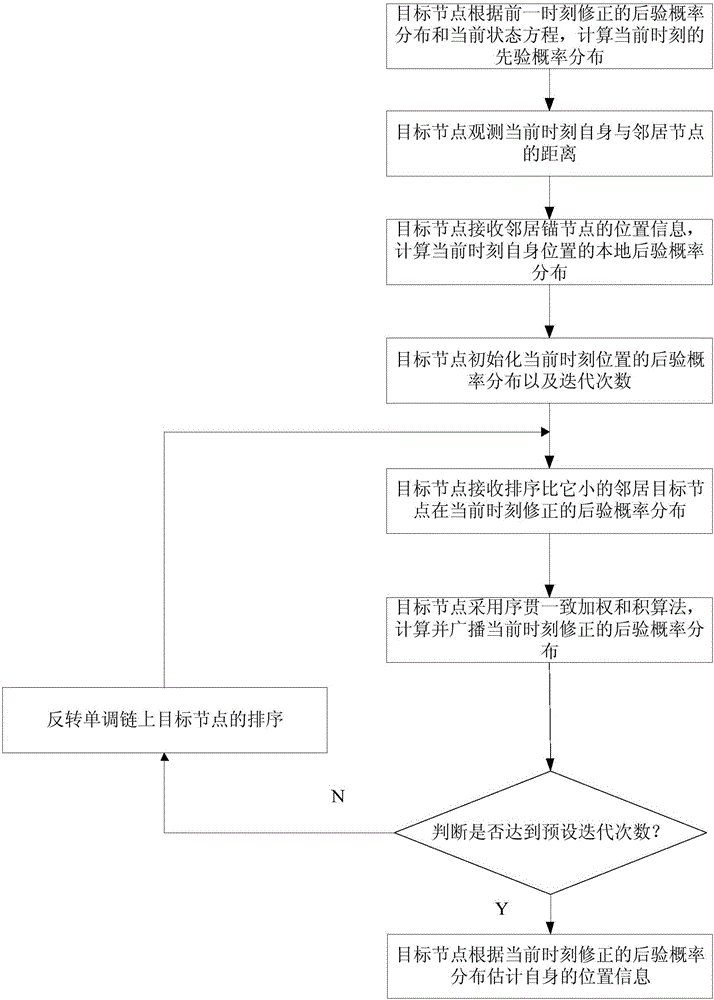
[0045] Such as figure 1 As shown, the collaborative positioning method based on the sequential consistent weighted sum product algorithm includes the following steps:

[0046] Step 1, the target node i corrects the posterior probability distribution p according to its own Nth iteration at time t-1 (N) (x i,t-1 |z 1:t-1 ) and its own state equation at time t, calculate its prior probability distribution p(x i,t |z 1:t-1 );

[0047] where i∈V T , V T Represents the set of all target nodes, x i,t-1 Indicates the position of the target node i in the two-dimensional space at time t-1, x i,t Indicates the position of the target node i in the two-dimensional space at time t, z 1:t-1 Indicate...