
Method for predicting three-dimensional abnormal pore pressure based on rock physical seismic information
A technology of pore pressure and rock physics, applied in the field of oil and gas exploration and development data processing, can solve problems such as incomplete and accurate prediction of formation pressure
Patent Information
- Authority / Receiving Office
- CN · China
- Patent Type
- Applications(China)
- Current Assignee / Owner
- Publication Date
- 2017-02-01
Smart Images
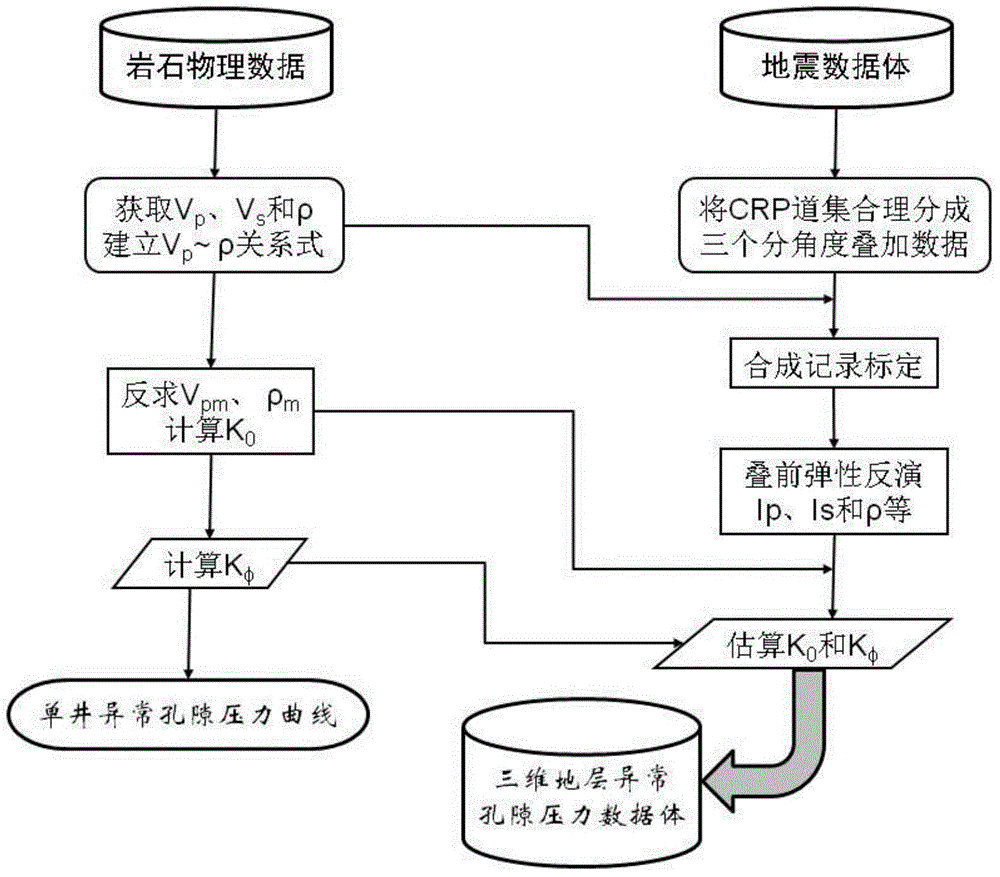
Figure 1 
Figure 2 
Figure 3
Abstract
Description
technical field
[0001] The present invention relates to the field of data processing methods for oil and gas exploration and development. It mainly utilizes geophysical information obtained from well logging and seismic data and petrophysical parameters to predict the abnormal pore pressure of formations and serve the exploration and development of oil and gas fields, such as analysis of oil and gas migration and accumulation, Well site preparation before drilling, etc. Background technique
[0002] Formation pressure and formation temperature are important basic parameters for oil and gas field development. The formation pressure and temperature of oil and gas reservoirs not only determine the properties of oil and gas fluids, but also determine the way of oil and gas field development, the technical characteristics and economic costs of oil and gas extraction, and the ultimate recovery rate.
[0003] Abnormal formation pressure environment is a common geological phenomeno...
Examples
Embodiment Construction
[0054] Such as figure 1 As shown, the implementation of the invention is mainly divided into the following steps:
[0055] (1) Comprehensive analysis of logging data, lithology, lithoelectric characteristics, and geological stratification of drilled wells to obtain rock geophysical parameters (acoustic compressional wave velocity, shear wave velocity, and density) and other information at the well point. The compressional wave velocity and density of multiple wells are intersected, and the empirical relationship between the compressional wave velocity and density is established.
[0056] (2) Using acoustic logging and density logging to obtain the porosity formula, inversely calculate the acoustic wave velocity and density of the formation skeleton, so as to obtain the formation matrix bulk modulus K 0 .
[0057] (3) Combining with the pore type composition and components of the well point, the formula of stress seeking pore space stiffness is used to calculate the formation...