Analytical astronomical positioning method for determining the position of celestial bodies or the position of the observer
A technology of celestial bodies and surveyors, applied in astronomical navigation, instruments, navigation calculation tools, etc., can solve the problems that have not become the mainstream method of astronomical positioning and navigation, and have not been selected into astronomical navigation reference books and astronomical navigation tutorials.
- Summary
- Abstract
- Description
- Claims
- Application Information
AI Technical Summary
Problems solved by technology
Method used
Image



Examples
specific Embodiment approach 1
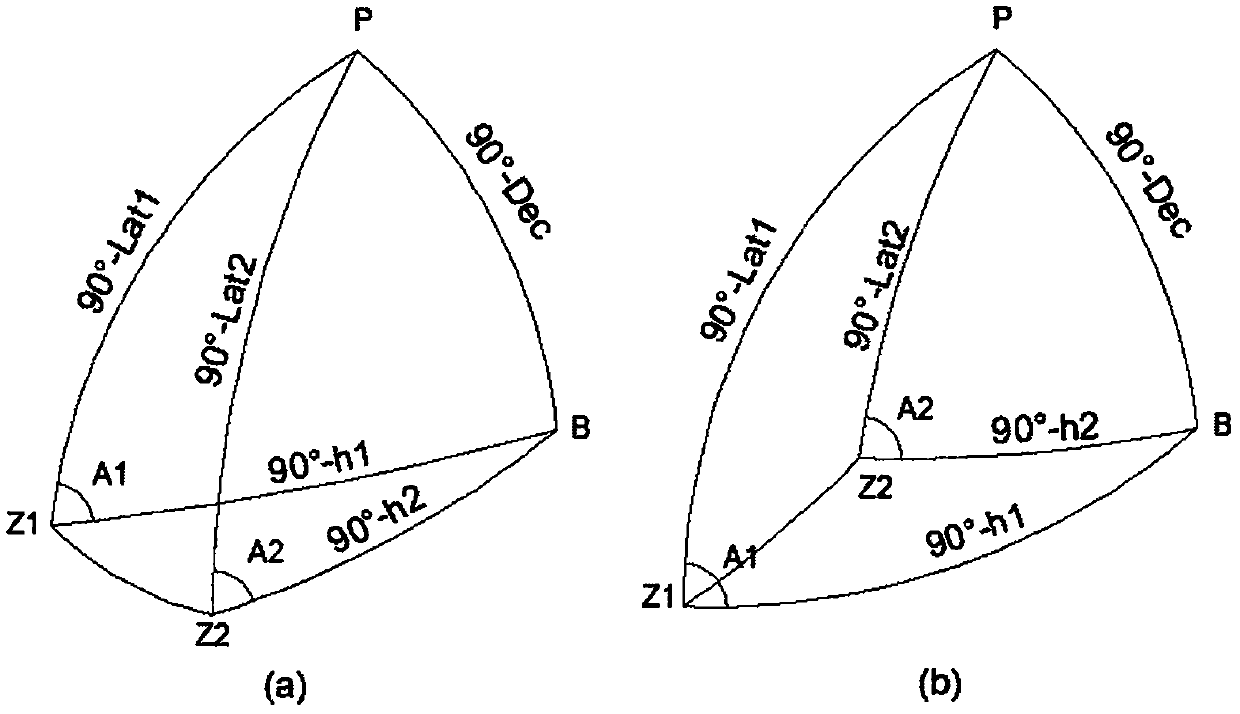
[0044] Specific embodiment 1, at a known position Z 1 (Lat1 / Long1), Z 2 (Lat2 / Long2), observe the true azimuths of the same unknown celestial body B as A1 and A2 respectively, and calculate the position of the celestial body; Z 1 and Z 2 Located on the same side of celestial body B as figure 1 ,Z 1 and Z 2 Located on the opposite side of celestial body B such as figure 2 ;Connect points Z on the sphere with a great arc 1 and Z 2 Get two auxiliary triangles △PZ 1 Z 2 and △BZ 1 Z 2 and astronomical triangle △PZ 1 B and ΔPZ 2 B forms an associative spherical triangle, such as figure 1 or figure 2 shown;
[0045] In the triangle △PZ 1 Z 2 , the two sides (90°-Lat1), (90°-Lat2) and their included angle (Long2-Long1) are known, and the other side Z is solved using the cosine formula 1 Z 2 :
[0046] cos(Z 1 Z 2 )=cos(90°-Lat1)*cos(90°-Lat2)+sin(90°-Lat1)
[0047] *sin(90°-Lat2)*cos(Long2-Long1)
[0048] =sin(Lat1)*sin(Lat2)+cos(Lat1)*cos(Lat2)
[0049] *co...
specific Embodiment approach 2
[0075] Specific embodiment 2, at a known position Z 1 (Lat1 / Long1), Z 2 (Lat2 / Long2), observe the true heights of the same unknown celestial body B as h1 and h2 respectively, and calculate the position of the celestial body; Z 1 and Z 2 Located on the same side of celestial body B as figure 1 ,Z 1 and Z 2 Located on the opposite side of celestial body B such as figure 2 , connecting the points Z with a great arc on the sphere 1 and Z 2 Get two auxiliary triangles △PZ 1 Z 2 and △BZ 1 Z 2 and astronomical triangle △PZ 1 B and ΔPZ 2 B forms an associative spherical triangle, such as figure 1 and figure 2 shown;
[0076] In the triangle △PZ 1 Z 2 , the two sides (90°-Lat1), (90°-Lat2) and their included angle (Long2-Long1) are known, and the other side Z is solved using the cosine formula 1 Z 2 :
[0077] cos(Z 1 Z 2 )=cos(90°-Lat1)*cos(90°-Lat2)+sin(90°-Lat1)
[0078] *sin(90°-Lat2)*cos(Long2-Long1)
[0079] =sin(Lat1)*sin(Lat2)+cos(Lat1)*cos(Lat2)
[0...
specific Embodiment approach 3
[0100] Specific embodiment 3, observing a known celestial body B at an unknown position Z 1 (Dec1 / GHA1), B 2 The true azimuths of (Dec2 / GHA2) are A1 and A2 respectively, and the solution calculates the position of the tester; B 1 and B 2 Located on the same side as the subject Z image 3 , B 1 and B 2 Located on the opposite side of the tester Z, such as Figure 4 ; Connect points B on a sphere with a great arc 1 and B 2 Get two auxiliary triangles △PB 1 B 2 and △ZB 1 B 2 and astronomical triangle △PZB 1 and △PZB 2 Form associative spherical triangles, such as image 3 and Figure 4 shown;
[0101] In the triangle △PB 1 B 2 , the two sides (90°-Dec1), (90°-Dec2) and their included angle (GHA2-GHA1) are known, and the other side B is solved using the cosine formula 1 B 2 :
[0102] cos(B 1 B 2 )=cos(90°-Dec1)*cos(90°-Dec2)+sin(90°-Dec1)
[0103] *sin(90°-Dec2)*cos(GHA2-GHA1)
[0104] =sin(Dec1)*sin(Dec2)+cos(Dec1)*cos(Dec2)
[0105] *cos(GHA2-GHA1)
[...
PUM
 Login to View More
 Abstract
Description
Claims
Application Information
 Login to View More