Unlock instant, AI-driven research and patent intelligence for your innovation.

A priority-based scheduling method for heterogeneous flows in 4G networks

A priority and 4G technology, applied in the direction of wireless communication, electrical components, etc., can solve problems such as difficulty in guaranteeing delay and throughput, failure to consider the needs of business flow priority scheduling, and inapplicability of real-time flow, etc., to achieve improved Performance and user experience, and the effect of improving latency

Active Publication Date: 2020-04-14
NANJING UNIV OF POSTS & TELECOMM
View PDF3 Cites 0 Cited by
  • Summary
  • Abstract
  • Description
  • Claims
  • Application Information

AI Technical Summary

Problems solved by technology

[0004] However, the above-mentioned scheduling algorithms belong to the system-level scheduling and are not suitable for real-time flows, and these scheduling algorithms do not take into account the needs of business flow priority scheduling
Prioritized scheduling is an important technology to ensure the effectiveness and practicability of wireless networks. However, the traditional prioritized scheduling algorithm is difficult to guarantee the delay and throughput due to the lack of scientific allocation of QoS parameters or other reasons. Other QoS indicators

Method used

the structure of the environmentally friendly knitted fabric provided by the present invention; figure 2 Flow chart of the yarn wrapping machine for environmentally friendly knitted fabrics and storage devices; image 3 Is the parameter map of the yarn covering machine
View more

Image

Smart Image Click on the blue labels to locate them in the text.
Viewing Examples
Smart Image
  • A priority-based scheduling method for heterogeneous flows in 4G networks
  • A priority-based scheduling method for heterogeneous flows in 4G networks
  • A priority-based scheduling method for heterogeneous flows in 4G networks

Examples

Experimental program
Comparison scheme
Effect test

Embodiment Construction

[0030] The invention will be described in further detail below in conjunction with the accompanying drawings.

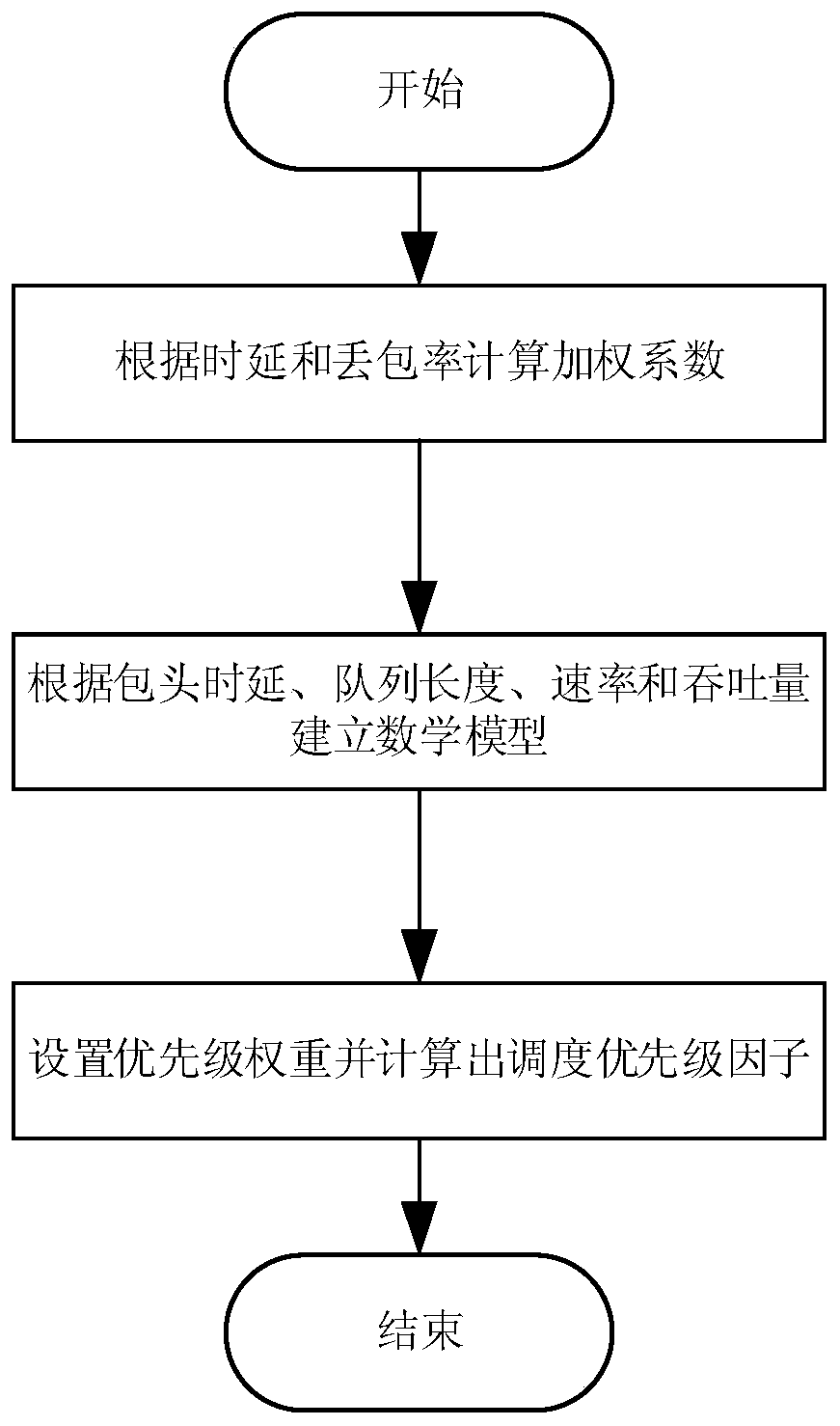
[0031] The main idea of ​​the present invention is to use the CQI mechanism of the data link layer at the user terminal to obtain channel information, calculate the weighting coefficient according to the delay and packet loss rate, and establish scheduling according to information such as packet header delay, queue length, rate and throughput. Model. Set the priority weight and calculate the scheduling priority factor, and assign the corresponding resource block to the user with the highest priority according to the user's priority factor. The inventive method comprises the steps:

[0032] Step 1: According to the CQI fed back by the user, the delay and packet loss rate of the user are obtained and the weighting coefficient is calculated:

[0033]

[0034] Among them, the maximum packet loss rate specifies the packet loss threshold in the data transmission proce...

the structure of the environmentally friendly knitted fabric provided by the present invention; figure 2 Flow chart of the yarn wrapping machine for environmentally friendly knitted fabrics and storage devices; image 3 Is the parameter map of the yarn covering machine
Login to View More

PUM

No PUM Login to View More

Abstract

The invention discloses a scheduling method for priority distinction of heterogeneous streams in a 4G network, which includes first obtaining the user's time delay and packet loss rate and calculating the weighting coefficient according to the CQI fed back by the user, and then according to the actual situation of 4G transmission, Considering the four factors of packet header delay, queue length, rate, and throughput, a mathematical model is established. Finally, according to the flow priority, the weight coefficient is set respectively, and the scheduling priority factor is calculated. The invention distinguishes different scheduling priorities according to the importance of business flows, and can also consider QoS indicators such as time delay, throughput, packet loss rate, etc., and ensures the fairness of scheduling. In the LTE-Sim simulation environment, the MP-MLWDF algorithm is compared with the existing SQPS. The simulation results show that the performance of the MP-MLWDF algorithm has been significantly improved.

Description

technical field [0001] The invention belongs to the technical field of computer wireless communication networks, and in particular relates to a priority-discriminating scheduling method for heterogeneous flows in a 4G network. Background technique [0002] With the development of the LTE (Long Term Evolution) network, its high-speed, low-latency and other characteristics have effectively improved the user's mobile service experience and can better meet the user's business needs. As the leading technology of the new generation of broadband wireless mobile communications, LTE has been rapidly commercialized around the world. At the same time, with the diversified development of various multimedia services such as high-definition voice, web pages, and videos, it has become a new trend to differentiate the priorities of different services to provide QoS (Quality of Service) guarantees. [0003] Although the performance of the 4G system has been greatly improved, it still requir...

Claims

the structure of the environmentally friendly knitted fabric provided by the present invention; figure 2 Flow chart of the yarn wrapping machine for environmentally friendly knitted fabrics and storage devices; image 3 Is the parameter map of the yarn covering machine
Login to View More

Application Information

Patent Timeline
no application Login to View More
Patent Type & Authority Patents(China)
IPC IPC(8): H04W72/12
CPCH04W72/569
Inventor 董育宁孙国岩刘继岩
Owner NANJING UNIV OF POSTS & TELECOMM