

User request distribution method and system
A user request and distribution system technology, applied in the field of network transmission, can solve the problems of keeping login, frequent logout of user accounts, and inability to reduce the load of transit nodes at the same time, so as to improve reliability and stability and improve efficiency.
- Summary
- Abstract
- Description
- Claims
- Application Information
AI Technical Summary
Problems solved by technology
Method used
Image



Examples
Embodiment 1
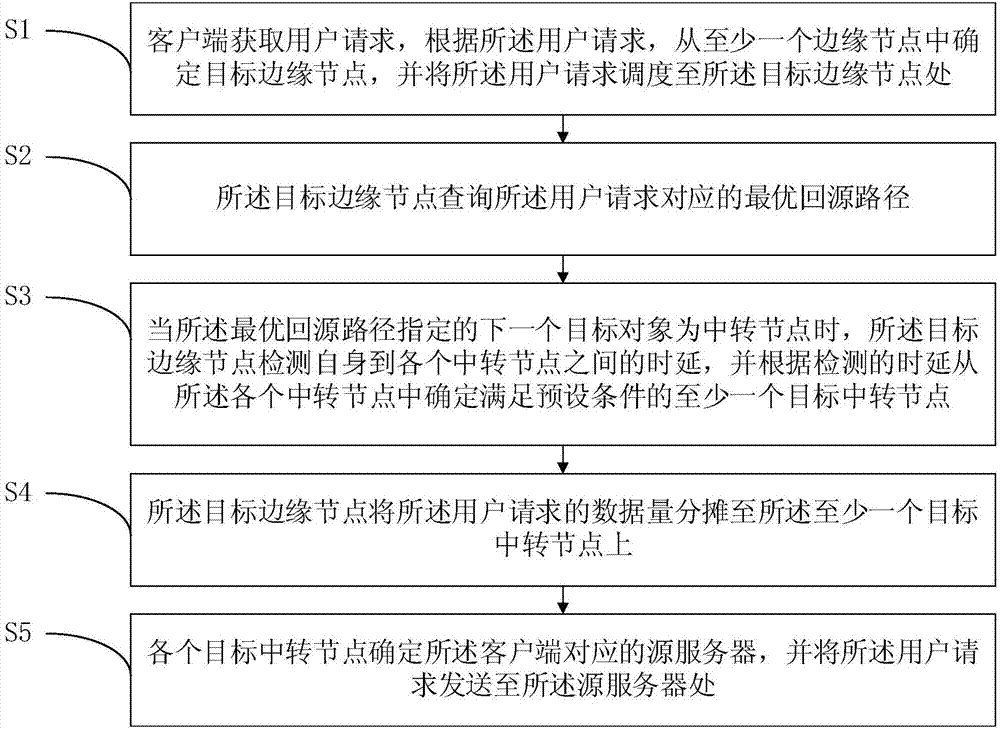
[0048] see figure 1 , the embodiment of the present application provides a method for distributing user requests, the method includes the following steps.
[0049] S1: The client acquires a user request, determines a target edge node from at least one edge node according to the user request, and dispatches the user request to the target edge node.
[0050] In this embodiment, the client may be an electronic device operated by a user, and the client may be a desktop computer, a notebook, a smart phone, a smart wearable device, and the like. The user can send a user request in the client, so that the client can receive the user request sent by the user. The user request may be sent by the client to the source server. In the user request, the IP address of the client may be included.
[0051] In this embodiment, the system architecture for distributing user requests may include a plurality of edge nodes, and these edge nodes may receive user requests sent by various clients. Sp...
Embodiment 2
[0081] The implementation mode of this application also provides a distribution system requested by users, please refer to Image 6 , the system includes a client, an edge node, a transit node, and a source server, wherein:
[0082] The client is configured to acquire a user request, determine a target edge node from at least one edge node according to the user request, and dispatch the user request to the target edge node;
[0083] The target edge node is used to query the optimal back-to-source path corresponding to the user request; when the next target object specified by the optimal back-to-source path is a transit node, detect the time between itself and each transit node Delay, and determine at least one target transit node that meets the preset condition from the various transit nodes according to the detected delay; allocate the amount of data requested by the user to the at least one target transit node;
[0084] Each target transit node is used for the user's request...
PUM
 Login to View More
 Abstract
Description
Claims
Application Information
 Login to View More