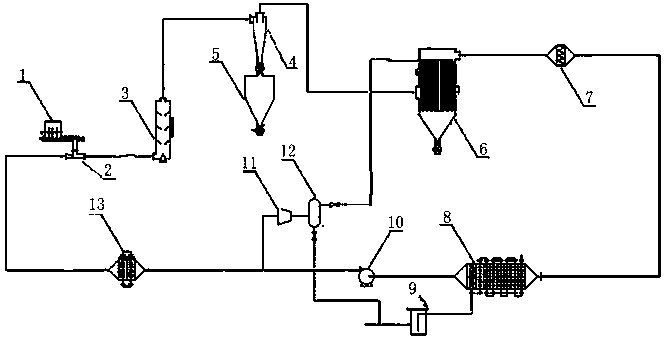
Closed-cycle drying process for 3,3'-dimethyl-4,4'-diaminodiphenylmethane

A diaminodiphenylmethane, closed-circuit cycle technology, applied in the direction of drying solid materials, drying gas arrangement, heating to dry solid materials, etc., can solve the problem that the emission content of o-methylaniline cannot meet the standard, the cost of incineration tail gas treatment is high, and the environment is unfavorable and other problems, to achieve the effect of improving the drying effect, simple structure and high drying efficiency

CN107940901AActive Publication Date: 2018-04-20ZHEJIANG UNIV OF TECH +1
7 Cites 3 Cited by

Patent Information

Authority / Receiving Office
CN · China
Current Assignee / Owner
Publication Date
2018-04-20

Smart Images

  • Figure 1
    Figure 1
Patent Text Reader

Abstract

The invention discloses a closed-cycle drying process for 3,3'-dimethyl-4,4'-diaminodiphenylmethane. The closed-cycle drying process is adopted, so that a solvent in wet materials is evaporated underaction of hot air; o-toluidine and MDT products are taken out by tail gas; dust content in the tail gas is enabled to meet requirements of a gas cycle and a compressor through cyclone separation, cloth-bag dust removal and medium-effect filter dust removal; the tail gas enters a condenser, the o-toluidine and water are condensed and recycled, so that content of o-toluidine in circulating air is reduced, and therefore, concentration of the o-toluidine in the tail gas is always kept to be lower than the lower explosive limit; the tail gas is pressurized by a circulating fan to re-enter a dryingprocess system to circulate, so that the drying effect is improved; MDT particles of waste gas in a drying process are removed by a cloth-bag dust remover and a medium-effect filter, so that dust content in the gas meets requirements of the gas cycle and the compressor, and therefore, a gas closed cycle is realized; and residual o-toluidine in the waste gas is condensed and recycled, so that emission of poisonous gas is avoided, and therefore, the closed-cycle drying process has very good economical and environmental effects.
Need to check novelty before this filing date? Find Prior Art

Description

technical field

[0001] The invention belongs to the technical field of chemical product drying, and relates to a 3,3'-dimethyl-4,4'-diaminodiphenylmethane closed-circuit circulation drying process, in particular to the closed-circuit circulation drying of dust particles containing MDT, especially to adjacent MDT closed loop drying process for methylaniline solvent recovery. Background technique

[0002] At present, the industrial production of 3,3'-dimethyl-4,4'-diaminodiphenylmethane (MDT) mainly uses o-methylaniline as a raw material, and the product is obtained through a catalytic reaction. The wet product during workup contains unreacted o-toluidine. After the MDT wet material is dried by hot air, the exhaust gas is directly discharged after the product is recovered by the cyclone separator and the bag filter. The exhaust gas contains a certain amount of o-methylaniline solvent, which is a known carcinogen. O-methylaniline is mostly a light yellow oily liquid at room t...

Examples

Embodiment Construction

[0023] The present invention will be further described below in conjunction with accompanying drawing of description, but protection scope of the present invention is not limited thereto:

[0024] Such as figure 1 As shown, a MDT closed cycle drying process of the present invention can avoid the discharge of MDT dust particles during the drying process, and can recover the residual o-methylaniline in the waste gas to realize automatic control and clean production. It adopts a closed-circuit circulation drying system for drying. The closed-circuit circulation drying system includes a feeder 1, a feeder 2, a cyclone dryer 3, a cyclone separator 4, an automatic packaging machine 5, a bag filter 6, and a medium-efficiency filter 7. , condenser 8, waste liquid tank 9, circulating fan 10, air compressor 11, oil-water separator 12 and heat exchanger 13, feeder 1 and heat exchanger 13 are all connected to the inlet end of feeder 2, feeder 2 The outlet end of the outlet is connected t...