
Detection on content of lincomycin in feeds through liquid chromatography-mass spectrography method
A lincomycin and liquid chromatography technology is applied in the field of liquid chromatography-mass spectrometry/mass spectrometry to detect the content of lincomycin in feed, which can solve the problem of decreased immunity of livestock and poultry, bacterial resistance, and animal body. Residue and other problems, to achieve the effect of good separation effect, high recovery rate and simple extraction process
- Summary
- Abstract
- Description
- Claims
- Application Information
AI Technical Summary
Problems solved by technology
Method used
Image

Examples
Embodiment 1
[0029] The assay method of embodiment 1 liquid chromatography erythromycin, lincomycin
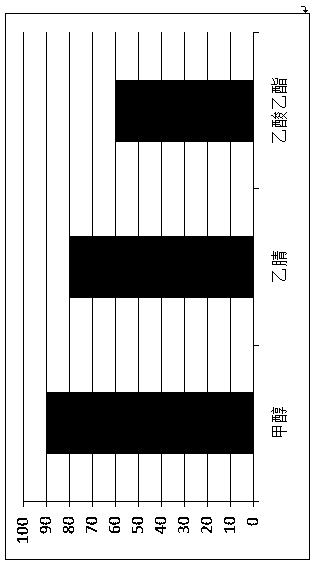
[0030] 1. When acidified methanol solution was used as the extraction solvent, the recoveries of lincomycin and erythromycin were all less than 10%, which may be due to the glycoside bond structure in lincomycin and erythromycin under acidic conditions. Hydrolysis occurs. In this study, methanol extraction was finally used. The recoveries of the two substances were high and the extraction process was simple.
[0031] 2. The addition of saturated lead acetate
[0032] After the supernatants were combined and blown nearly dry with nitrogen, 5 mL of 0.1 mol / L phosphate buffer solution was added to dissolve them. When the extract was to be purified, 100 μL of saturated lead acetate (adsorbed protein, In order to prevent the column from being blocked during purification), vortex and centrifuge to obtain the supernatant to achieve the purpose of removing protein.
[0033] 2. Selection of extr...
Embodiment 2
[0039] Embodiment 2 lincomycin stability
[0040] The standard stock solutions of lincomycin and erythromycin were placed at -18°C, and their stability was investigated at 1 month, 3 months and 6 months respectively. The experimental results showed that at 6 months Within the period, the stock solutions of lincomycin and erythromycin had no degradation phenomenon, so the storage period of the stock solutions of the two analytes was stipulated in the text as 6 months.
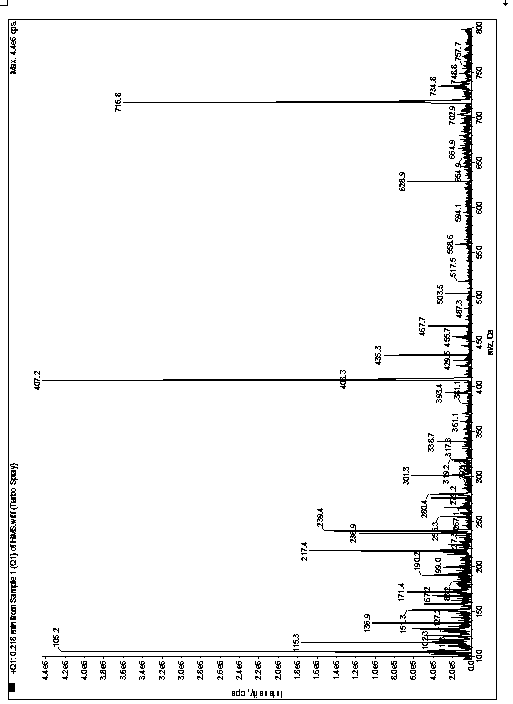
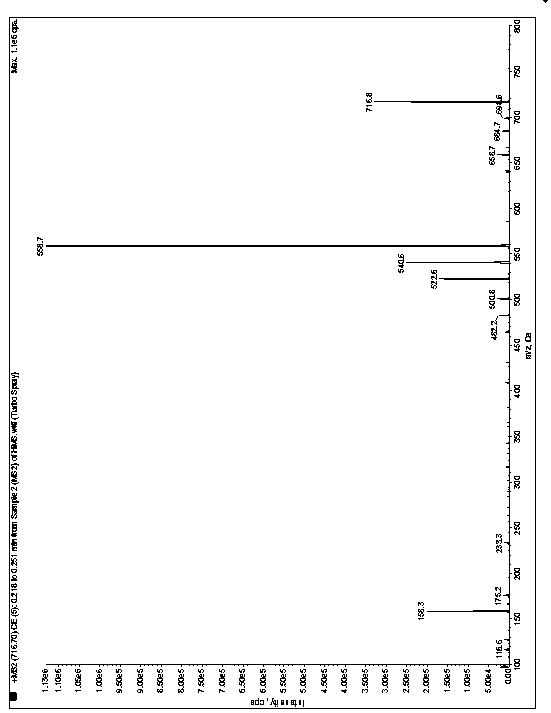
[0041]Lincomycin and erythromycin standard solutions with a concentration of 1 μg / mL were injected into the mass spectrometry system with a needle pump. Using Q1 full scan (Q1 MS) and fragment ion scan (Product Ion MS2) to determine precursor ions and product ions respectively, and optimize related parameters, Figures 1 to 4 It is the mass spectrum of 1 μg / mL lincomycin and erythromycin standard solution in Q1 and Product Ion (MS2) mode. Table 1 is the qualifier and quantifier ions of lincomycin and erythromy...
Embodiment 3
[0053] Embodiment 3 lincomycin in liquid chromatograph
[0054] 1. Quantitation limit and detection limit
[0055] Prepare a mixed standard solution of lincomycin and erythromycin, dilute it to a certain concentration of standard solution: 1.0, 2.0, 5.0, 10.0, 20.0, 50.0, 100.0 μg / L, and carry out under the best chromatographic and mass spectrometric conditions Determination, linear regression analysis was carried out with the peak area as the ordinate and the mass concentration as the abscissa. Gradually dilute the mixed standard solution, and take the signal-to-noise ratio greater than 10 (S / N≥10) as the lower limit of determination. The linear equation and correlation coefficient are shown in Table 3; the curve is as follows Figure 6 and 7 shown.
[0056]
[0057] 2. Precision
[0058] Using the addition method, that is, adding aflatoxin B to samples without aflatoxin in the background 1 , G 1 2.5 µg / kg, 5.0 µg / kg, 25 µg / kg, aflatoxin B 2 , G 2 Three levels of ...
PUM
 Login to View More
 Abstract
Description
Claims
Application Information
 Login to View More