
Forming technology for rapidly growing into century-old tree through geometric weaving
A technology, fast technology, applied in application, cultivation, agriculture, etc., can solve problems such as long cycle
Patent Information
- Authority / Receiving Office
- CN · China
- Patent Type
- Applications(China)
- Current Assignee / Owner
- Publication Date
- 2018-12-28
- Estimated Expiration
- Not applicable · inactive patent
Smart Images
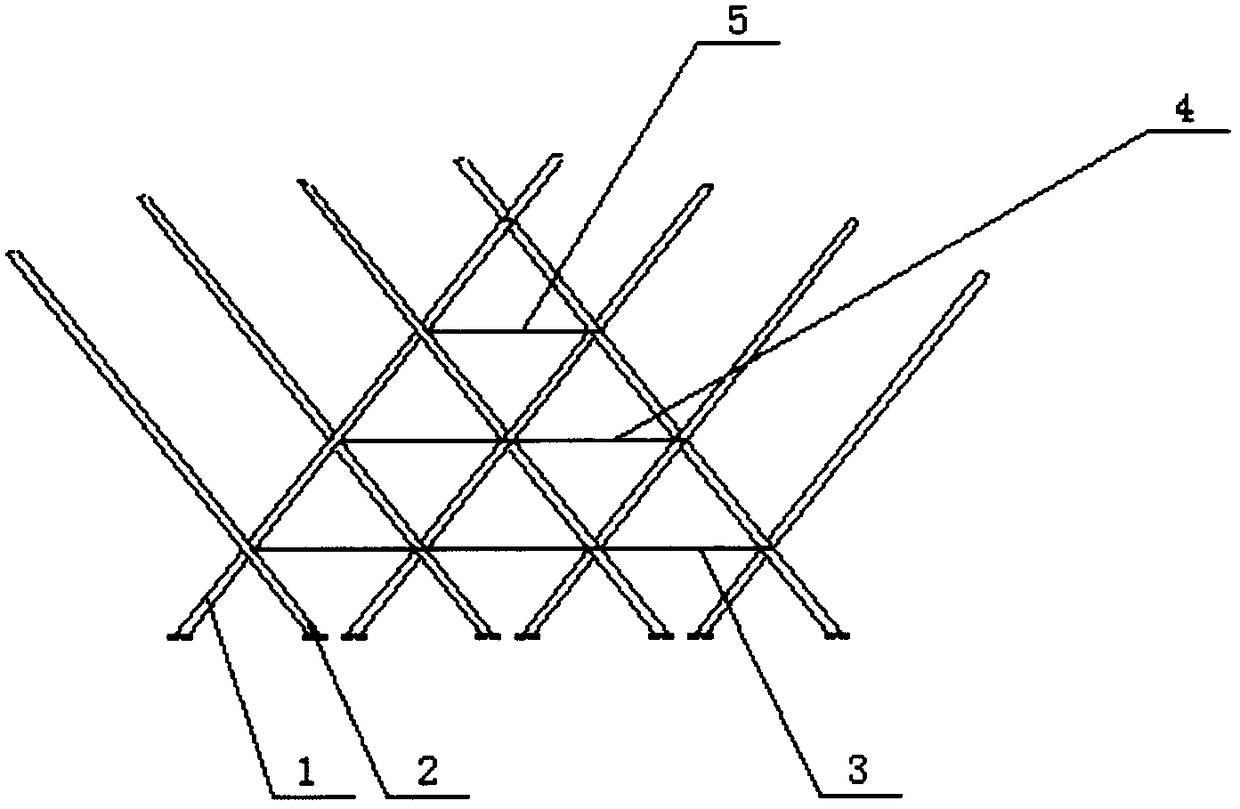
Figure 1
Abstract
Description
technical field
[0001] The invention belongs to the technical field of weaving large trees, and in particular relates to a forming technology for geometric weaving to rapidly grow into a hundred-year-old tree. Background technique
[0002] It takes 50 to hundreds of years for an arbor (mainly referring to street tree species: silk cotton wood, Chinese pagoda tree, purple leaf plum, etc.) to grow into a tree with a diameter of 50 cm. It usually grows for 8-15 years to grow to 15-30 cm thick Obviously, the cycle is too long to keep up with the current market demand for large trees of a certain size in China's ecological construction, so is there a technology that can make arbors and trees quickly formed to meet the growing demand for large trees in the market, and effectively avoid digging large trees in the mountains? Therefore, it is of great significance to develop a kind of rapid prototyping technology that makes trees grow rapidly, have a high survival rate and internally...
Examples
Embodiment 1
[0015] Such as figure 1 As shown, a geometric weaving rapidly grows into a century-old tree forming technology, which includes a weaving material and a weaving technology, and the weaving material is silk cotton wood, and the weaving technology is for each pair starting from a1, The first layer 3 intersects with the pair b2, using the inner side of a1 and the inner side of b2; the second layer adjacent to a pair of b2 intersects whether it is a1 or b2, it is the inner layer and the outer layer, and the cross is superimposed layer by layer. Fabrication distribution, layer by layer, inside and outside, all the way to the top; the acute angle between a1 and b2 ranges from 50° to 70°.
[0016] When adopting among the arbor trees with a dry height of more than 3.3 meters and a large arbor tree with a thickness of 1.5-2.5 centimeters to make weaving materials, the selection is silk cotton wood with high flexibility and survival rate. The tree is made up with 8 pairs (8X2 strains = ...
Embodiment 2
[0018] Such as figure 1 As shown, a geometric weaving rapidly grows into a century-old tree forming technology, which includes a weaving material and a weaving technology, and the weaving material is silk cotton wood, and the weaving technology is for each pair starting from a1, The first layer 3 intersects with the pair b2, using the inner side of a1 and the inner side of b2; the second layer adjacent to a pair of b2 intersects whether it is a1 or b2, it is the inner layer and the outer layer, and the cross is superimposed layer by layer. Fabrication distribution, layer by layer, inside and outside, all the way to the top; the acute angle between the a1 and b2 ranges from 50° to 70°, and the a1 and b2 are in a state of mutual contact at the root. Said a1 is parallel to a1, and b2 is parallel to b2. When the trunk height exceeds 3.3 meters and the thickness is 1.5-2.5 centimeters among the arbors, silk cotton wood with high flexibility and survival rate is selected.