Holographic display method and holographic display device
A holographic display and holographic technology, applied in the field of holographic display, can solve the problems of limited viewing angle, the observer cannot move at will, affecting the look and feel, etc., to achieve the effect of expansion
- Summary
- Abstract
- Description
- Claims
- Application Information
AI Technical Summary
Problems solved by technology
Method used
Image



Examples
Embodiment 1
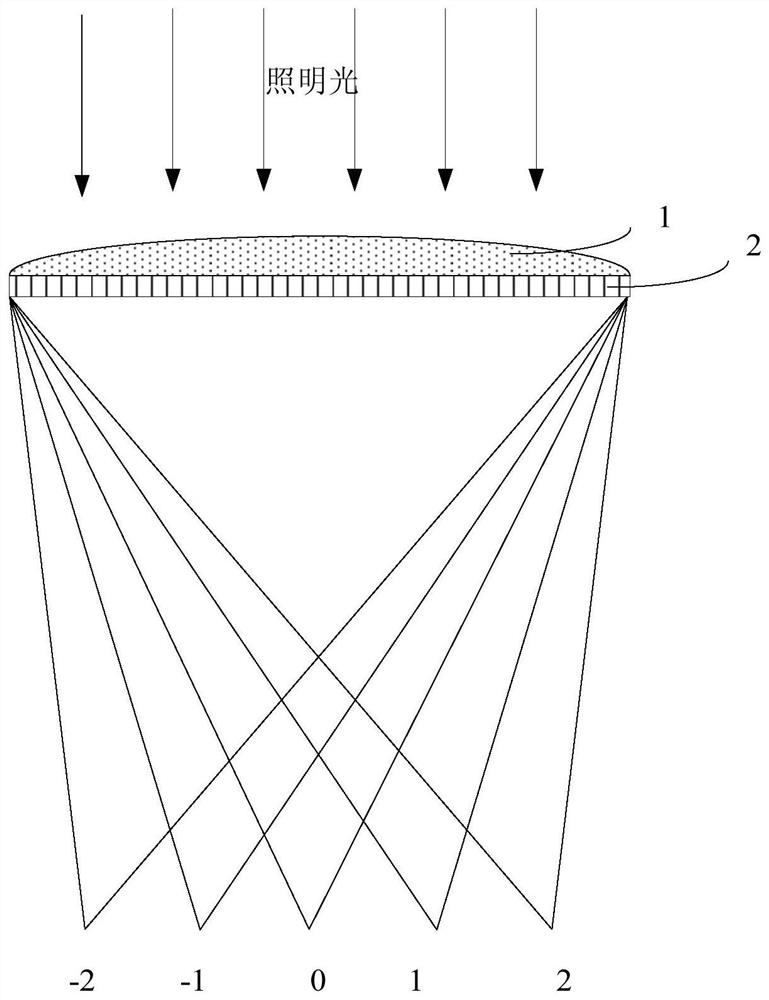
[0048]In this embodiment, the size of the window holographic window is determined by hardware parameters. The hardware parameters determine that normal images cannot be seen outside the window area, and hardware parameters are usually not adjustable, which will limit the visible range of the window hologram to the window. The problem is to provide a holographic display method, by adjusting the complex amplitude distribution of the hologram to present a holographic image in multiple diffraction order areas, setting up a window other than the existing window area so that normal images can be seen, and realizing the holographic visual range of the window Expansion, and the expansion of the window holographic viewing range will greatly increase the comfort of the viewer.
[0049] The holographic display method is based on the phase connection between different levels of diffraction, and can realize the expansion of the window by adjusting the data. Such as figure 2 As shown, the...
Embodiment 2
[0078] Corresponding to the display method in Embodiment 1, this embodiment provides a holographic display device, which presents holographic images in multiple diffraction order regions by adjusting the complex amplitude distribution of the hologram, and realizes the expansion of the holographic visual range of the window.
[0079] Such as Figure 5 As shown, the holographic display device includes a spatial light modulator 2, and also includes a calculation unit 3, an eye position acquisition unit 4 and a processing unit 5, wherein:
[0080] The eye position acquisition unit 4 is used to acquire the position of the window where the eye is located, and transmit the eye position to the calculation unit 3;
[0081] The calculation unit 3 is used to calculate the holographic complex amplitude distribution corresponding to the N-order diffraction window according to the diffraction level area corresponding to the position of the eye in the window to obtain window hologram informa...
PUM
 Login to View More
 Abstract
Description
Claims
Application Information
 Login to View More