An action simulation fitting degree evaluation method

An evaluation method and a technology of fitting degree, which is applied in the field of anthropometric measurement and human-computer interaction, can solve problems such as the evaluation of human body movement fitting degree, and achieve the effects of avoiding visual distance distortion, excellent processing effect, and improving training effect

CN109815930AActive Publication Date: 2019-05-28中国人民解放军总医院第六医学中心 +1
11 Cites 5 Cited by

Patent Information

Authority / Receiving Office
CN · China
Current Assignee / Owner
Publication Date
2019-05-28

Smart Images

  • Figure 1
    Figure 1
  • Figure 2
    Figure 2
  • Figure 3
    Figure 3
Patent Text Reader

Abstract

The invention discloses an action imitation fitting degree evaluation method, which is characterized by describing the human body postures by the unit vectors of the limbs of the human body; carryingout fitting calculation on a demonstrator key frame and a plurality of simulator comparison frames in a set range; obtaining the posture, closest to the demonstrator, of the simulator, so that the comparison errors caused by action time delay of the simulator and the demonstrator are avoided, the method is closer to the actual situation that the simulator learns along with the demonstrator in action interaction training, and the processing effect is superior to that of a DTW algorithm. By introducing a time difference index attenuation function, the time difference between the posture of the demonstrator and the posture of the simulator is considered, and the fitting degree calculation error possibly caused by comparison of multiple postures of the simulator is made up. The method can be used for the fitting degree evaluation of long-time continuous actions, can evaluate and display the fitting degree in real time, and can guide a simulator to improve the training effect in a targetedmanner through the comparison of a fitting degree curve and a demonstrator key frame.
Need to check novelty before this filing date? Find Prior Art

Description

technical field

[0001] The invention belongs to the technical field of anthropometry and human-computer interaction, and in particular relates to an evaluation method for the similarity degree of body movement postures. Background technique

[0002] Human-computer interaction technology has been used in various training and entertainment. Provide guidance to the learners and imitators through the actual demonstrator video or the movement of the three-dimensional human body model of the demonstrator; obtain the limb data of the learners and imitators through measurement, and evaluate the learning and imitation effects and achievements. This technology has been applied in various training and entertainment occasions, such as sports training, skill movement training, interactive games and so on. Among them, there are many ways to measure the body movements of the learner and the imitator, and the position and direction information of the body of the measured person can be obta...

Examples

Embodiment Construction

[0060] The present invention will be further explained below in conjunction with the accompanying drawings and specific embodiments.

[0061] The action imitation fitting evaluation method of the present invention comprises steps:

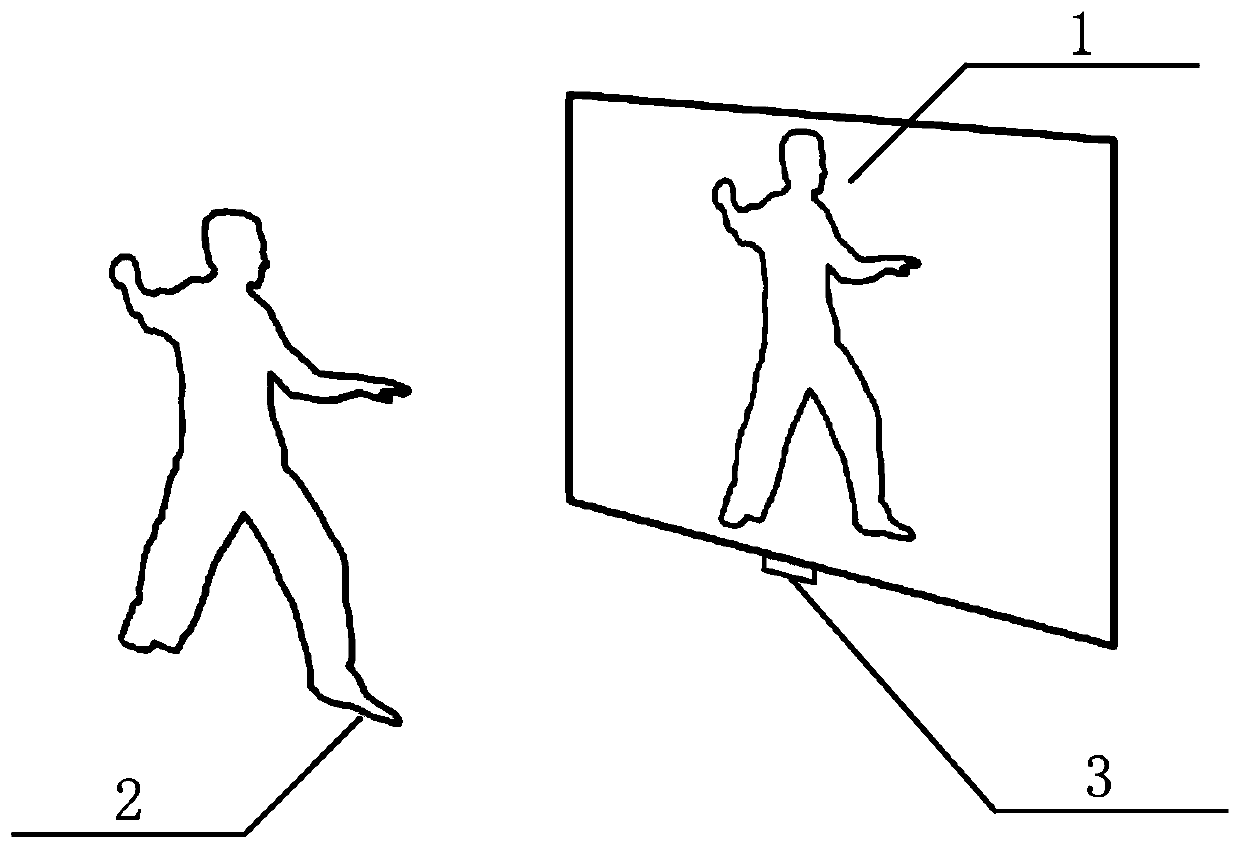
[0062] (1) Using a motion capture device to obtain the limb position data or bone joint data of the demonstrator and the imitator. In this embodiment, the FOHEART C1 system is used to collect the demonstrator's body movement data, the FOHEART C1 device is used to obtain the demonstration movement data of the demonstrator, and the Kinect somatosensory device is used to obtain the imitator's body movement data. Store the collected demonstrator action data as human body action data files (this example uses FBX data format files), and use the virtual reality application program development engine to build an interactive training interface (here, the example uses Unity), forming a such as figure 1 The action interactive learning interface shown: the im...