
High-dispersion polyoxometallate magnetic microsphere catalyst, and preparation method and application thereof
A technology of polyoxometalates and magnetic microspheres, applied in chemical instruments and methods, physical/chemical process catalysts, organic compounds/hydrides/coordination complex catalysts, etc., can solve difficult recovery, difficult separation, active Limited space and other issues
- Summary
- Abstract
- Description
- Claims
- Application Information
AI Technical Summary
Problems solved by technology
Method used
Image

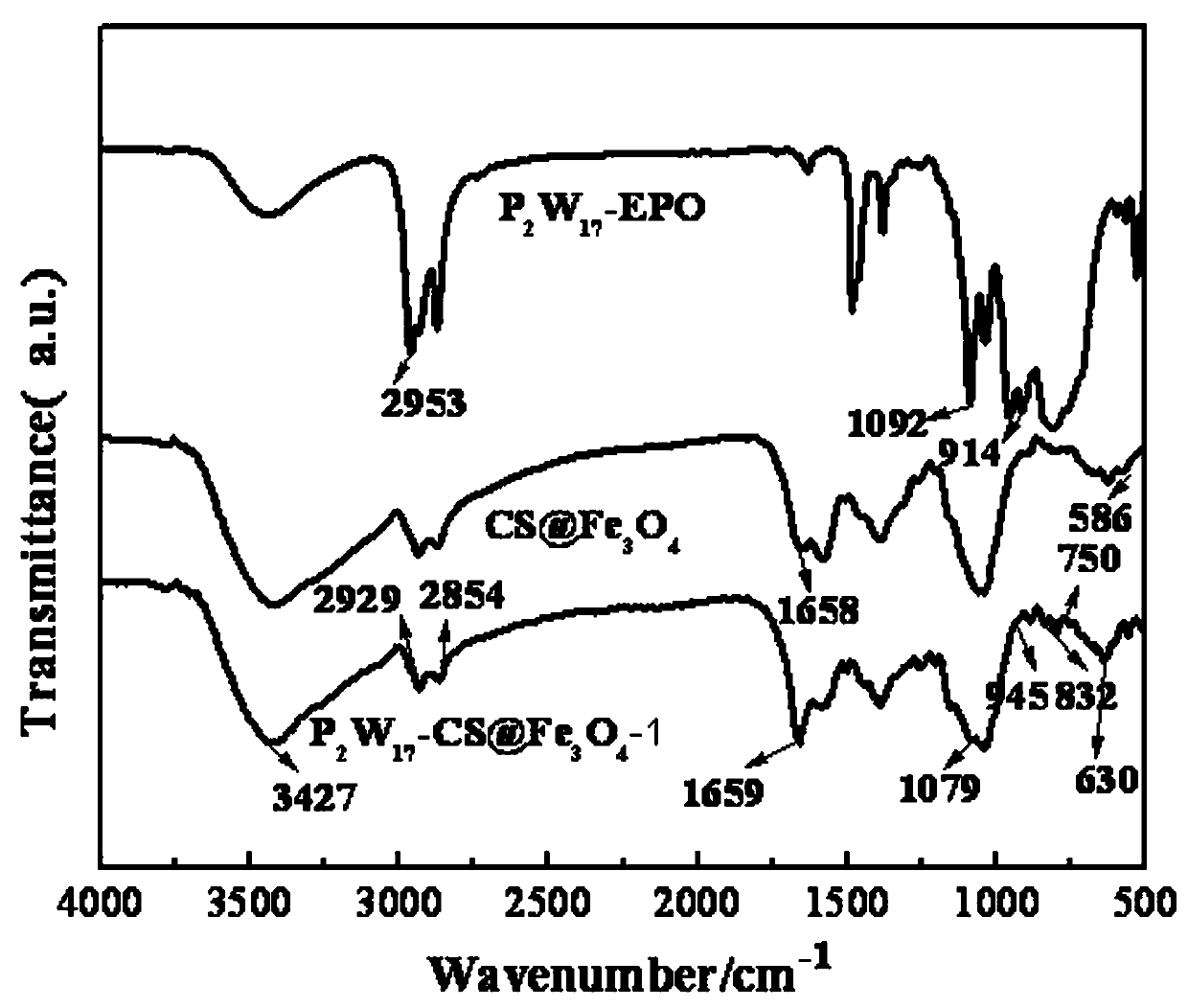
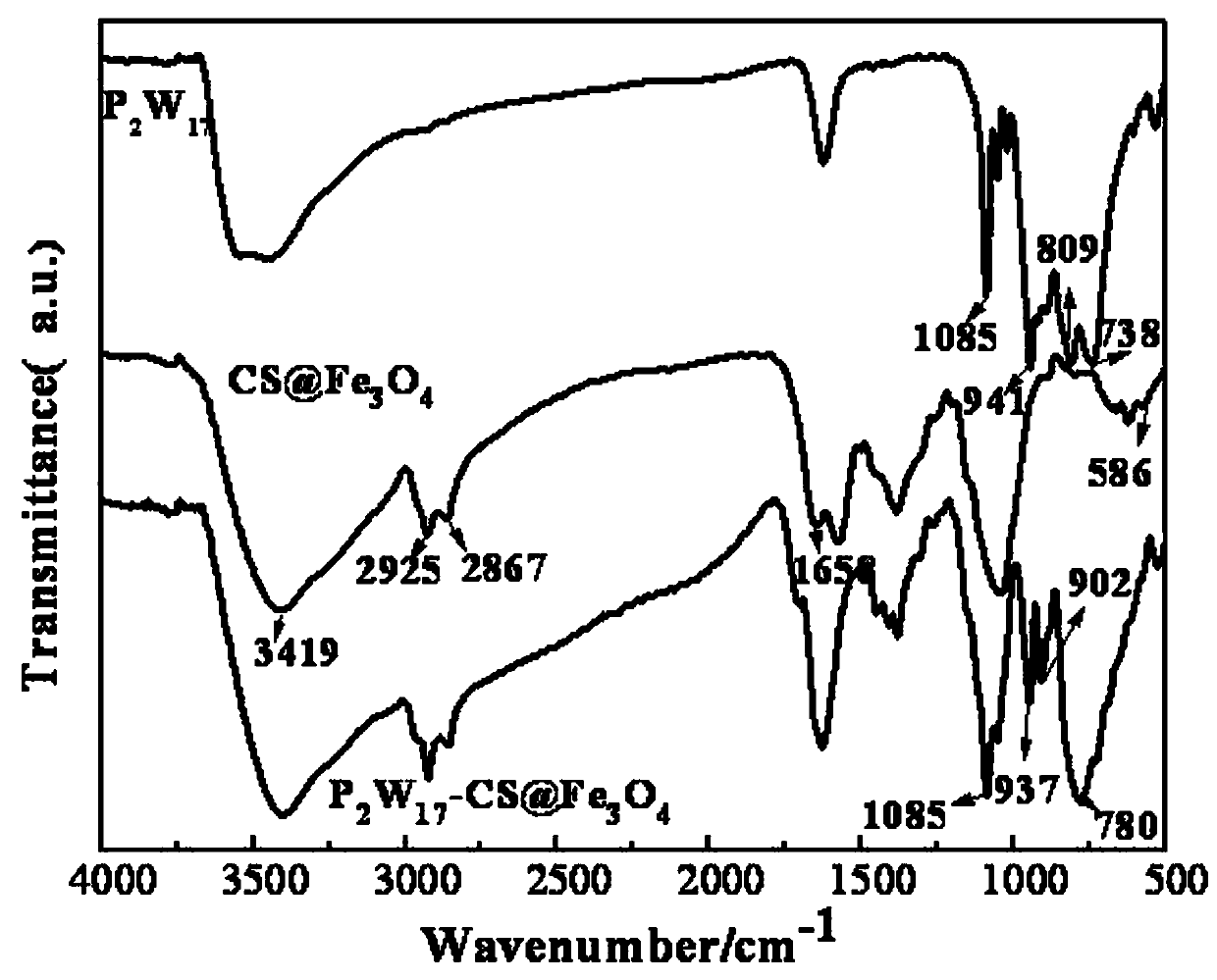
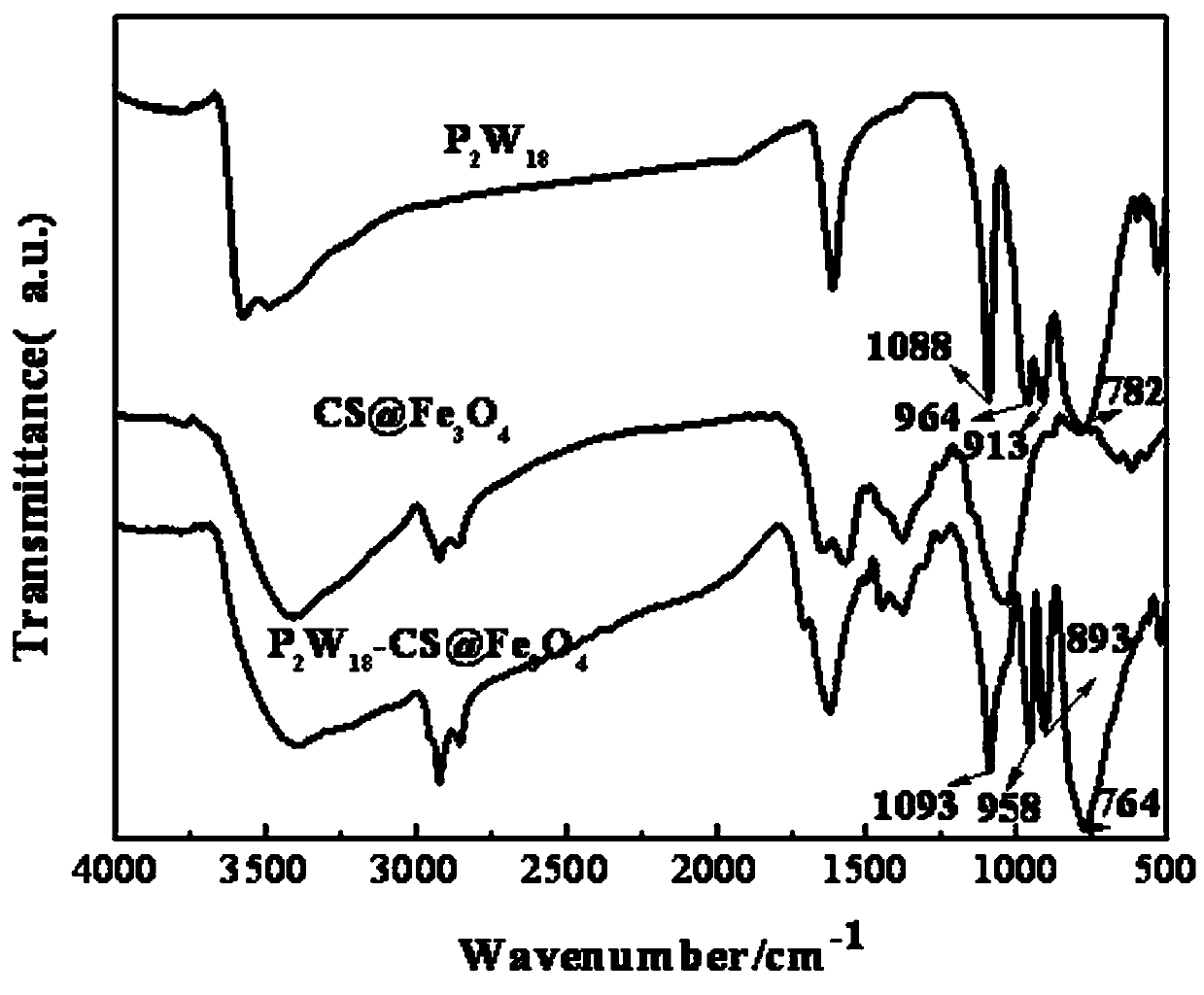
Examples
Embodiment 1
[0023] Embodiment 1: the Fc of chitosan modification 3 o 4 Covalent loading of P on magnetic microspheres 2 W 17 Composite catalyst P 2 W 17 -CS@Fe 3 o 4 -1 preparation: the steps are as follows: 156 mg KH-560 and 1.0 g P 2 W 17 Add it to a mixed solution of 30 mL of acetonitrile and water ((V / V)=1:2), adjust the pH of the solution to 2, react at room temperature for 6 h, and then pour the reaction solution into a beaker. Then containing 0.84 gNBu 4 Add 5 mL of Br aqueous solution to the above reaction solution, the solution turns white, and viscous precipitates form at the bottom, filter, wash with ethanol and water in sequence, and dry with ether to obtain a white solid powder, which is epoxy-modified tungsten phospholipid Salt P 2 W 17 -EPO; then 0.3 g CS@Fe 3 o 4 Microspheres were added to 30 mL of DMF, N 2 Under protection, add 0.1 g NaOH solid and 0.3 gP 2 W 17 -EPO,N 2 Under protection, raise the temperature to 60 °C, react for 24 h, cool to room temper...
Embodiment 2
[0024] Embodiment 2: the Fc of chitosan modification 3 o 4 Covalent loading of P on magnetic microspheres 2 W 17 Composite catalyst P 2 W 17 -CS@Fe 3 o 4 -1 preparation: the steps are as follows: 256 mg KH-560 and 2.0 g P 2 W 17 Add it to a mixed solution of 40 mL of acetonitrile and water ((V / V)=2:2), adjust the pH of the solution to 3, react at room temperature for 8 h, and then pour the reaction solution into a beaker. Then containing 0.84 gNBu 4 Add 7 mL of Br aqueous solution to the above reaction solution, the solution turns white, and a viscous precipitate forms at the bottom. Then, filter, wash with ethanol and water in sequence, and dry with ether to obtain a white solid powder, which is epoxy-modified Phosphotungstate P 2 W 17 -EPO; then 0.4 g CS@Fe 3 o 4 Microspheres were added to 40 mL of DMF, N 2 Under protection, add 0.2 g Na 2 CO 3 solid and 0.4 g P 2 W 17 -EPO,N 2 Under protection, the temperature was raised to 70 °C, reacted for 25 h, cooled...
Embodiment 3
[0025] Embodiment 3: the Fc of chitosan modification 3o 4 Covalent loading of P on magnetic microspheres 2 W 17 Composite catalyst P 2 W 17 -CS@Fe 3 o 4 -1 preparation: the steps are as follows: 356 mg KH-560 and 3.0 g P 2 W 17 Add it to a mixed solution of 50 mL of acetonitrile and water ((V / V)=2:3), adjust the pH of the solution to 4, react at room temperature for 9 h, and then pour the reaction solution into a beaker. Then containing 0.84 gNBu 4 9 mL of aqueous solution of Br was added to the above reaction solution, the solution turned white, and a viscous precipitate formed at the bottom. Then, it was filtered, washed with ethanol and water in sequence, and dried with ether to obtain a white solid powder, which was epoxy-modified Phosphotungstate P 2 W 17 -EPO. Then 0.5 g CS@Fe 3 o 4 Microspheres were added to 50 mL of DMF, N 2 Under protection, add 0.3 g NaHCO 3 Solid and 0.5 g epoxy-modified phosphotungstate P 2 W 17 -EPO,N 2 Under protection, raise t...
PUM
 Login to View More
 Abstract
Description
Claims
Application Information
 Login to View More