Unmanned aerial vehicle and control method of unmanned aerial vehicle

A control method and technology of drones, applied in the field of drones, can solve problems such as the exhaustion of the drone's battery, the deviation of the drone's course from the preset course, and the impact on the flight safety of the drone, so as to ensure safe return, The effect of improving reliability and safety

CN110998474AActive Publication Date: 2020-04-10SZ DJI TECH CO LTD
13 Cites 1 Cited by

Patent Information

Authority / Receiving Office
CN · China
Patent Type
Applications(China)
Current Assignee / Owner
Publication Date
2020-04-10

Smart Images

  • Figure 1
    Figure 1
  • Figure 2
    Figure 2
  • Figure 3
    Figure 3
Patent Text Reader

Abstract

A control method of an unmanned aerial vehicle (1a, 1b, 1c) and an unmanned aerial vehicle (1a, 1b, 1c) are provided. The control method includes generating a return command to make the unmanned aerial vehicle (1a, 1b, 1c) to perform a return movement, which includes at least one cruise phase during which flight parameters of the unmanned aerial vehicle (1a, 1b, 1c) are measured, allowing the unmanned aerial vehicle (1a, 1b, 1c) to enter a high wind blockage state when it is determined that the unmanned aerial vehicle (1a, 1b, 1c) is in the high wind blockage state based on the flight parameters; measuring flight parameters in the high wind blockage state; and allowing the unmanned aerial vehicle (1a, 1b, 1c) to enter the cruise phase when it is determined that the unmanned aerial vehicle(1a, 1b, 1c) is out of the high wind blockage state based on the flight parameters.
Need to check novelty before this filing date? Find Prior Art

Description

technical field

[0001] The present disclosure relates to the field of unmanned aerial vehicles, and in particular to a method for controlling an unmanned aerial vehicle and the unmanned aerial vehicle. Background technique

[0002] The UAV may encounter strong winds during the flight process such as return flight and normal operation. When the wind is strong, the forward flight component of the UAV may not be enough to counteract the wind, which will reduce the speed of the UAV and even make the UAV stall. Wind can also cause the drone to veer significantly from its preset heading. However, the existing technology does not detect strong winds, and UAVs will not avoid strong winds during flight, which may easily cause the power of the UAV to run out and fail to reach the target point, affecting the flight safety of the UAV. Contents of the invention

[0003] The present disclosure provides a method for controlling a UAV, which includes: generating a return command to enab...

Examples

Embodiment Construction

[0030] Hereinafter, embodiments of the present disclosure will be described with reference to the drawings. It should be understood, however, that these descriptions are exemplary only, and are not intended to limit the scope of the present disclosure. Also, in the following description, descriptions of well-known structures and techniques are omitted to avoid unnecessarily obscuring the concepts of the present disclosure.

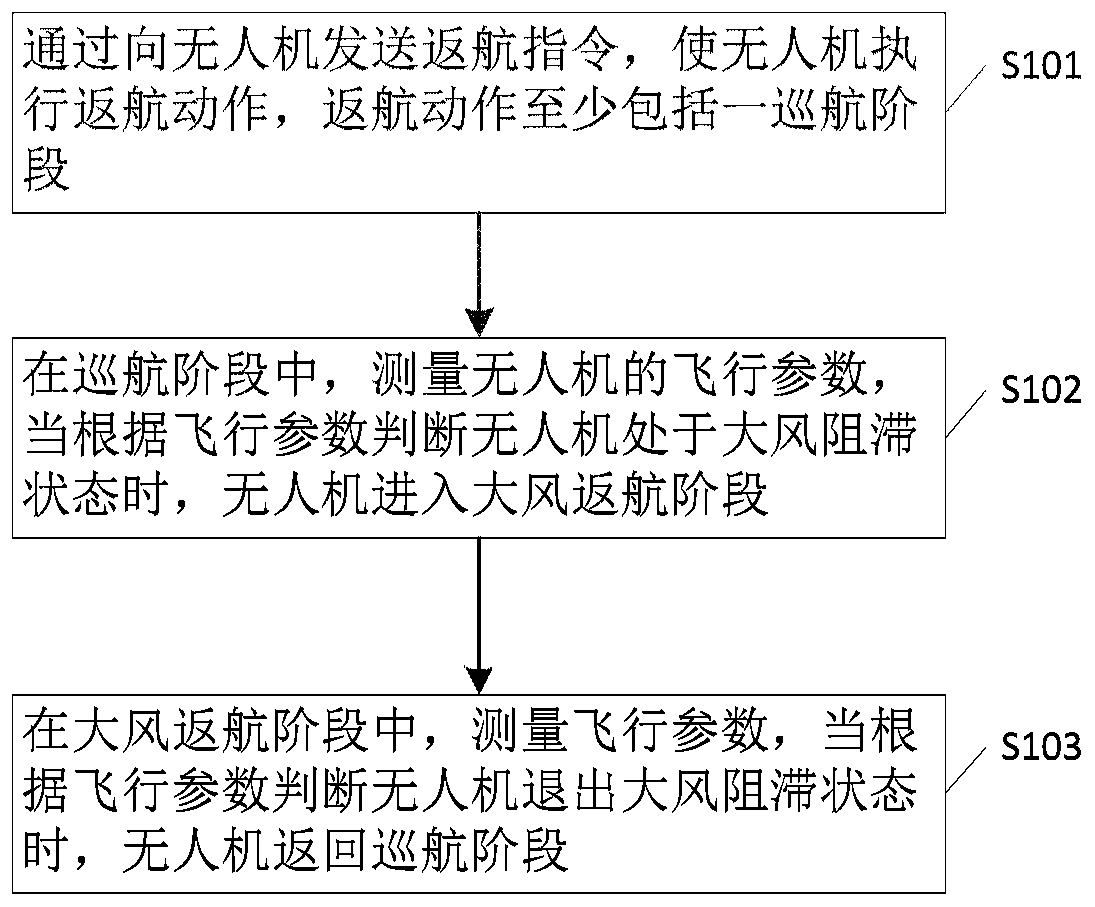
[0031] An embodiment of the present disclosure provides a method for controlling a drone, such as figure 1 As shown, the control method includes the following steps:

[0032] Step S101: By sending a return command to the UAV, the UAV performs a return action, and the return action includes at least one cruising phase.

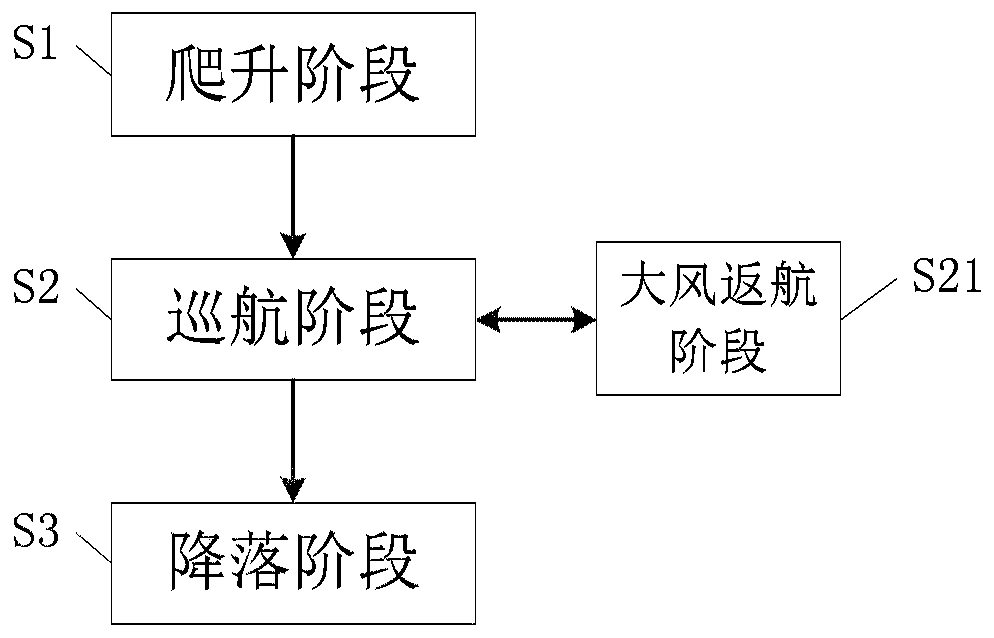
[0033] Such as figure 2 As shown, the return action includes: climbing phase S1, cruising phase S2, and landing phase S3, and the cruising phase S2 includes a strong wind returning phase S21.

[0034] The climb stage includes: return p...