Object deformation control method based on connection relationship

A technology for connecting relationships and objects, applied in the field of animation production, can solve the problems of low calculation speed, deformation tools are prone to distortion, and parameter control is cumbersome, etc., and achieves the effect of high calculation speed and avoiding cumbersome and insufficient parameter control.

CN111199571AInactive Publication Date: 2020-05-26江苏原力数字科技股份有限公司
9 Cites 0 Cited by

Patent Information

Authority / Receiving Office
CN · China
Patent Type
Applications(China)
Current Assignee / Owner
Publication Date
2020-05-26
Estimated Expiration
Not applicable · inactive patent

Smart Images

  • Figure 1
    Figure 1
  • Figure 2
    Figure 2
Patent Text Reader

Abstract

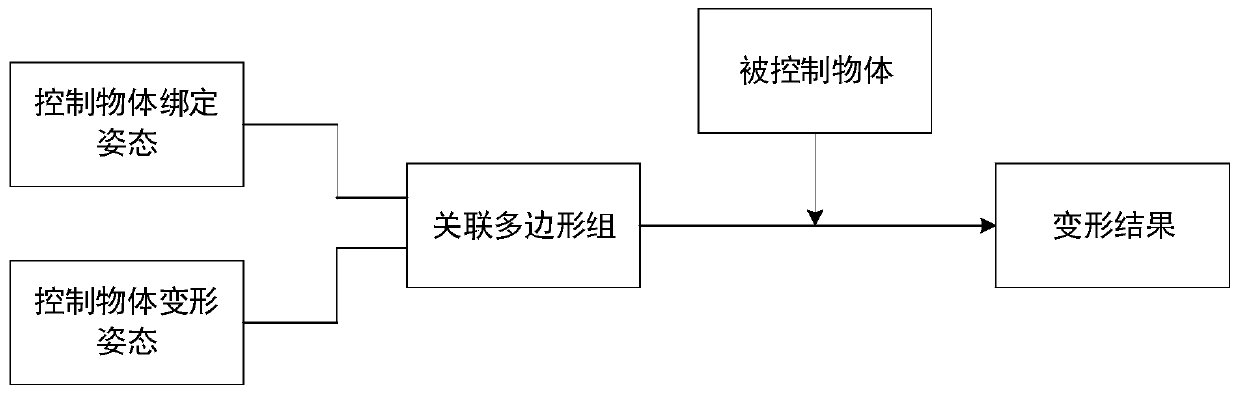
The invention provides an object deformation control method based on a connection relationship. The method comprises the following steps: preprocessing: before transformation, solving a polygon closest to each connected domain of a control object and a controlled object at a binding position, storing the normal information of the binding position of the polygon, and recording the association relationship between the polygon on the control object and each connected domain of the controlled object at the same time; performing deformable animation, when teach object is controlled to deform; acquiring normal and position information of all polygons associated with all connected domains of the controlled object, then calculating a transformation matrix according to the normal and position information bound with the polygons, substituting the transformation matrix of each polygon into the vertex of each connected domain according to the associated information of the connected domains to acquire a final deformation result. According to the method, optimization is carried out for the problems that when model additional deformation operation is carried out, a traditional deformation tool isprone to distortion, parameter control is tedious, and the calculation speed is low.
Need to check novelty before this filing date? Find Prior Art

Description

technical field

[0001] The invention belongs to the technical field of animation production, and in particular relates to a method for controlling object deformation based on a connection relationship. Background technique

[0002] In the process of 3D animation production, there is often interdependence between models, such as adsorption: the buttons on the clothes should move with the clothes when the clothes are deformed, instead of artificial manual control. The use of deformers is particularly important at this time. Generally speaking, adsorption means that one model as a whole is adsorbed to another model as a whole, and then according to a certain algorithm, the animation of the adsorbed object is used to drive the adsorbed object. However, there is a situation where a model actually contains many parts. In this case, if it is rigid adsorption, the traditional method needs to manually break up the model, making each part a separate model, and then adsorbing them to ...

Examples

Embodiment Construction

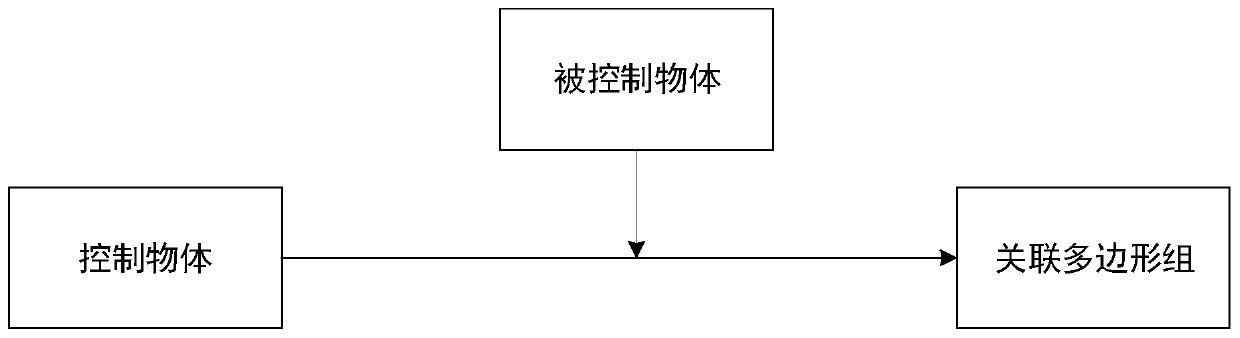
[0016] Such as figure 1 As shown, a control object deformation method based on the connection relationship is in the preprocessing stage: before the transformation, the nearest polygon of each connected domain between the control object and the controlled object is obtained at the binding position, and the binding position of the polygon is saved At the same time, it records the connection relationship between the polygons on the control object and the connected domains of the controlled object.

[0017] Specifically, the nearest neighbor polygon of connectivity is solved:

[0018] f cnt Represents all face sequences of connected domains, F ctrl Represents the sequence of all faces of the control object.

[0019] Such as figure 2 As shown, a control object deformation method based on the connection relationship is in the deformation animation stage: when the control object is deformed, the normal and position information of all polygons associated with each connected do...