
Carbon layer-coated nano-manganese tetraoxide shell-core structure material and preparation method thereof
A core-shell structure and coating technology, applied in nanotechnology, structural parts, nanotechnology, etc., can solve the problems of material capacity reduction, slow electron transmission rate, low rate performance, etc., to promote dispersion and grain growth, The effect of stabilizing cyclic Coulombic efficiency and alleviating structural collapse
- Summary
- Abstract
- Description
- Claims
- Application Information
AI Technical Summary
Problems solved by technology
Method used
Image

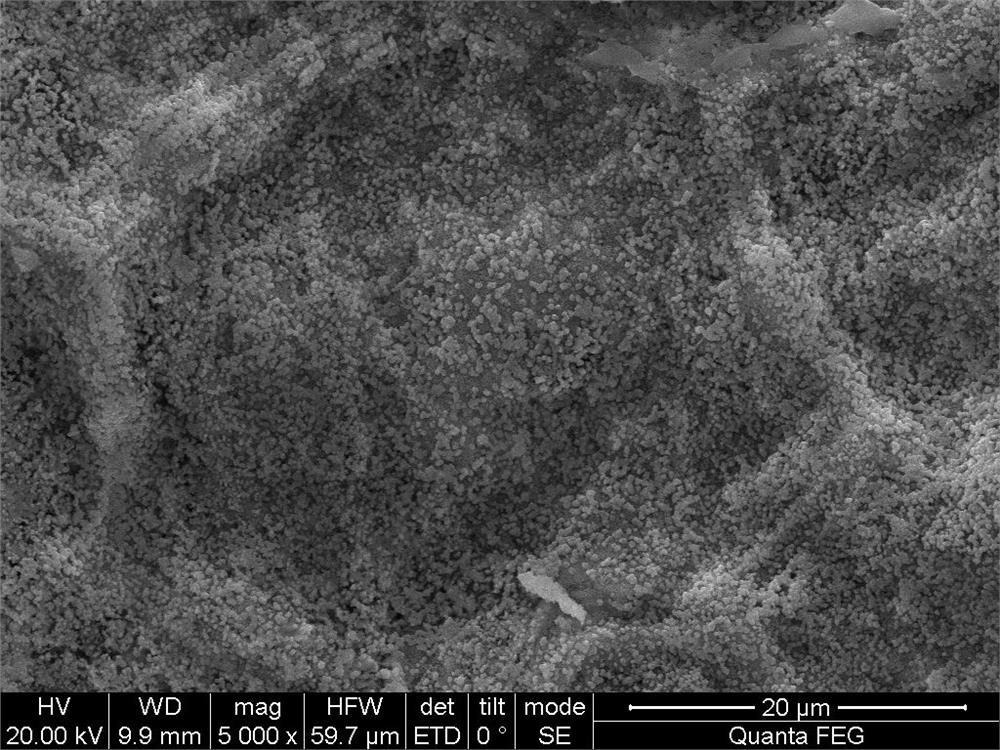
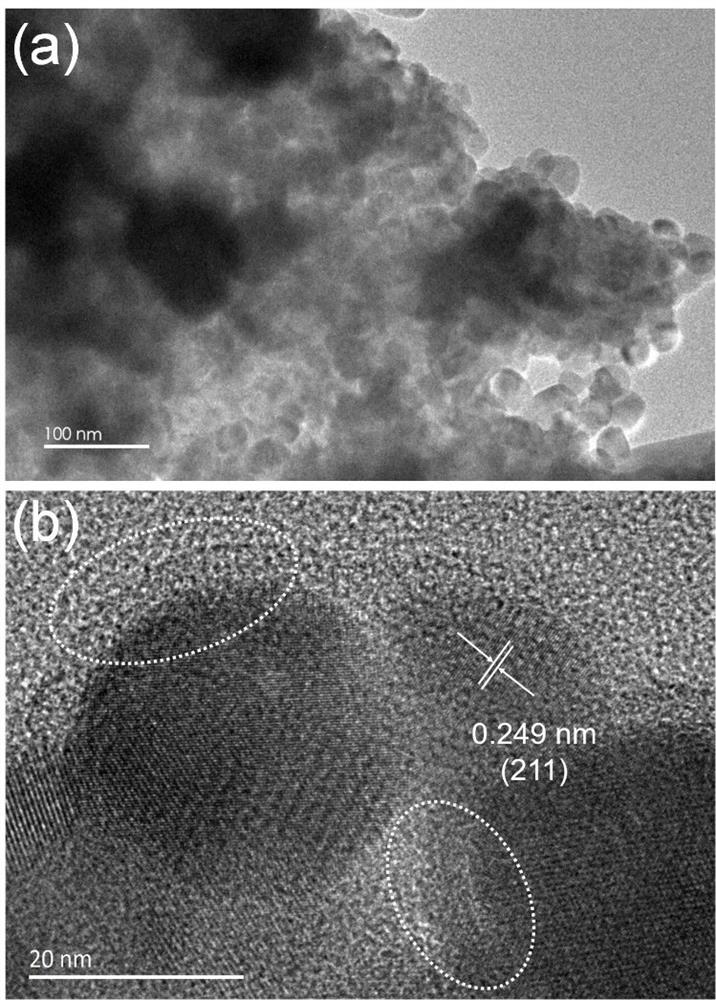
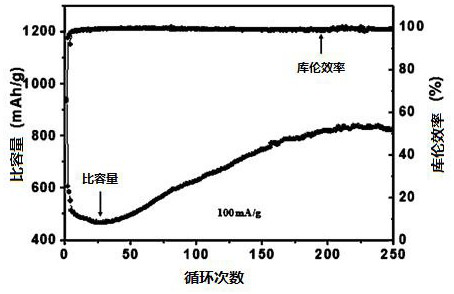
Examples
Embodiment 1
[0033] A kind of nano Mn 3 o 4 The synthetic method of @C material comprises the following steps:
[0034] (1) Wash the cabbage leaves with distilled water and soak them in EtOH solution (EtOH:H 2 O=1:1), and use hydrochloric acid to adjust the pH=2~4, pretreatment for two weeks to remove the organic matter and pigment in the cabbage leaves.
[0035] (2) Take out the pretreated cabbage leaves, wash them with distilled water and dry them, then soak them in 50% Mn(NO 3 ) 2The solution prepared with a concentration of 0.05 mol / L Mn(NO 3 ) 2 72 h in aqueous solution.
[0036] (3) Take out the soaked leaves, wash them with distilled water, and dry them at room temperature.
[0037] (4) Calcining the dried leaves, first in N 2 The temperature was raised to 600 °C under the atmosphere, and the heating rate was 10 °C min -1 , keep warm for 2 h, take it out and then raise the temperature to 700 °C in the air atmosphere, the heating rate is 10 °C·min -1 , and finally get the n...
Embodiment 2
[0045] (1) Wash the cabbage leaves with distilled water and soak them in EtOH solution (EtOH:H 2 O=1:1), and use hydrochloric acid to adjust the pH=2~4, pretreatment for two weeks to remove the organic matter and pigment in the cabbage leaves.
[0046] (2) Take out the pretreated cabbage leaves, wash them with distilled water and dry them, then soak them in 50% Mn(NO 3 ) 2 The concentration of solution preparation is 0.10mol / L Mn(NO 3 ) 2 72 h in aqueous solution.
[0047] (3) Take out the soaked leaves, wash them with distilled water, and dry them at room temperature.
[0048] (4) Calcining the dried leaves, first in N 2 The temperature was raised to 600 °C under the atmosphere, and the heating rate was 10 °C min -1 , keep warm for 2 h, take it out and then raise the temperature to 700 °C in the air atmosphere, the heating rate is 10 °C·min -1 , and finally get the nanometer Mn 3 o 4 @C material.
Embodiment 3
[0050] (1) Wash the cabbage leaves with distilled water and soak them in EtOH solution (EtOH:H 2 O=1:1), and use hydrochloric acid to adjust the pH=2~4, pretreatment for two weeks to remove the organic matter and pigment in the cabbage leaves.
[0051] (2) Take out the pretreated cabbage leaves, wash them with distilled water and dry them, then soak them in 50% Mn(NO 3 ) 2 The concentration of solution preparation is 0.15mol / L Mn(NO 3 ) 2 72 h in aqueous solution.
[0052] (3) Take out the soaked leaves, wash them with distilled water, and dry them at room temperature.
[0053] (4) Calcining the dried leaves, first in N 2 The temperature was raised to 600 °C under the atmosphere, and the heating rate was 10 °C min -1 , keep warm for 2 h, take it out and then raise the temperature to 700 °C in the air atmosphere, the heating rate is 10 °C·min -1 , and finally get the nanometer Mn 3 o 4 @C material.
PUM
| Property | Measurement | Unit |
|---|---|---|
| size | aaaaa | aaaaa |
| lattice spacing | aaaaa | aaaaa |
| current efficiency | aaaaa | aaaaa |
Abstract
Description
Claims
Application Information
 Login to View More