
Distributed joint resource allocation method for coordinating 5G ultra-dense network interference
An ultra-dense network and resource allocation technology, which is applied in the field of distributed joint resource allocation for coordinating 5G ultra-dense network interference, can solve problems such as congestion, lack of consideration of mutual independence of base stations, and large signaling overhead. The effect of saving energy consumption and reducing interference in ultra-dense networks
Inactive Publication Date: 2021-04-06
CHONGQING UNIV OF POSTS & TELECOMM
View PDF6 Cites 2 Cited by
- Summary
- Abstract
- Description
- Claims
- Application Information
AI Technical Summary
Problems solved by technology
[0004] However, the traditional centralized power control method does not take into account the mutual independence between base stations, and in an ultra-dense network, when the user traffic is heavy, centralized control may affect user experience due to congestion, and it will also bring high signaling overhead
In most of the existing studies, the base station and user locations are modeled as a Poisson point process (Poisson point process, PPP), based on the base station selection strategy that the user selects the nearest base station access, and does not consider the impact of noise, how to reduce the number of users When inter-cell interference, it does not take into account that due to the densification of the base station, the interference received by the user mainly comes from its second nearest base station, but considers how to reduce the interference to the user from all other base stations except the target base station
Method used
the structure of the environmentally friendly knitted fabric provided by the present invention; figure 2 Flow chart of the yarn wrapping machine for environmentally friendly knitted fabrics and storage devices; image 3 Is the parameter map of the yarn covering machine
View moreImage
Smart Image Click on the blue labels to locate them in the text.
Smart ImageViewing Examples

Examples
Experimental program
Comparison scheme
Effect test
Embodiment Construction
[0028]The embodiments of the present invention will be easily understood by those skilled in the
[0029]The drawings are intended to be illustrative only, rather than illustrative, not to be understood, in order to better illustrate embodiments of the invention, and other components of the present invention will be omitted. Enlarge or shrink does not represent the size of the actual product; some well-known structures and descriptions thereof may be understood in the draw...
the structure of the environmentally friendly knitted fabric provided by the present invention; figure 2 Flow chart of the yarn wrapping machine for environmentally friendly knitted fabrics and storage devices; image 3 Is the parameter map of the yarn covering machine
Login to View More PUM
 Login to View More
 Abstract
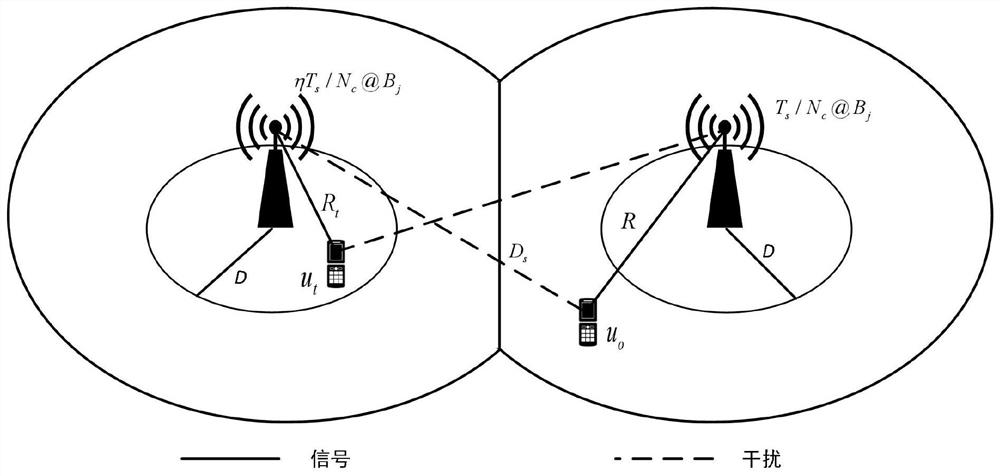
The invention relates to a distributed joint resource allocation method for coordinating 5G ultra-dense network interference, and belongs to the technical field of communication. The method comprises the following steps: dividing cell users based on distance; determining a channel allocation scheme according to the cell user division to reduce the interference received by the user; determining a power adjustment scheme according to the channel allocation scheme, minimizing the power consumption on the premise of ensuring the communication quality, and dividing the cell users according to the size relationship between the distance from the cell users to the target base station and the constrained predefined distance constant; based on the divided user types, reducing inter-cell same-frequency interference of the users in a combined manner, and reducing the energy consumption, so a reasonable distributed channel allocation and power adjustment scheme is realized.
Description
Technical field[0001]The present invention belongs to the field of communication technologies involving a distributed combined resource allocation method for coordinating 5G super-intensive network interference.Background technique[0002]In order to solve the growing growth of wireless network capacity, 5G users provide faster download speeds and better network quality experience, Ultra-Dense Network, UDN technology is a very promising technology. The basic idea of UND technology is to deploy a large number of low-emission power in a macro honeycomb cover to reduce the distance between the user and the base station to increase the capacity of the network, increasing the rate of the user access network.[0003]UDN technology improves the overall performance of the network, but the super-intensive deployment of the small base station reduces the coverage of the base station so that the neighboring cell overlaps, so that a large number of users in multiple cell overlapping coverage are ...
Claims
the structure of the environmentally friendly knitted fabric provided by the present invention; figure 2 Flow chart of the yarn wrapping machine for environmentally friendly knitted fabrics and storage devices; image 3 Is the parameter map of the yarn covering machine
Login to View More Application Information
Patent Timeline
 Login to View More
 Patent Type & AuthorityApplications(China)
IPC IPC(8): H04W52/24H04W72/04H04W72/08H04W72/54
CPCH04W52/243H04W72/53H04W72/541
Inventor刘乔寿邹建纹王汝言吉福生吴大鹏谷颖辰
OwnerCHONGQING UNIV OF POSTS & TELECOMM