

Handover procedures in radio communication system
A telecommunication system and handover technology, which is applied in wireless communication, multiplexing communication, code division multiplexing system, etc., can solve the problem of unbearable execution delay, etc., and achieve the effect of high handover processing speed
- Summary
- Abstract
- Description
- Claims
- Application Information
AI Technical Summary
Problems solved by technology
Method used
Image

Examples
Embodiment Construction
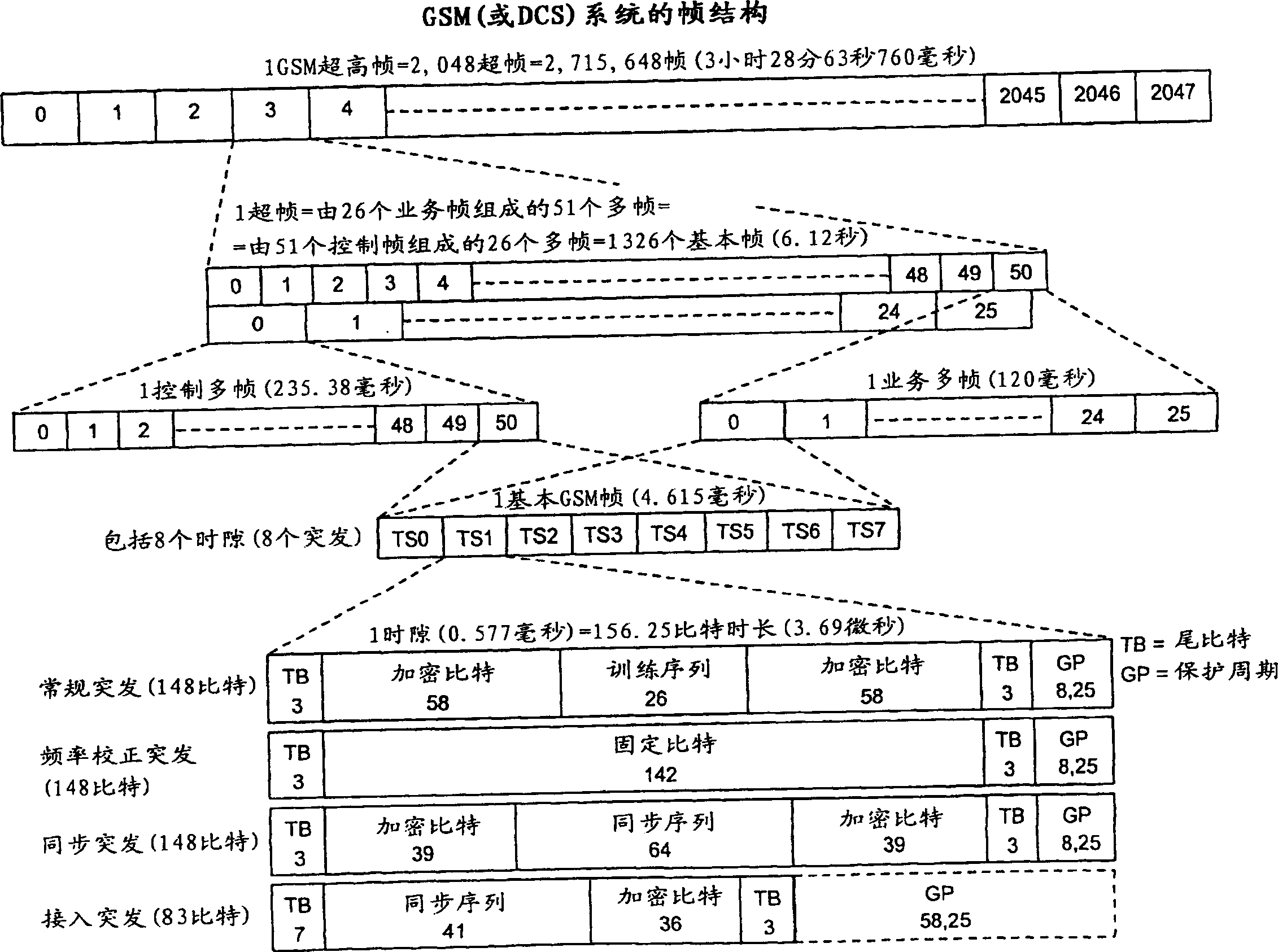
[0169] Figure 9 (Explained in previous figures) shows the sequential structure of seven time intervals or time slots and three other special time slots (to be described later) within a 3G basic frame, which is used for those used for cells One of the general carriers (which are much smaller in number than those used in GSM due to the wide band) repeats indefinitely. Figure 9 The basic frame consists of m time slots UL#0, ..., UL#m (uplink) from mobile unit MS and from BTSC ( figure 2 ) of n time slots DL#n, ..., DL#0 (downlink), the TDD type full duplex is implemented in the 3G system. The physical channel of the Uu interface is formed by a set including the carrier and its used time slot and spreading code, which is used to support channel characteristic information from a logical point of view. Sequential frames are organized in multiple levels observed across all carriers used in the 3G system. The carriers transmitted by the BTSs transmit mutually synchronized frames...
PUM
 Login to View More
 Abstract
Description
Claims
Application Information
 Login to View More