

Communication device and non-transitory computer-readable storage medium storing program for controlling the communication device
a communication device and computer-readable storage technology, applied in the direction of resistance/reactance/impedence, measurement devices, instruments, etc., can solve the problem that the capacitance type of the touch sensor may be erroneously activated or operated, and achieve the effect of reducing the detection area of the sensor
- Summary
- Abstract
- Description
- Claims
- Application Information
AI Technical Summary
Benefits of technology
Problems solved by technology
Method used
Image



Examples
first embodiment
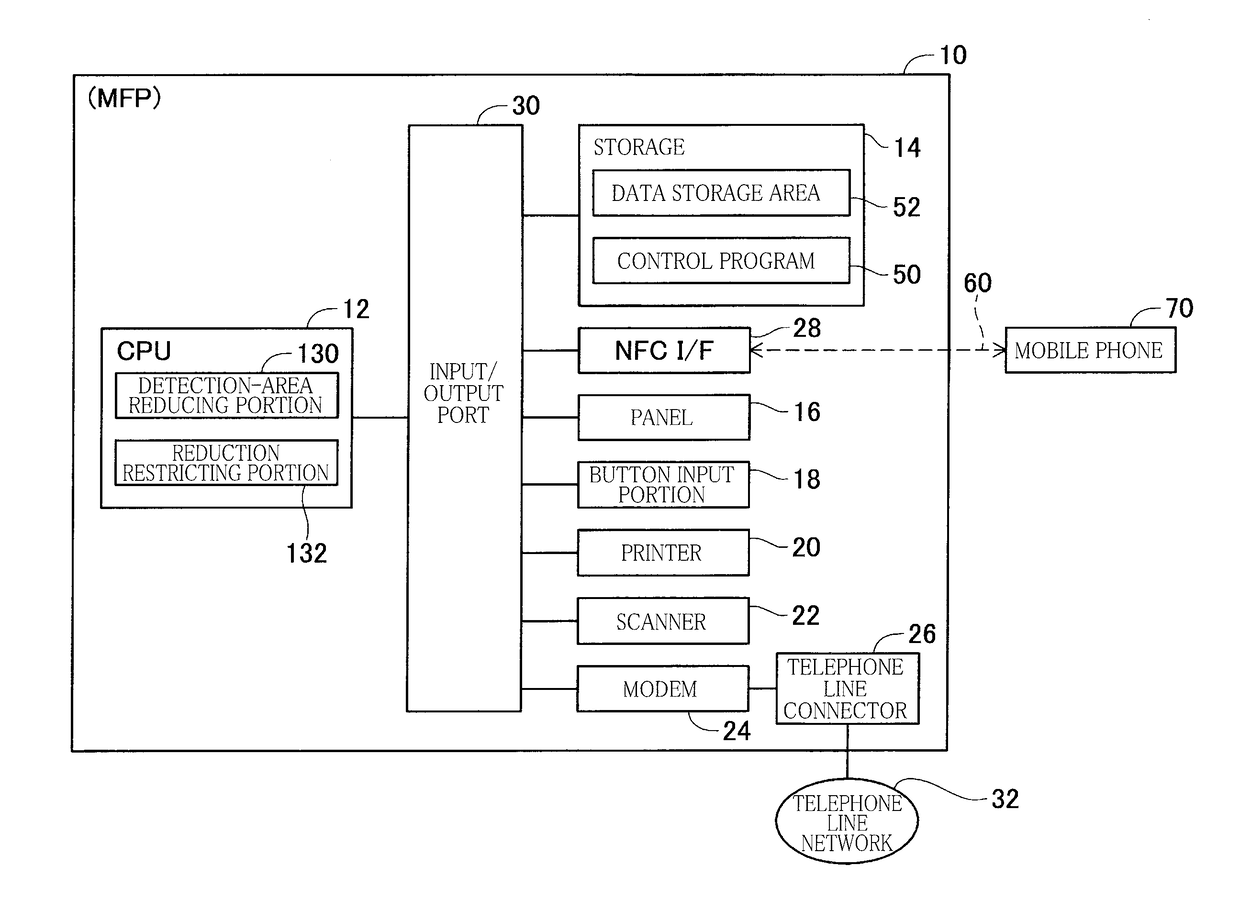
[0033]FIG. 1 is a block diagram of a Multifunction Peripheral (MFP) (as one example of a communication device in the present invention) 10 according to one embodiment of the present invention. The MFP 10 mainly includes a Central Processing Unit (CPU) (as one example of a controller and one example of a computer) 12, a storage 14, a panel 16, a button input portion 18, a printer 20, a scanner 22, a modem 24, a telephone line connector 26, an NFC (Near Field Communication) I / F (as one example of a near field communicator) 28. These components are communicably coupled to one another via an input / output port 30.
[0034]The panel 16 has a display surface on which various functions of the MFP 10 are to be displayed. The button input portion 18 includes touch sensors and is configured to detect an approach or a touch of an input tool (that will be described) to or on the button input portion 18 and to accept a button operation by a user. The input tool may be referred to as an input object....
second embodiment
[0079]There will be next explained an operation of the MFP 1 according to a second embodiment of the present invention. The MFP 10 of the second embodiment is identical in construction with the MFP 10 in the first embodiment, and a detailed explanation of the construction of the MFP 10 of the second embodiment is dispensed with.
[0080]In the MFP 10 of the first embodiment, the sensor detection areas are changed back to original areas when the operation keys 120, 122 are successively operated in a situation in which the sensor detection areas are reduced. In the MFP 10 of the second embodiment, the sensor detection areas remain reduced even the operation keys 120, 122 are successively operated in the situation in which the sensor detection areas are reduced. With reference to FIG. 14, there will be explained a flow for reducing the sensor detection areas in the MFP 10 according to the second embodiment. Because the flow of FIG. 14 is substantially the same as the flow of FIGS. 12 and ...
third embodiment
[0082]There will be next explained an operation of the MFP 10 according to a third embodiment of the present invention. The MFP 10 of the third embodiment is identical in construction with the MFP 10 in the first embodiment, and a detailed explanation of the construction of the MFP 10 of the third embodiment is dispensed with.
[0083]In the MFP 10 of the first embodiment, the sensor detection areas are reduced by decreasing the amplification coefficients. In the MFP 10 of the third embodiment, the sensor detection areas are reduced by increasing the threshold. More specifically, in the communication-unperformable state in which the NFC communication cannot be performed, a first threshold is set at 50, and a second threshold is set at 40, as shown in the table of FIG. 15. The first threshold is for detection of a touch or an approach of the input tool 100, and the second threshold is judging separation of the input tool 100 away from the touch sensors 88.
[0084]More specifically, when t...
PUM
 Login to View More
 Abstract
Description
Claims
Application Information
 Login to View More