Unlock instant, AI-driven research and patent intelligence for your innovation.

Solar tracker

a tracker and solar energy technology, applied in the direction of solar thermal energy generation, moving/orienting solar heat collectors, lighting and heating apparatus, etc., can solve the problems of increasing the land required for the plant, increasing the cost, and the array of photovoltaic modules cannot be moved to a safe position

Active Publication Date: 2020-04-14
HELIOSLITE
View PDF11 Cites 8 Cited by
  • Summary
  • Abstract
  • Description
  • Claims
  • Application Information

AI Technical Summary

Benefits of technology

This solution enhances energy production efficiency by minimizing self-shading losses, reducing land requirements, and lowering system complexity and costs, while maintaining accurate sun alignment with improved tracking accuracy and ground coverage ratio.

Problems solved by technology

However, the kinetic motion of these fixed-tilt trackers, rotating around an axis having an inclined angle, induces a significant increase of self-shading losses between the photovoltaic solar arrays of each tracker unit resulting in an increase of the land required for the plant.
In addition, for fixed-tilt trackers the arrays of photovoltaic modules cannot be moved to a safe position during wind storms with the arrays placed in a flat horizontal position.
An increase of the overall height of the arrays of photovoltaic modules directly translates into higher wind loads on the tracker structure and the foundations, thus increasing the cost.
It is also known dual-axis photovoltaic solar tracker systems which provide means for more accurately aligning the arrays of photovoltaic modules to the sun but at the expense of a significant increase in system complexity.
This increase in complexity translates into higher costs, and the increase in cost is typically too high to compensate the small gain obtained in energy production.
An exemplary design described in the patent application PCT / IB2014 / 000114 addresses many of the limitations of prior-art dual axis trackers, but the kinetic of these “tilt and roll” trackers does not address the general problem of poor ground coverage ratio of dual-axis tracking systems.
Moreover, the higher energy gain provided by dual-axis trackers can only be realized with solar plants with a field layout using a low ground coverage ratio.
The use of a low ground coverage ratio indirectly translates into further cost increase as more land area is required to install the solar power plant and longer electrical cables are necessary to interconnect the tracker units in the field.

Method used

the structure of the environmentally friendly knitted fabric provided by the present invention; figure 2 Flow chart of the yarn wrapping machine for environmentally friendly knitted fabrics and storage devices; image 3 Is the parameter map of the yarn covering machine
View more

Image

Smart Image Click on the blue labels to locate them in the text.
Viewing Examples
Smart Image
  • Solar tracker
  • Solar tracker
  • Solar tracker

Examples

Experimental program
Comparison scheme
Effect test

Embodiment Construction

[0057]The invention essentially provides a tracking photovoltaic solar system comprising at least a one tracker unit relying on a “Rocking” and “Rolling” kinetic to maintain an array of photovoltaic modules aligned to the sun during the course of the day. This specific and original new tracker unit is sometimes referred to here after as “a one and a half axis” tracker unit.

[0058]In order to simplify the description of the invention, the tracking system of the invention is systematically described assuming that the system is installed at a site located in the Northern hemisphere, however this tracking system may also be installed on sites located in the Southern hemisphere after performing a rotation of 180 degrees.

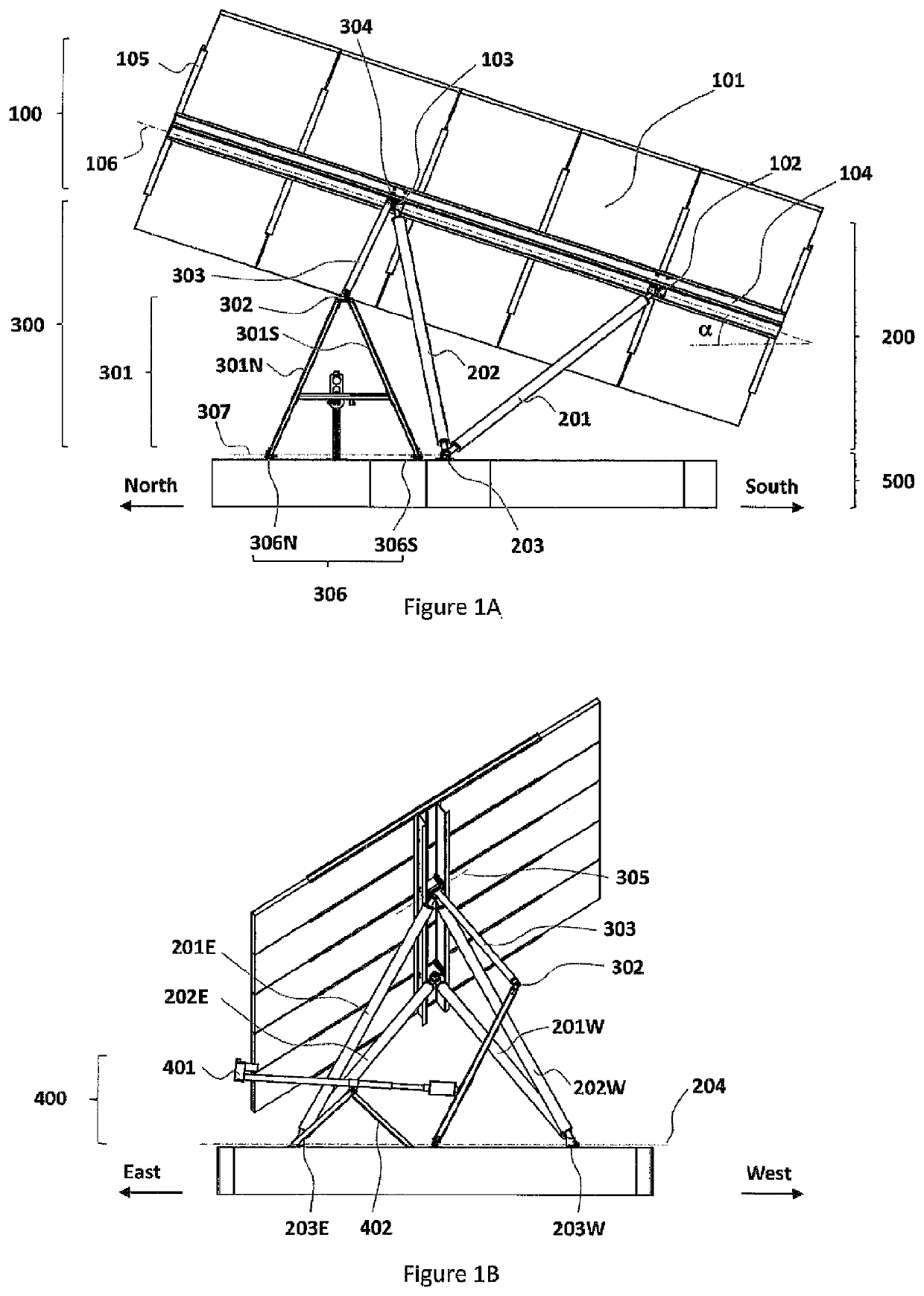
[0059]FIGS. 1A and 1B illustrate diagrams of an embodiment of a 1.5-axis photovoltaic solar tracker unit of the invention.

[0060]The tracker unit includes a module support structure 100 comprising an array of module support elements 105 supporting an array of photovoltaic m...

the structure of the environmentally friendly knitted fabric provided by the present invention; figure 2 Flow chart of the yarn wrapping machine for environmentally friendly knitted fabrics and storage devices; image 3 Is the parameter map of the yarn covering machine
Login to View More

PUM

No PUM Login to View More

Abstract

The present invention relates to a tracking photovoltaic solar system comprising at least a tracker unit maintaining an array of photovoltaic modules (101) aligned to the sun during the course of the day. The tracker unit includes: a support structure (100), said support structure comprising a plurality of elongated elements (105) supporting said array of photovoltaic modules and a torque tube (104) for rigidly supporting said plurality of elongated elements and arranged to rotate along a first rotational axis (106), a pole structure (200) operably connected to said support structure, having an upper part rotationally fixed along said first rotational axis (106) on said support structure, and a lower part rotationally connected along a second rotational axis (204) orthogonal to the first rotational axis on foundations (500), and a steering mechanism (300) mechanically coupling together said first and said second rotational axis for rotating said support structure and said operably connected pole structure around said first and second rotational axis in the same movement.

Description

FIELD OF THE INVENTION[0001]This invention is in the general field of solar power generation.[0002]More specifically, one particularly important, although nonexclusive, application of the invention is in the field of photovoltaic solar tracker systems capable of tracking the sun during the course of the day to maximize the energy output of photovoltaic modules.PRIOR ART DISCUSSION[0003]The most basic photovoltaic solar tracker systems are single axis trackers.[0004]These systems provide means for rotating an array of photovoltaic solar modules around a fixed axis providing a way for roughly orienting the modules toward the sun.[0005]The fixed rotation axis of these single axis trackers may be vertical, horizontal or at an inclined angle.[0006]One exemplary design of single axis tracker rotating an array of photovoltaic solar around an axis at an inclined angle is described in U.S. Pat. No. 7,888,588. In this fixed-tilt single axis tracker design, multiple tracker units rotate in uni...

Claims

the structure of the environmentally friendly knitted fabric provided by the present invention; figure 2 Flow chart of the yarn wrapping machine for environmentally friendly knitted fabrics and storage devices; image 3 Is the parameter map of the yarn covering machine
Login to View More

Application Information

Patent Timeline
no application Login to View More
Patent Type & Authority Patents(United States)
IPC IPC(8): F24S30/458F24S30/48F24S30/45F24S30/00
CPCF24S30/48F24S30/45F24S30/458F24S2030/136Y02E10/47F24S2030/131F24S2030/137
Inventor MENARD, ETIENNE
Owner HELIOSLITE