Check patentability & draft patents in minutes with Patsnap Eureka AI!

Enzymatic digestion of microalgal biomass for lipid, sugar, and protein recovery

a technology of applied in the field of enzyme-based digestion of microalgal biomass for lipid, sugar and protein recovery, can solve the problems of unmet needs, many challenges, and more effective and cost-effective methods, and achieve the effects of reducing the cost of operation, increasing the accessibility of enzymes, and simple equipmen

Active Publication Date: 2020-08-25
UNIVERSITY OF TOLEDO
View PDF5 Cites 0 Cited by
  • Summary
  • Abstract
  • Description
  • Claims
  • Application Information

AI Technical Summary

Benefits of technology

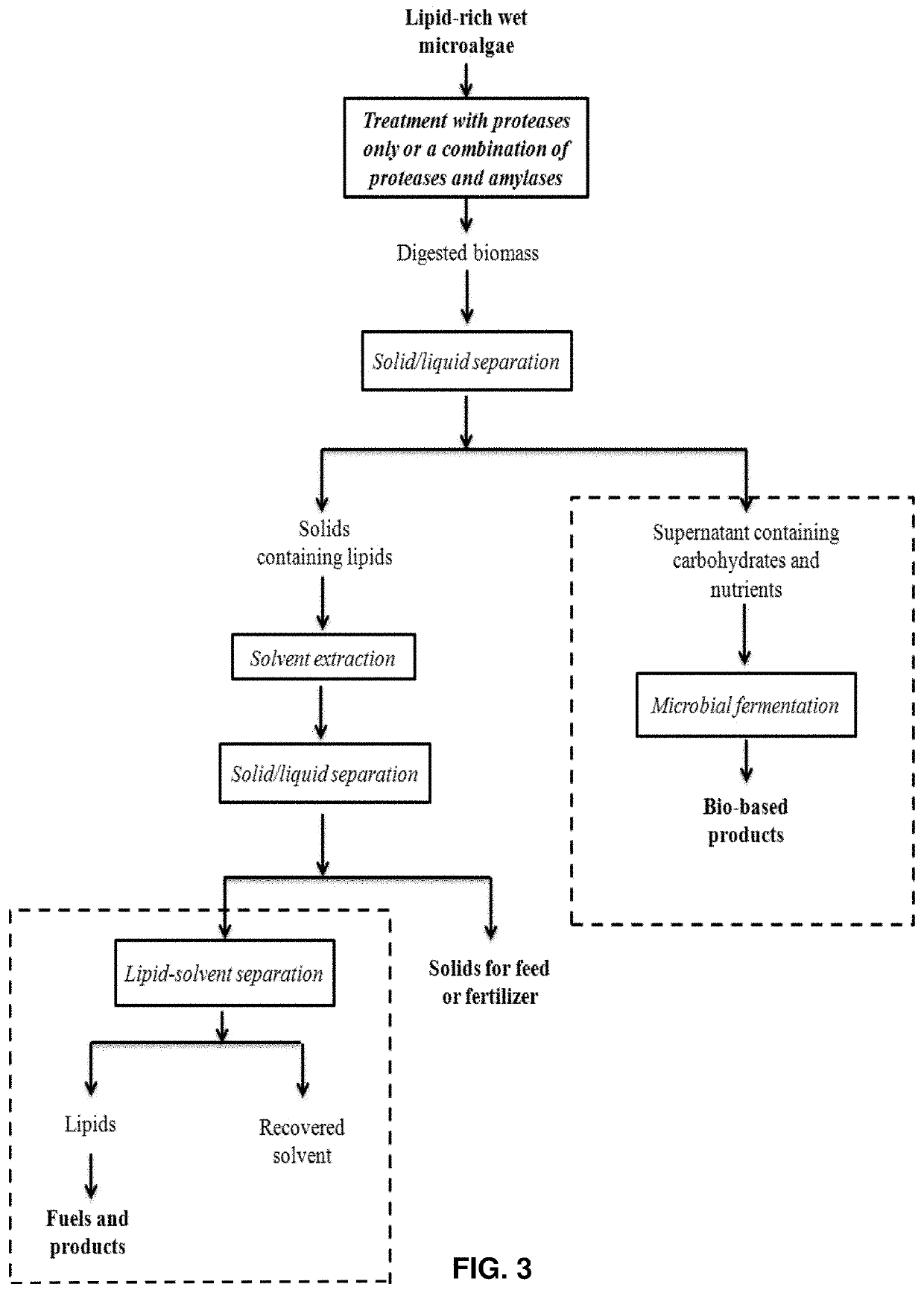
[0011]Further provided is a method of enzymatic hydrolysis involving a single step in which the release of lipids and breakdown of polysaccharides into simple fermentable sugars occurs simultaneously. The method utilizes an enzyme mixture comprising proteases, amylases, or a combination thereof. In certain embodiments, the method requires no pretreatment (thermal or mechanical) prior to enzymatic hydrolysis, and can be conducted at low temperatures using relatively simple equipment.
[0015]Further provided is a method of conducting succinic acid fermentation, the method comprising simultaneously disrupting the cell wall, releasing carbohydrates, and hydrolyzing the released carbohydrates into monomer sugars, all while using a mixture of enzymes from lipid-free microalgae. In certain embodiments, the method does not require any pretreatment prior to enzymatic hydrolysis and can be conducted at low temperatures using relatively simple equipment. This significantly reduces the cost of operation. In some embodiments, over 99% of the monomer sugar can be released under optimized conditions.
[0016]In certain embodiments, hydrothermal treatment is used to increase the accessibility of the enzymes to the binding sites on the polysaccharides, which significantly improves the enzyme activity and reduces the enzyme loading.

Problems solved by technology

For bio-based succinic acid production, looking for the inexpensive feedstocks and optimization of the pretreatment process are important challenges in reducing the cost of the succinic acid production.
However, there remain many challenges and an unmet need in the art for more effective and cost-efficient methods of enzyme hydrolysis.

Method used

the structure of the environmentally friendly knitted fabric provided by the present invention; figure 2 Flow chart of the yarn wrapping machine for environmentally friendly knitted fabrics and storage devices; image 3 Is the parameter map of the yarn covering machine
View more

Image

Smart Image Click on the blue labels to locate them in the text.
Viewing Examples
Smart Image
  • Enzymatic digestion of microalgal biomass for lipid, sugar, and protein recovery
  • Enzymatic digestion of microalgal biomass for lipid, sugar, and protein recovery
  • Enzymatic digestion of microalgal biomass for lipid, sugar, and protein recovery

Examples

Experimental program
Comparison scheme
Effect test

example 1

of Lipids and Monomeric Sugars from Wet Algal Biomass Using Enzymatic Treatment Methods

[0069]Two strains of algae were used in these experiments: a) Chlorella sp. SLA-04, and b) Schizochitrium limacium SR21, obtained from ATCC (MYA 1381).

[0070]Biomass digestions were performed at a solid concentration of 10% (w / v) in 50 mM citrate buffer adjusted to a pH of 4.5. Protease alone or a mixture of protease with α-amylase and amyloglucosidase (all purchased from Sigma) were added to the biomass slurries. Enzyme loadings (per g-biomass) used were as follows—(a) protease 312 U / g; (b) α-amylase 1875 U / g; and (c) glucoamylase 18.75 U / g. 1 α-amylase unit is defined as the amount of enzyme that liberates 1 μmol maltose per minute at pH 6.0 and 25° C.; 1 glucoamylase unit is defined as the amount of enzyme which cleaves 1 μmol of maltose per min at pH 4.3 and 25° C.; and 1 protease unit is defined as the amount of enzyme which hydrolyzes 1 μmol of L-leucine-p-nitroanilide per min.

[0071]The algae...

example 2

overy from Microalgal Biomass by Enzymatic Digestion

[0077]Enzymatic hydrolysis experiments were conducted using protease, α-amylase, and glucoamylase, and their combinations. A mixed culture of lipid-lean algal biomass (lipid content<5% (w / w)) was obtained from a commercial wastewater treatment facility. The biomass had a carbohydrate content of 24.5% (w / w). The digestion experiments were performed at a solids' loading of 16% (w / v) at a pH of 4.5. The amount of each enzyme was fixed as follows: 2.5 kU protease, 5 kU of α-amylase, and 150 U of glucoamylase. Enzymatic hydrolysis reactions were performed in sealed serum vials agitated at 200 rpm for 2 h at 55° C. Samples were collected at the end of the incubation period and analyzed by HPLC using a Shodex SH1011 ion exchange column with refractive index (RI) detector.

[0078]The results (FIG. 11) show that treatments with protease alone resulted in the release of a significant amount of monomeric sugars. Without wishing to be bound by t...

example 3

overy from Microalgal Biomass by Hydrothermal Pretreatment Followed by Enzymatic Digestion

[0081]Hydrothermal pretreatment was used in combination with enzymatic digestion to evaluate the potential for lowering enzyme requirements for sugar recovery. For the hydrothermal treatment, algal slurries (16% w / w) were loaded into sealed serum bottles and autoclaved at 120° C. for 30 minutes. After cooling to room temperature, the pretreated slurries were digested at 55° C. for 6 h using a mixture of α-amylase and glucoamylase (pH=4.5). A series of digestions were performed with α-amylase loadings between 0.5 and 15 kU while maintaining a glucoamylase loading of 150 U. Monomeric sugar release was measured at the end of the experiments. As seen from FIG. 15, the pretreatment improved enzymatic digestibility relative to controls which were not thermally pretreated. As a result, up to 90% sugar recovery was able to be achieved at α-amylase loadings as low as 5 kU.

the structure of the environmentally friendly knitted fabric provided by the present invention; figure 2 Flow chart of the yarn wrapping machine for environmentally friendly knitted fabrics and storage devices; image 3 Is the parameter map of the yarn covering machine
Login to View More

PUM

PropertyMeasurementUnit
pHaaaaaaaaaa
pHaaaaaaaaaa
temperaturesaaaaaaaaaa
Login to View More

Abstract

Methods for the recovery of lipids, sugars, and proteins from microbial biomass by enzymatic digestion are disclosed. The methods involve treating microalgae with a fungal acid protease, or with a mixture of at least one protease and at least one amylase.

Description

RELATED APPLICATIONS[0001]This application claims the benefit of the PCT / US2014 / 053421 filed Aug. 29, 2014, which claims priority to U.S. Provisional Application Ser. No. 61 / 871,997 filed under 35 U.S.C. § 111(b) on Aug. 30, 2013, and U.S. Provisional Application Ser. No. 61 / 877,497 filed under 35 U.S.C. § 111(b) on Sep. 13, 2013, the entire disclosures of which are incorporated herein by reference for all purposes.STATEMENT REGARDING FEDERALLY SPONSORED RESEARCH[0002]This invention was made with government support under Grant number CHE1230609 awarded by National Science Foundation and Grant number DE-EE0005993 awarded by the United States Department of Energy. The government has certain rights in this invention.BACKGROUND OF THE INVENTION[0003]Rising petrochemical prices and interest in reducing CO2 emissions have prompted the development of bio-based chemical production. As one example, succinate is an important platform chemical for the production of various high value-added der...

Claims

the structure of the environmentally friendly knitted fabric provided by the present invention; figure 2 Flow chart of the yarn wrapping machine for environmentally friendly knitted fabrics and storage devices; image 3 Is the parameter map of the yarn covering machine
Login to View More

Application Information

Patent Timeline
no application Login to View More
Patent Type & Authority Patents(United States)
IPC IPC(8): C12P7/46C12P19/02C12P7/64C12P19/14C12P21/06
CPCC12P21/06C12P19/14C12P7/6463C12P7/46C12P19/02C12Y304/21014C12Y302/01001C12P2203/00
Inventor VADLAMANI, AGASTESWAR K.RELUE, PATRICIAVIAMAJALA, SRIDHARSHAO, HENGVARANASI, SASIDHAR
Owner UNIVERSITY OF TOLEDO
Features
  • R&D
  • Intellectual Property
  • Life Sciences
  • Materials
  • Tech Scout
Why Patsnap Eureka
  • Unparalleled Data Quality
  • Higher Quality Content
  • 60% Fewer Hallucinations
Social media
Patsnap Eureka Blog
Learn More