[0014]In a non-limiting embodiment, the controller may be further configured to execute the transient slip control in such a manner that the torque transmitting capacity of the first clutch is increased with respect to an ideal torque transmitting capacity of the first clutch given that the first clutch is engaged partially in an ideal condition in which the speed of the engine will not be changed.
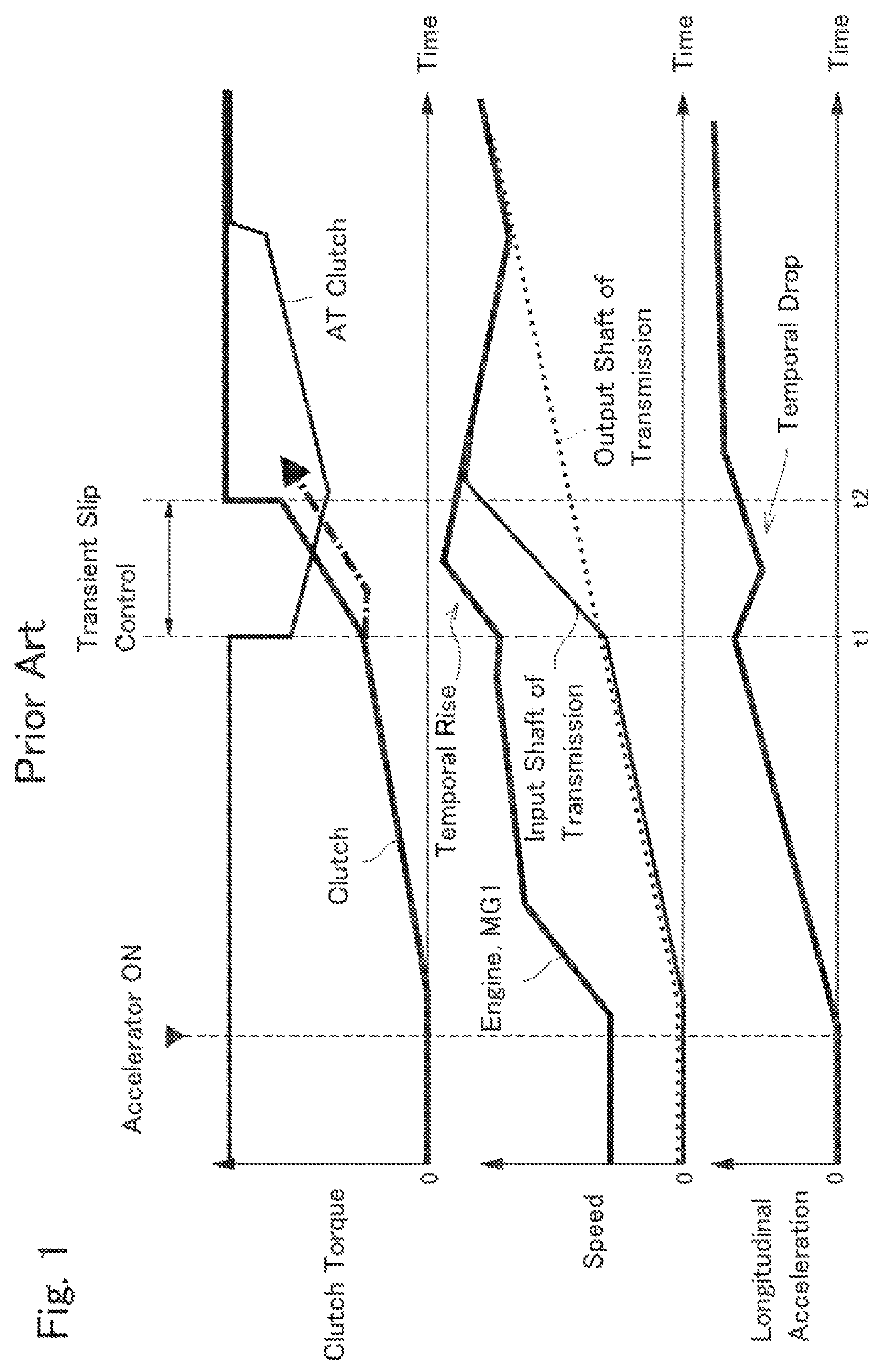
[0016]Thus, according to the exemplary embodiment of the present disclosure, the transient slip control is executed to prevent an overheating of the first clutch engaged partially to launch the hybrid vehicle, when the temperature of the first clutch reaches the predetermined level. In this situation, if the speed of the engine is changed undesirably as a result of executing the transient slip control, the speed of the engine is corrected by controlling the correction torque of the first motor by a feedback method. For example, in the case that the speed of the engine is raised temporarily as indicated in FIG. 1, such rise in the speed of the engine is suppressed by generating a negative correction torque by the first motor. By contrast, in the case that the speed of the engine is reduced temporarily as indicated in FIG. 1, such reduction in the speed of the engine is suppressed by generating a positive correction torque by the first motor. According to the exemplary embodiment of the present disclosure, the thermal damage to the first clutch may be limited when launching the hybrid vehicle, and the hybrid vehicle may be launched smoothly without generating shocks.
[0017]During execution of the transient slip control, drive force to propel the hybrid vehicle and acceleration of the hybrid vehicle may be changed as a result of correcting the speed of the engine by the correction torque of the first motor during execution of the transient slip control of the clutches. In order to suppress such change in the drive force and the acceleration, according to the exemplary embodiment of the present disclosure, the second motor generates the counter torque against the correction torque of the first motor. According to the exemplary embodiment of the present disclosure, therefore, overheating of the first clutch may be prevented when launching the hybrid vehicle, and the hybrid vehicle is allowed to launch smoothly without shock. In other words, the first clutch can be protected while improving driving comfort when launching the hybrid vehicle.
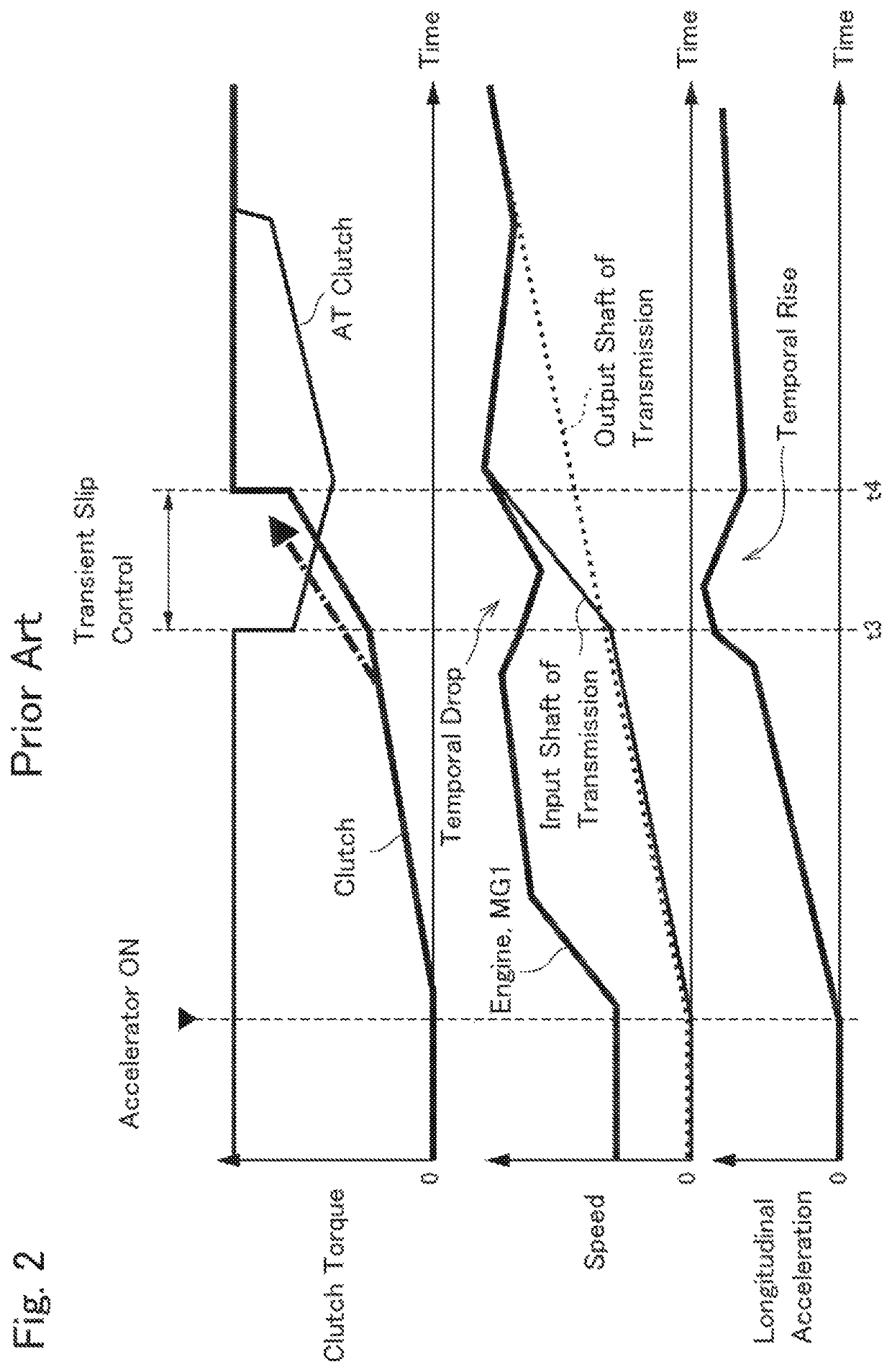
[0018]The second motor is mainly used under high load to launch and accelerate the hybrid vehicle by generating the positive torque, therefore, the positive torque of the second motor may be restricted when reaches an upper limit. However, the second motor is allowed to generate the negative torque without restriction to counteract to the positive correction torque of the first motor. Therefore, the controller executes the transient slip control in such a manner that the torque transmitting capacity of the first clutch is increased with respect to the ideal torque transmitting capacity. In this case, as indicated in FIG. 2, the speed of the engine is reduced from the target speed during execution of the transient slip control. Consequently, the second motor is allowed to generate the counter torque in the negative direction to counter act to the positive correction torque generated by the first motor. In this case, therefore, change in the drive force to propel the hybrid vehicle and change in the acceleration of the hybrid vehicle resulting from correcting the speed of the engine by the first motor may be suppressed certainly by generating the negative torque by the second motor without restriction. For this reason, the thermal damage to the first clutch may be limited without shock.
[0019]In addition, after engaging the first clutch completely during execution of the friction start, the controller continues the friction start by causing the second clutch to slip. According to the exemplary embodiment of the present disclosure, therefore, the hybrid vehicle is allowed to be launched smoothly by the friction start without damaging the first clutch.


 Login to View More
  Login to View More