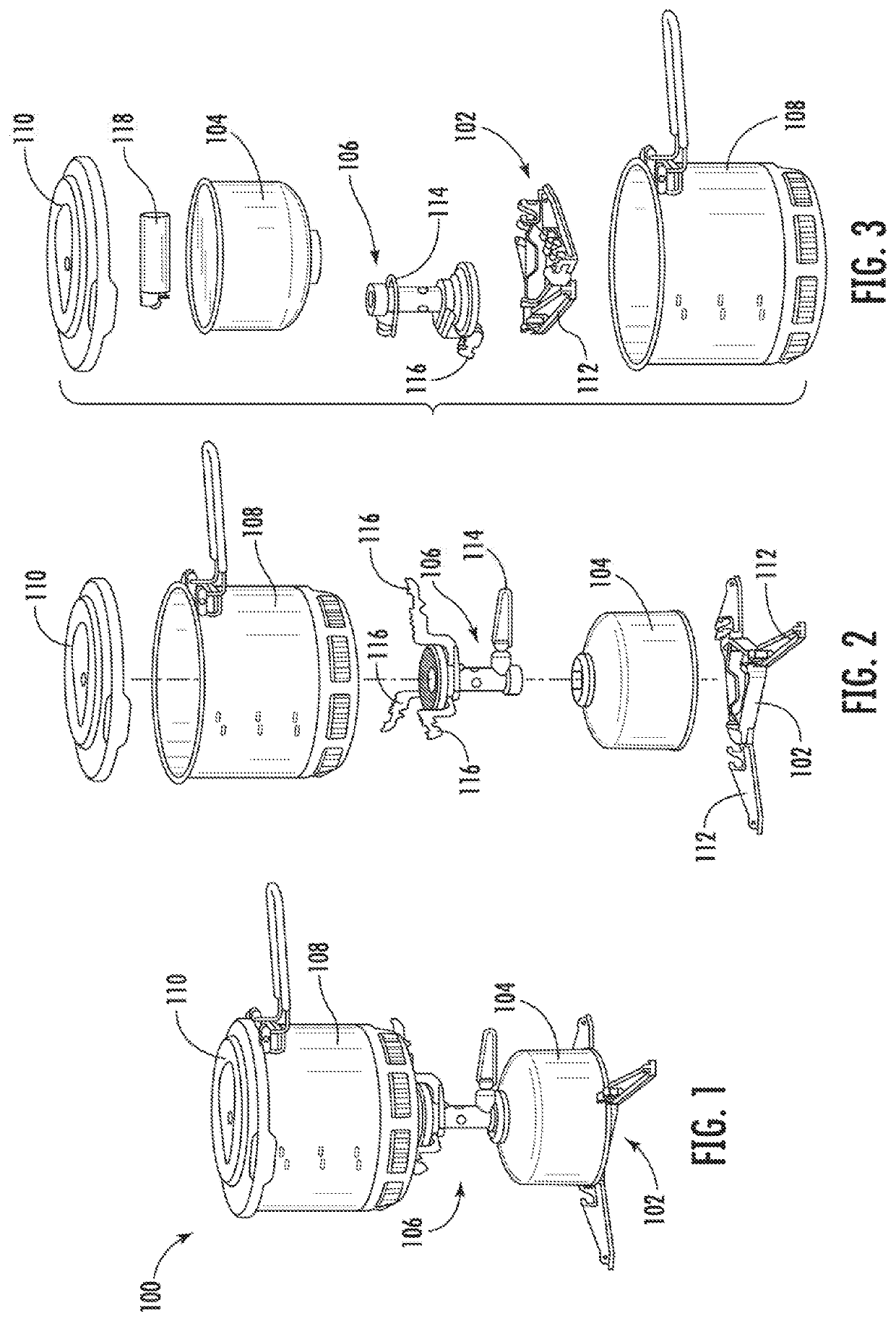
[0010]In one embodiment, the lid of the integrated canister cooking system holds the fuel canister, preferably in an off-center position within the cooking pot. This configuration reduces the potential for metal-to-metal contact between the fuel canister and the cooking pot, which reduces or eliminates rattling and possible staining, and in the preferred embodiment opens up an envelope that extends along the side wall of the pot beside the off-center-held canister of fuel. This envelope could not hold the burner base if the prior folding leg design were used due to the increase in exterior dimension discussed above when the legs are folded down for storage. However, in an embodiment of the present invention, this off-center containment of the fuel canister by the lid can accommodate the burner because it is reconfigured to be longer (taller) and nests its cooking vessel support legs to one side at the end. This resulting L-shaped configuration is then able to be housed as discussed.
[0011]In one embodiment, utilization of a longer burner base allows the use of aluminum instead of steel for its construction. With the taller configuration of the burner base of this embodiment, because it is farther from the flame, aluminum can be used even though it has a higher thermal conductivity than steel. This provides the added benefit of being lighter. So, while other integrated canister cooking systems in the field have similar parts, embodiments of the present invention can pack them all together in a smaller envelope that weighs less. One advantage leads to another, which leads to another in embodiments of the present invention.
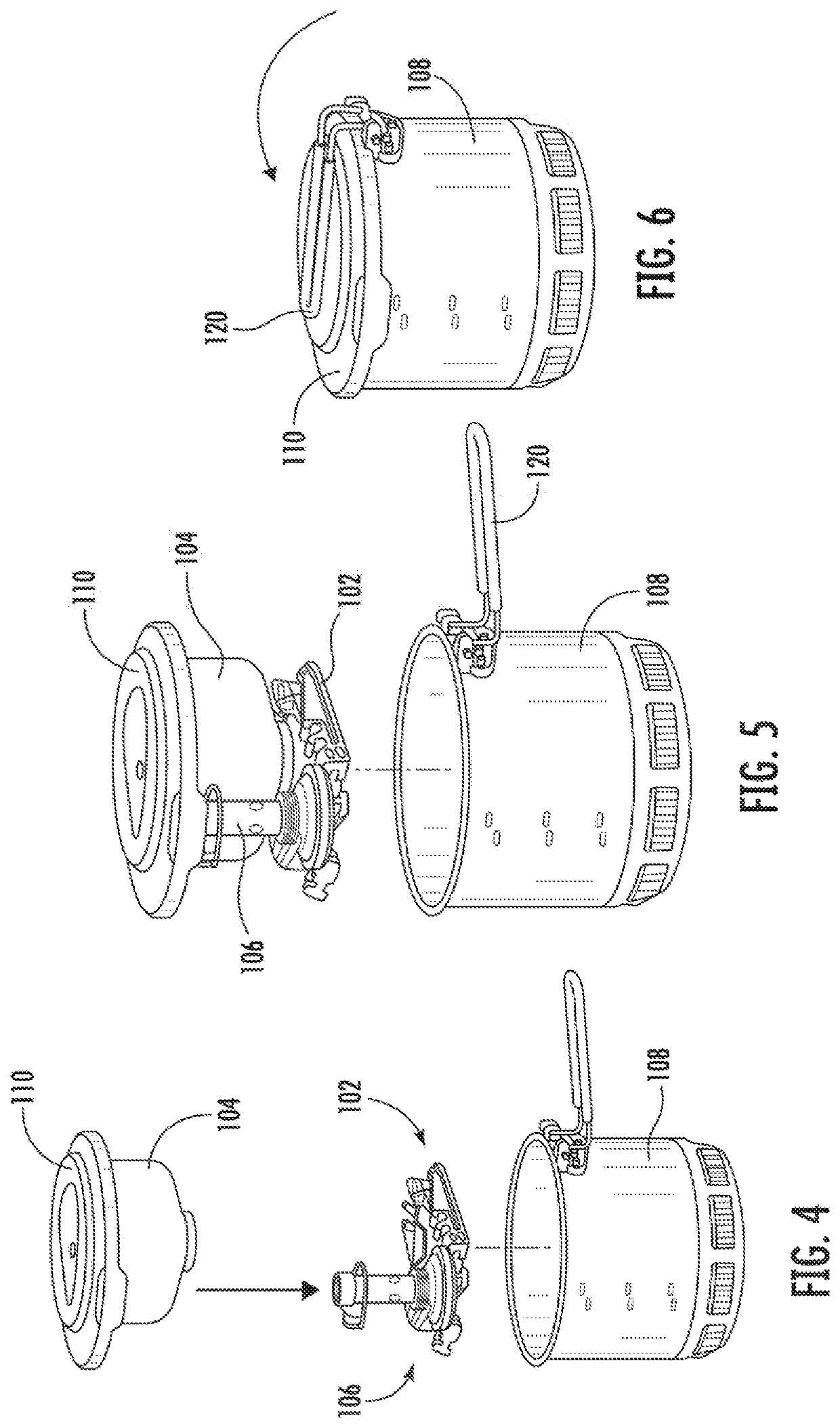
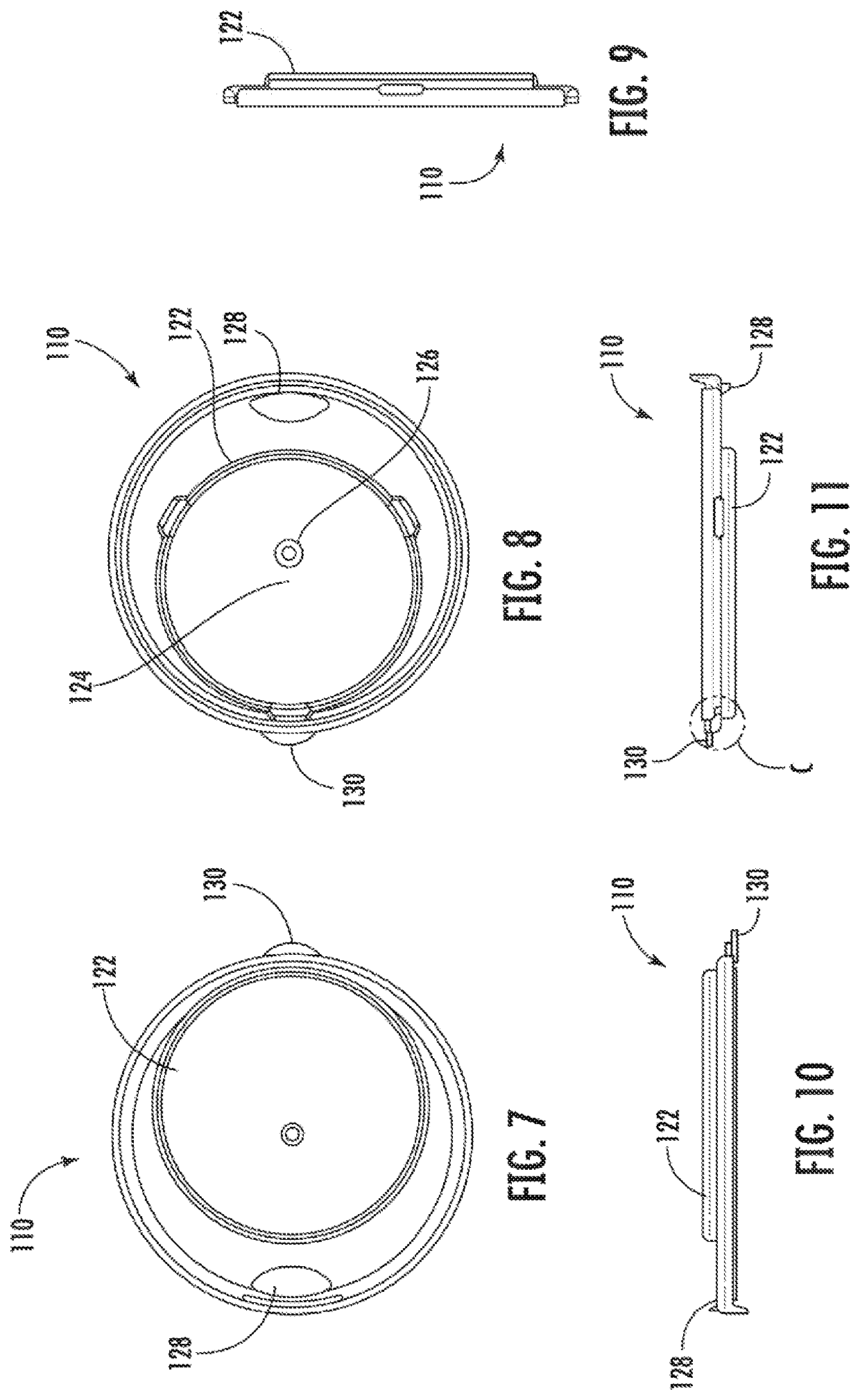
[0012]In embodiments of the present invention, the design features allow for extremely compact packing to provide maximum efficiency and space savings. The lid is designed to snap fit onto fuel canister. This assists the user in packing embodiments of the present invention by positioning the fuel canister within the pot so space of ideal size and shape remains for the burner base. The lid is also designed to hold fuel canister in the lid to eliminate the fuel canister from contacting the cookpot. This also allows space under the canister within the pot to store the fuel stabilizer, and in certain embodiments, the burner base.
[0013]Advantageously in embodiments of the present invention, the pot support legs of the burner are designed to rotate sideways about the axis of the burner for storage. A single large joint simplifies the design and minimizes part count. By folding to the side and adding a sideways bend in the legs, they fit the tall, curved space between the fuel can and cookpot wall when packed. The combination of the two design elements provide a unique packing methodology for a highly compact system.
[0014]The pot support leg design of certain embodiments is a hybrid between a universal cookware-compatible approach and a cookware / burner integrated connection. This provides a unique dual benefit, to wit, it maximizes performance (efficiency) by ensuring self-centered system cook pot as part of the integrated canister cooking system, and it also is compatible with flat bottom cookware without the use of accessories or adapters.
[0015]Embodiments of the present invention are lightweight and utilize a gram strategy. This gram strategy is applied to embodiments of the present invention and the resulting design and arrangement of parts is unique. Specifically, each part is scrutinized for non-essential material recognizing that small savings add up. In one embodiment the system utilizes a cast aluminum handle bracket. Commonly, this part is made of stamped stainless steel sheet metal. By casting it from aluminum a more complex shape with lighter weight and better hinging / locking function is achieved. This strategy also resulted in a reduced cook pot wall thickness to eliminate weight, and utilizes titanium on the burner head for additional weight savings. Further, the mix tube is made of lightweight aluminum instead of Stainless Steel in preferred embodiments as discussed above.


 Login to View More
  Login to View More