[0005] The present invention relates to a
consumer-friendly, ready-to-bake refrigerated or frozen dough that requires only a minimum amount of manipulation during use and which advantageously minimizes or eliminates dough pieces that need to be reshaped or recycled. Also, this dough is preformed easily into shapes to assist in the preparation and baking of the product.
[0026] The dough typically includes a
leavening agent. Any conventional leavening agent can be utilized depending upon the final product and its desired characteristics. One common leavening agent is
baking powder, and this is advantageous for preparing dough which flows when baked. This agent at least in part contributes to the ability of the dough pieces to flow into a round bakery product, such as a biscuit or roll, during baking.
[0064] Additional embodiments of the invention relate to a sheet of dough. After preparing the sheet in a desired size, such as 4".times.8" and 1 / 8" thick, the sheet is provided with non-intersecting score lines that define the final product to be baked. One embodiment, is illustrated in FIG. 7, where the dough sheet (20) is provided with score lines (21), (22), (23), to define four triangular dough pieces (24), (25), (26), (27), that can be broken off, folded or rolled into a final shape and then baked, or vice versa. Before rolling, a filling can be provided, if desired. According to yet another embodiment of the invention, the dough sheet has nested forms of different specific shapes or sizes. Thus, different shapes or sizes can be provided on the same sheet without having to recycle or reuse any part of the dough. For example, it is possible to have geometric shapes, like triangles, squares, rectangles, or any other shapes. Advantageously, these shapes are nested or otherwise interlaced to efficiently use as much of the sheet as possible. Preferably, the entire dough sheet is divided into the shapes without any waste.
[0065] This embodiment is illustrated in FIG. 8, wherein the dough sheet (30) includes a number of different shapes of figures, geometric forms, toy characters, etc., outlined by score lines. These shapes includes a letter (31), arrows (32), (33), a star (34), an oval (35), a half circle (36), a face (37), and other random shapes (38), (39), (40), (41), (42), (43), (44), (45), (46), (47). The shapes are separated, such as by
cutting or breaking them off from the sheet along the score lines to form the individual portions for baking. These portions are then placed on a pan and baked as described above, or the block is baked and then the portions separated. The dough can be formulated to retain its shape rather than to flow into a round shape during the baking process, thus retaining the shape of the figure in the final baked product. The nested configuration of the shapes conserves dough and avoids
wasting or resizing dough pieces, e.g., those that could be left over after using a shaped cutter on a dough sheet.
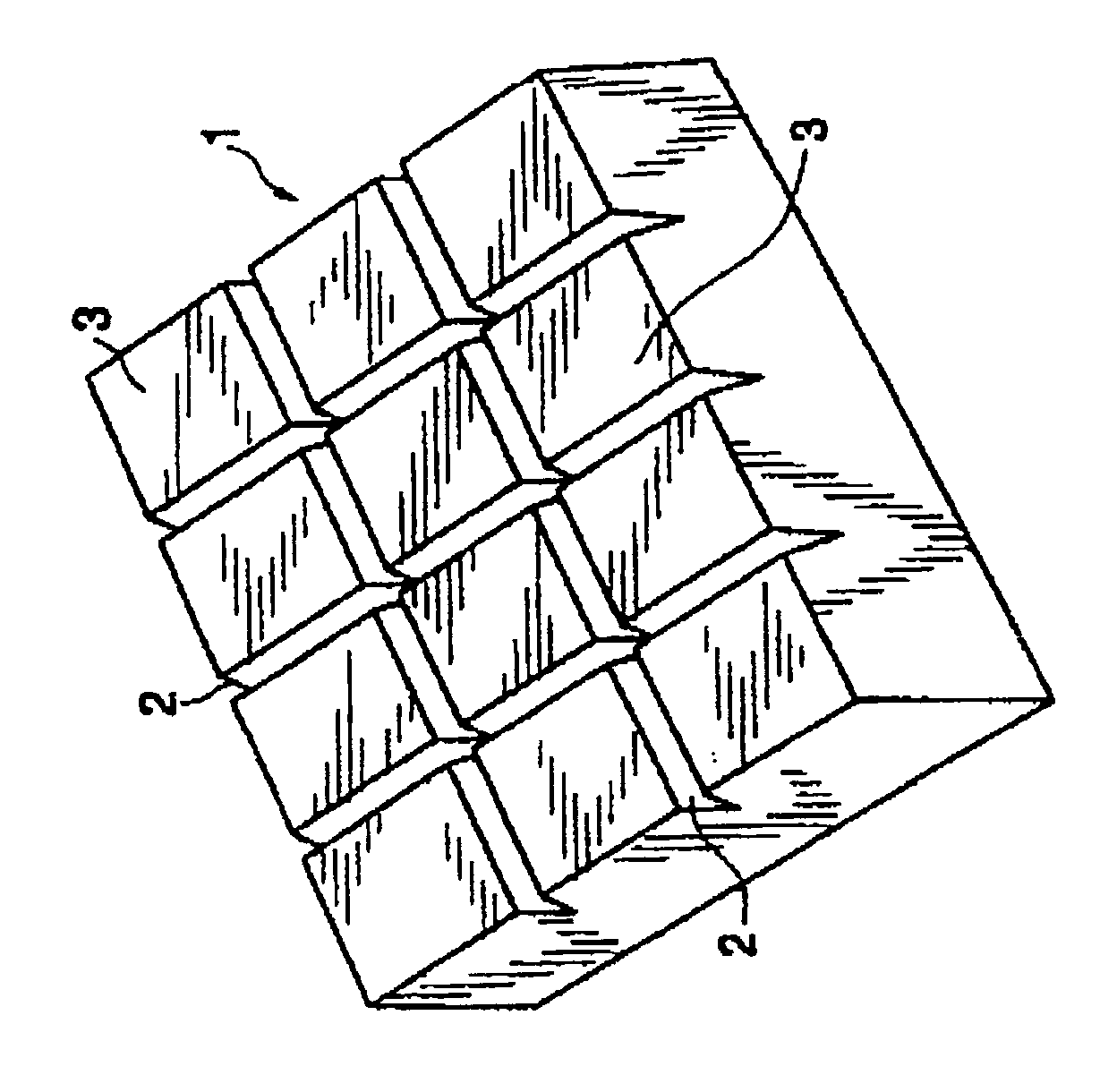
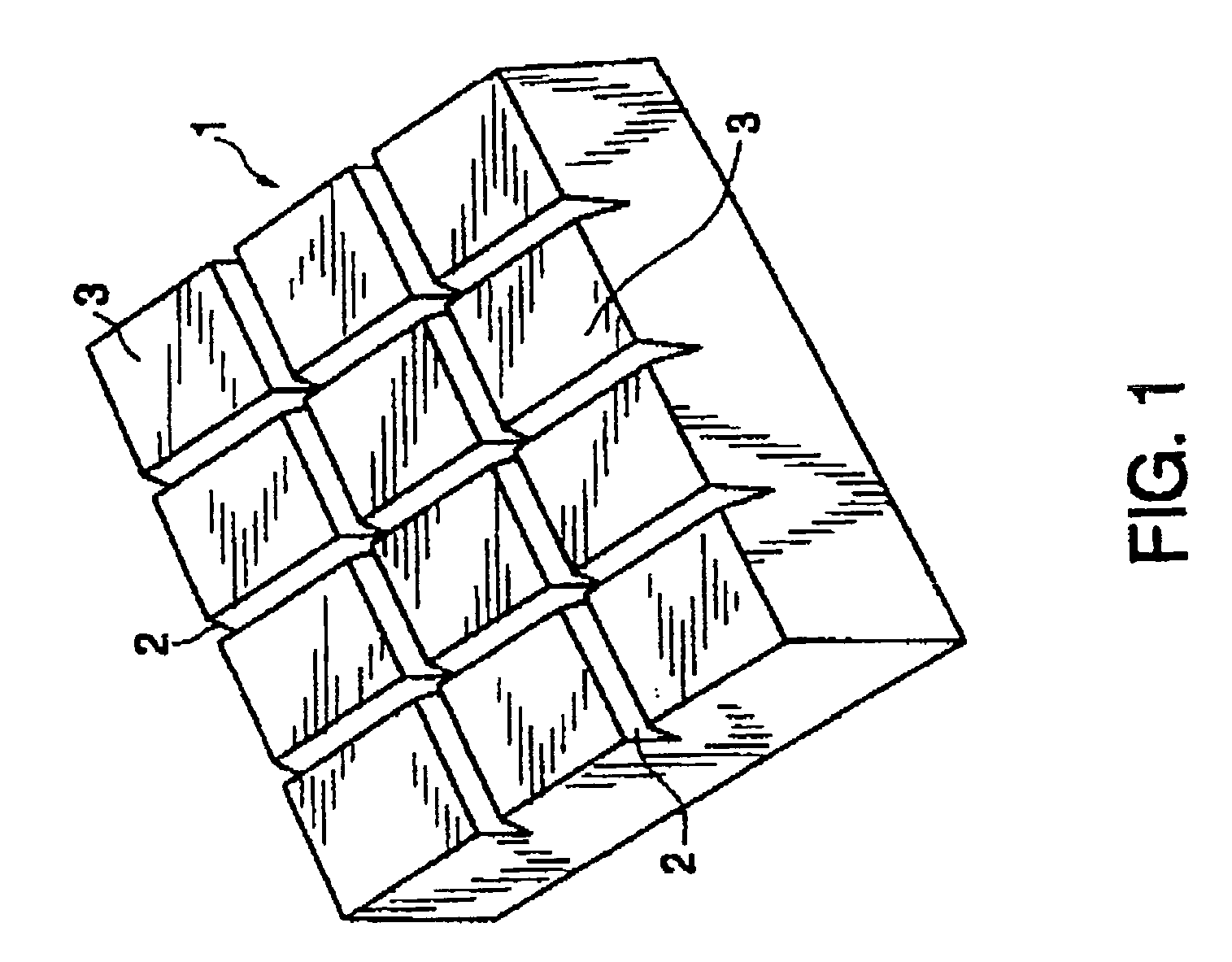
[0067] In an alternative of the invention, the grooved block is separated into a plurality of individually predetermined pieces, which are then individually positioned in individual forms, recesses or containers. These forms, recesses or containers are sized so as to leave sufficient room to enable each individual piece to rise and bake properly. This method is more directed to the preparation of small round bakery dough products, e.g., muffins or cupcakes. The pieces that are broken off or separated from a block of dough can be baked in separate pans or in pans having separate compartments (i.e., muffin or cupcake pan). The compartments assist in forming the desired final size, configuration and shape of the bakery product, while providing the dough in sheet form with score lines to define the individual pieces enables the user to quickly dispense the dough pieces into the pan compartments. Of course, in another embodiment, the dough can be baked first before the pieces are separated.
[0072] Also, dough sheets can be individually wrapped, or a plurality, typically between 2 and 4 sheets, can be stacked on paper or
cardboard sheets before being packaged. When thin dough sheets (i.e., less than about 3 mm) are used, they may be rolled into cylinders of about 75 mm in
diameter before being packaged in a round, square, rectangular or triangular container or box. This conserves space and allows for more convenient packaging and shipping of the products. For this embodiment, the
consumer simply removes the rolled sheets from the container, and flattens them before separating the pieces from the sheet. When rolled frozen dough sheets or blocks are provided, the dough is allowed to thaw before attempts are made to flatten it The dough can be packaged with instructions, such as to bake a bakery dough block first and then to separate the number of pieces desired. These instructions can take any suitable form, including a
label attached to the packaging; a
label or insert disposed inside the sealed
package with the dough, optionally separately packaged to minimize
moisture damage to the instructions; packaging with the instructions printed or otherwise applied directly thereon; or the like. The instructions can also include one or more of other relevant storage details, cooking information,
serving size, governmentally-required ingredient labeling, or the like, each of which will be readily determined by one of ordinary skill in the art understanding that these depend on the specific dough product to which the instructions are affixed.



 Login to View More
  Login to View More