Pacemaker passive measurement testing system and method

a technology of passive measurement and pacemaker, which is applied in the field of cardiac pacemakers and implantable cardioverterdefibrillators, can solve problems such as the potential to disturb the pacing function of the pacemaker

US20050102004A1Inactive Publication Date: 2005-05-12CARDIAC PACEMAKERS INC
35 Cites 6 Cited by

Patent Information

Authority / Receiving Office
US · United States
Patent Type
Applications(United States)
Current Assignee / Owner
Publication Date
2005-05-12
Estimated Expiration
Not applicable · inactive patent

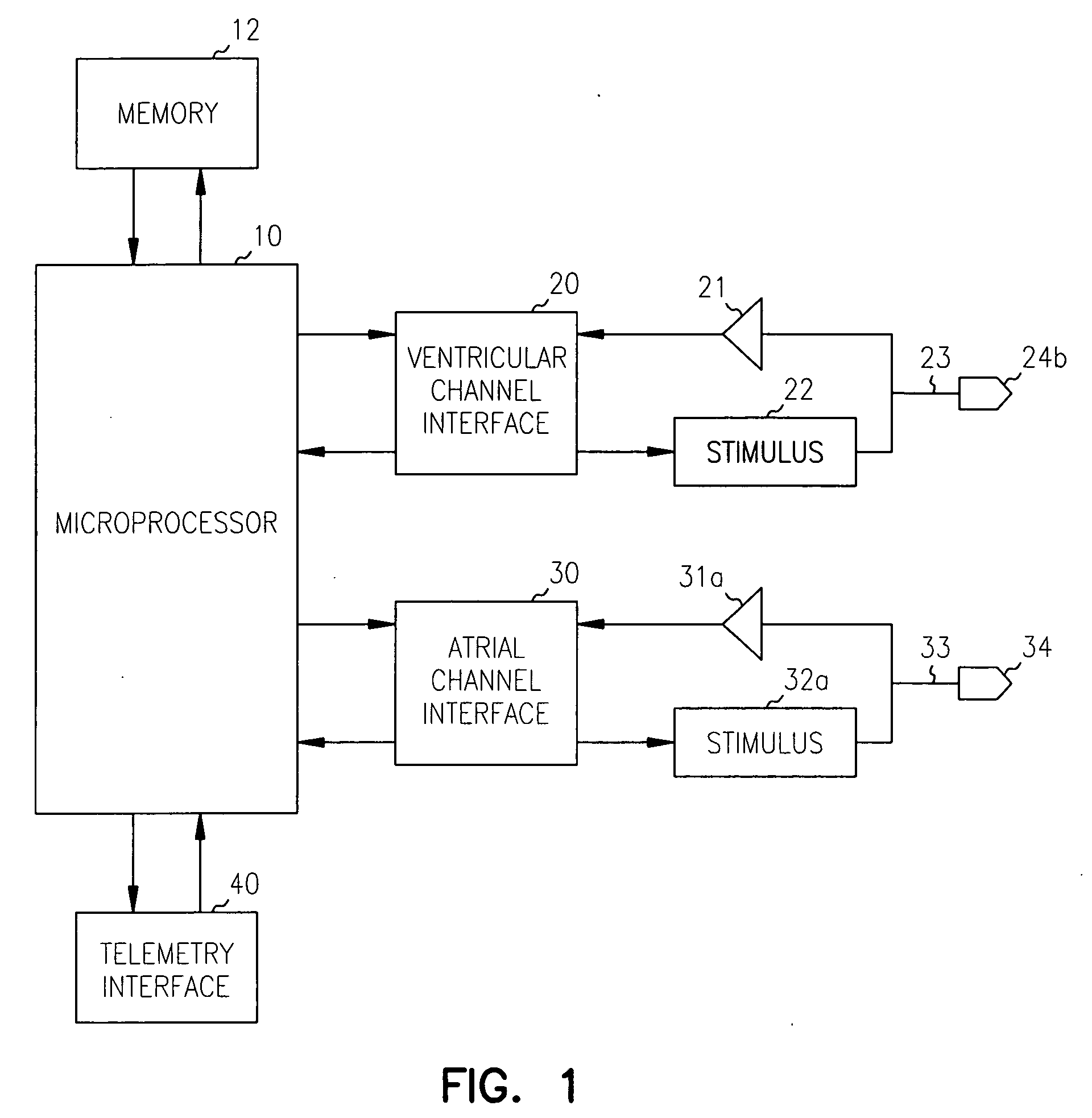
Smart Images

  • Figure 1
    Figure 1
  • Figure 2
    Figure 2
  • Figure 3
    Figure 3
Patent Text Reader

Abstract

A system and method for passively testing a cardiac pacemaker in which sensing signal amplitudes and lead impedance values are measured and stored while the pacemaker is functioning in its programmed mode. The amplitude and impedance data may be gotten and stored periodically at regular intervals to generate a historical record for diagnostic purposes. Sensing signal amplitudes may also be measured and stored from a sensing channel which is currently not programmed to be active as long as the pacemaker is physically configured to support the sensing channel. Such data can be useful in evaluating whether a switch in the pacemaker's operating mode is desirable.
Need to check novelty before this filing date? Find Prior Art

Description

CROSS-REFERENCE TO RELATED APPLICATIONS

[0001] This patent application is a continuation of U.S. patent application Ser. No. 10 / 118,601, filed Apr. 8, 2002, which is a continuation of U.S. patent application Ser. No. 09 / 378,315, filed on Aug. 20, 1999, now issued as U.S. Pat. No. 6,370,432, the specification of which is incorporated herein by reference.FIELD OF THE INVENTION

[0002] This invention pertains generally to the field of cardiac pacemakers and implantable cardioverter-defibrillators having a pacemaking function. In particular, the invention relates to a system and method for testing selected operating parameters in an implanted pacemaker. BACKGROUND

[0003] As pacemaker technology has developed, a number of standard operating modes have been developed which define how the device paces the heart. These modes are usually described by a three-letter code developed by the Inter-Society Commission for Heart Disease where each letter in the code refers to a specific function of t...

Examples

Embodiment Construction

[0014] The basic function of a modern pacemaker is to deliver pacing pulses to the heart in accordance with sensed cardiac signals. Programmability of the pacemaker allows it to operate in a number of different pacing modes. The electronic circuitry for controlling the pacemaker can be either in the form of custom integrated circuits or a microprocessor based design with application specific software. Because of its inherent flexibility and the ease with which additional functionality can be added, a microprocessor-based designs is the most widely used. In the description that follows, a microprocessor-based pacemaker will be referred to as incorporating the system and method which is the present invention. It should be appreciated, however, the invention could also be incorporated into a pacemaker controlled by custom logic circuitry either in addition to or instead of a programmed microprocessor. The term “circuitry” as used herein should therefore be taken to mean either custom c...