Unlock instant, AI-driven research and patent intelligence for your innovation.

Secure authenticated channel

Inactive Publication Date: 2006-05-04
MAGNOLIA LICENSING LLC
View PDF14 Cites 73 Cited by
  • Summary
  • Abstract
  • Description
  • Claims
  • Application Information

AI Technical Summary

Problems solved by technology

A problem with these protocols is that they are quite resource consuming and are as such difficult to implement in a device with limited computing capabilities, such as for example a portable security module, like a smart card.
Another problem is that the use of many cryptographic primitives makes it difficult to prove that a protocol is secure.

Method used

the structure of the environmentally friendly knitted fabric provided by the present invention; figure 2 Flow chart of the yarn wrapping machine for environmentally friendly knitted fabrics and storage devices; image 3 Is the parameter map of the yarn covering machine
View more

Image

Smart Image Click on the blue labels to locate them in the text.
Viewing Examples
Smart Image
  • Secure authenticated channel
  • Secure authenticated channel
  • Secure authenticated channel

Examples

Experimental program
Comparison scheme
Effect test

first embodiment

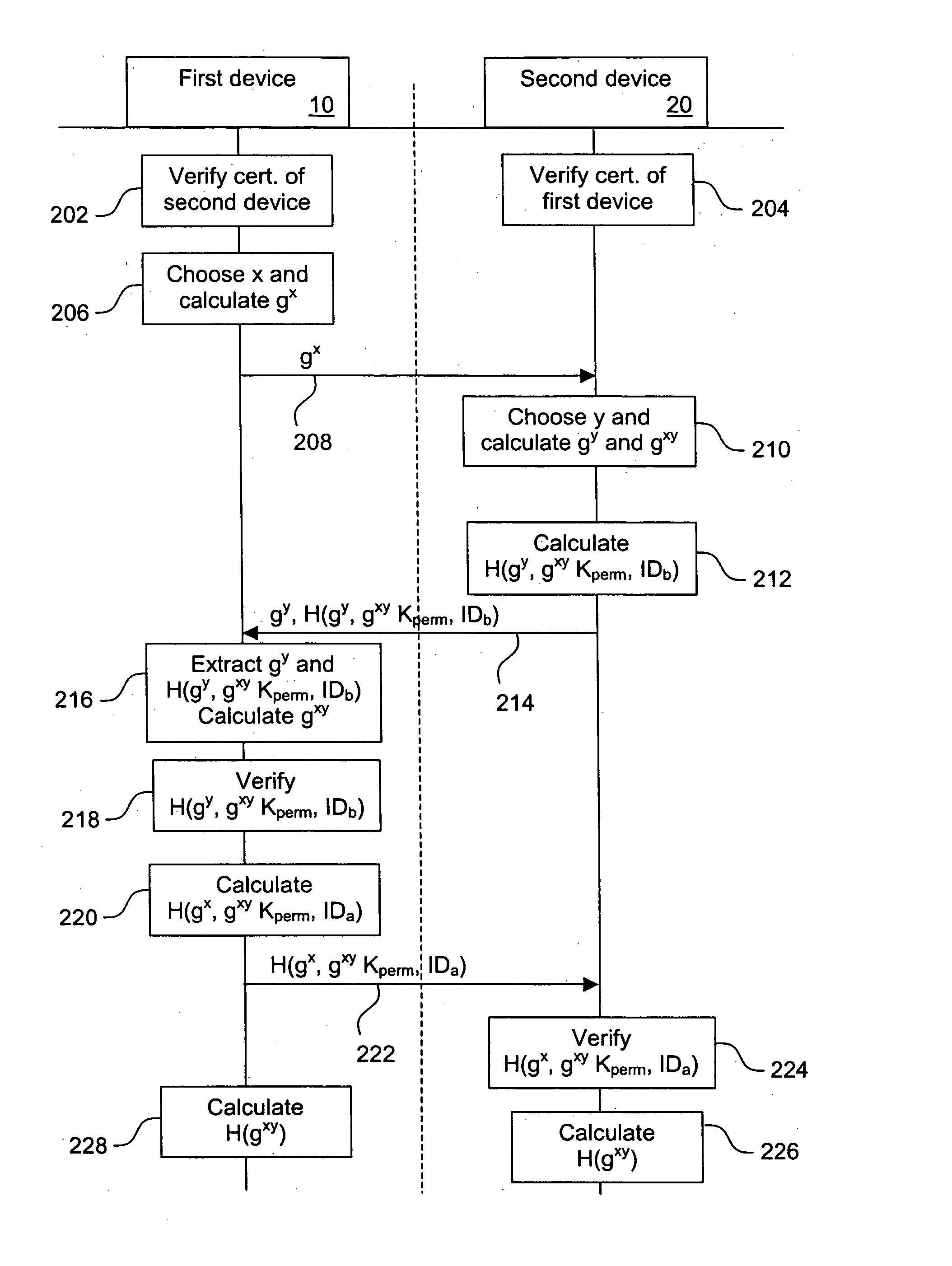
[0032]FIG. 2 illustrates the session key exchange according to the present invention, i.e. stage two of the secure access channel protocol. It should be noted that the second stage may be performed immediately upon termination of stage one (in which case certain steps, such as the verification of the validity of the certificates in steps 202 and 204 hereinafter) may be omitted, and that stage two preferably also is performed at intervals, regular or irregular, to refresh (i.e. change) the session key.

[0033] In steps 202 and 204 the first device 10 and the second device 20 independently verify that the two certificates 12, 22 have not been revoked, i.e. that they are still valid. It should be noted that is preferable that both devices verify both certificates. If a device detects that either its own certificate or the received certificate has been revoked, then it aborts the protocol and refuses to establish any session key. In practice, a device will normally verify a certificate on...

second embodiment

[0041]FIG. 3 illustrates the session key exchange according to the present invention.

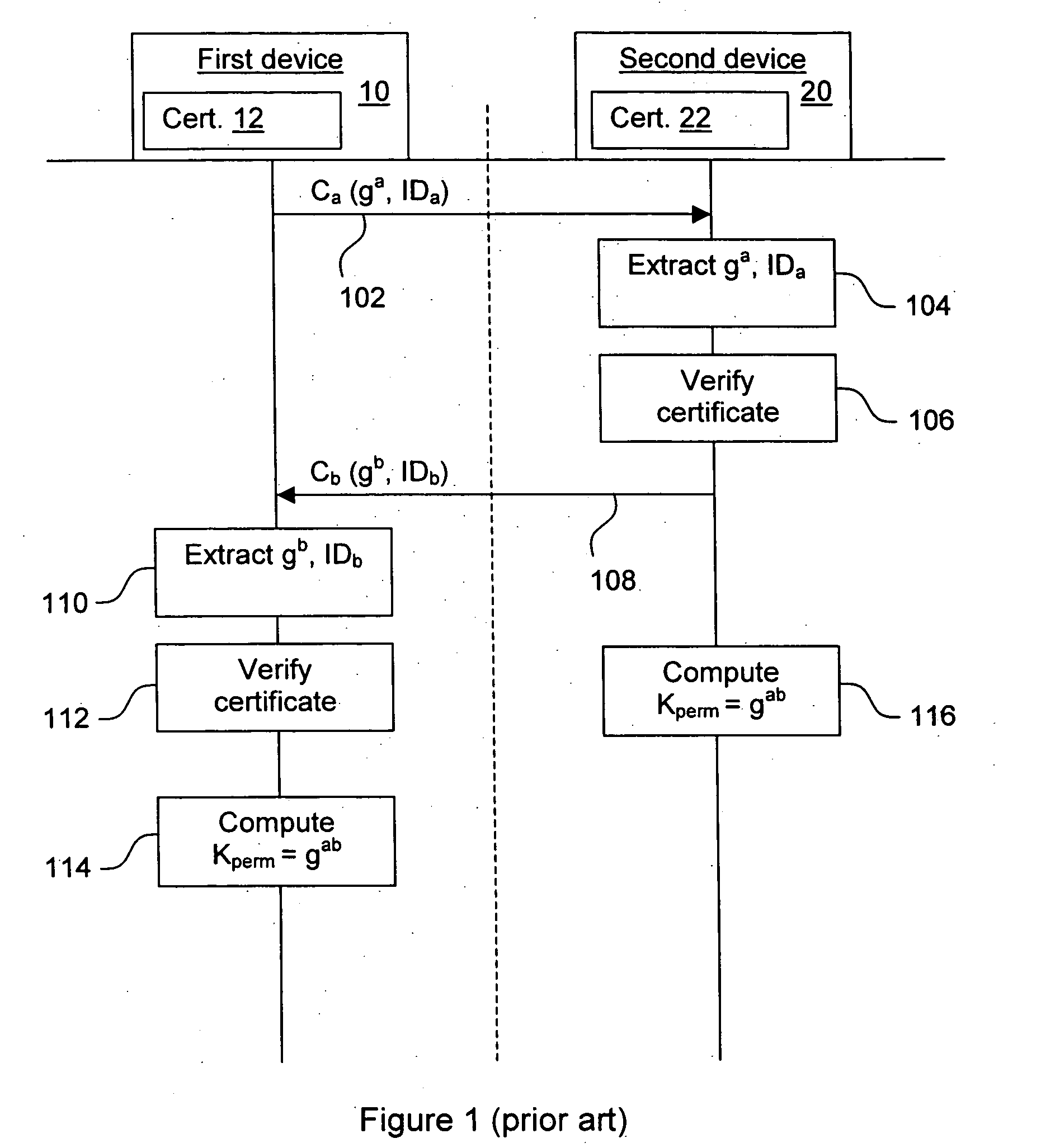
[0042] Before the start of the method, the first device 11 knows its identity IDa, its own private key a and public key ga. The second device 21 has the corresponding knowledge: IDb, b, gb Certificates for the devices comprise the public key and the identity; Ca(ga, IDa) and Cb(gb, IDb), respectively.

[0043] In step 252, the first device 11 chooses, preferably randomly, a first ephemeral private key x and calculates an ephemeral public key gx, that it sends together with its certificate Ca(ga, IDa) to the second device 21 in message 254.

[0044] Upon reception of message 254, the second device 21 verifies the certificate Ca(ga, IDa) of the first device 11; step 256. If the verification is unsuccessful, the second device 21 abandons the method. However, if the verification is successful, then it chooses, preferably randomly, a second ephemeral private key y, and calculates a second ephemeral public ke...

the structure of the environmentally friendly knitted fabric provided by the present invention; figure 2 Flow chart of the yarn wrapping machine for environmentally friendly knitted fabrics and storage devices; image 3 Is the parameter map of the yarn covering machine
Login to View More

PUM

No PUM Login to View More

Abstract

A protocol (i.e. method) and corresponding apparatuses for calculating a session key. Two peers with knowledge of a common Diffie-Hellman permanent key, Kperm, and the identity and public key of the other peer. A first peer chooses a first ephemeral private key x and calculates the first corresponding ephemeral public key gx, which is sent to the second peer. The second peer calculates a second ephemeral public key gy in the same manner, and an ephemeral shared key Keph, hashes gy, Keph, Kperm, and its identity, and sends gy and the hash to the first peer. The first peer calculates Keph, verifies the hash, and hashes gx, Keph, Kperm, and its identity, and sends it to the second peer that verifies this hash. Thereafter, both peers obtain a session key by hashing Keph. The apparatuses may then use the session key to establish a secure authenticated channel (SAC).

Description

TECHNICAL FIELD OF THE INVENTION [0001] The invention relates generally to secure authenticated channels, and in particular to calculation of session keys for establishment of such channels for protection of digital content, for example in a digital television system. BACKGROUND OF THE INVENTION [0002] Secure authenticated channels, well known in the art of cryptography, are established to allow two mutually authenticated devices (often called peers) to exchange information confidentially. A secure authenticated channel should preferably have the following characteristics: [0003] mutual authentication of the peers; [0004] key confirmation, i.e. a common secret is established and at least one peer is able to verify that the secret indeed is common; [0005] forward secrecy, i.e. old session keys cannot be calculated even when long-term secret keys (such as certificate secret keys) are known. [0006] These characteristics can be formally proven mathematically, and it has been proven that...

Claims

the structure of the environmentally friendly knitted fabric provided by the present invention; figure 2 Flow chart of the yarn wrapping machine for environmentally friendly knitted fabrics and storage devices; image 3 Is the parameter map of the yarn covering machine
Login to View More

Application Information

Patent Timeline
no application Login to View More
IPC IPC(8): H04L9/00
CPCH04L9/0844
Inventor DURAND, ALAINANDREAUX, JEAN-PIERRESIRVENT, THOMAS
Owner MAGNOLIA LICENSING LLC