Unlock instant, AI-driven research and patent intelligence for your innovation.

System and method for determining the cacheability of code at the time of compiling

a code and cacheability technology, applied in computing, instruments, electric digital data processing, etc., can solve the problems of non-cacheability and thrashing, and achieve the effect of increasing cache hits, avoiding cache thrashing, and increasing cache hits

Inactive Publication Date: 2006-09-14
KLEIN DEAN A
View PDF7 Cites 37 Cited by
  • Summary
  • Abstract
  • Description
  • Claims
  • Application Information

AI Technical Summary

Benefits of technology

[0006] The present invention provides an improved system and method for selectively enabling only certain information to be cached based on a variety of factors designed to increase cache hits and avoid cache thrashing. During compilation of a computer program, program instructions and / or data are marked as cacheable or non-cacheable. Instructions / data that are not likely to be recalled by the processor during execution of the computer program are marked as non-cacheable. In addition, instructions / data that, if cached, are likely to cause thrashing are also marked as non-cacheable. During execution of the computer program, cache hits are thus increased and cache thrashing is substantially reduced. According to one aspect of the invention, the information can also be marked to direct in which of several caches (e.g., level-one cache or level-two cache) and how (e.g., write-back vs. write-through) eligible information is cached.

Problems solved by technology

In addition, instructions / data that, if cached, are likely to cause thrashing are also marked as non-cacheable.

Method used

the structure of the environmentally friendly knitted fabric provided by the present invention; figure 2 Flow chart of the yarn wrapping machine for environmentally friendly knitted fabrics and storage devices; image 3 Is the parameter map of the yarn covering machine
View more

Image

Smart Image Click on the blue labels to locate them in the text.
Viewing Examples
Smart Image
  • System and method for determining the cacheability of code at the time of compiling
  • System and method for determining the cacheability of code at the time of compiling
  • System and method for determining the cacheability of code at the time of compiling

Examples

Experimental program
Comparison scheme
Effect test

Embodiment Construction

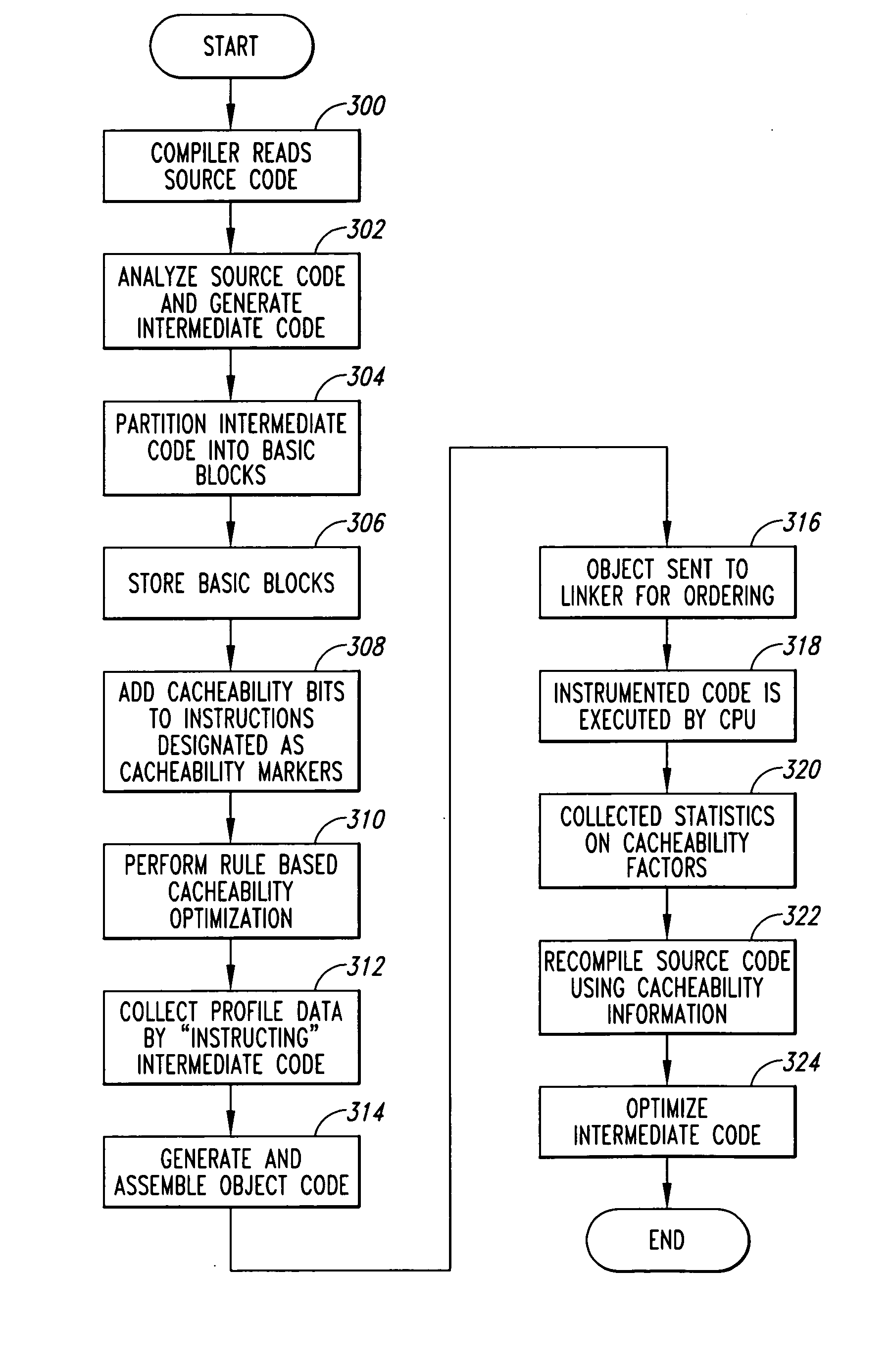
[0012] A preferred embodiment of a system and method according to the present invention utilizes a compile-time determination of cacheability to increase the speed and reliability of a computer system. Because computer programs are commonly written in a high level language (for example, the computer language “C”) and utilize source codes which are then converted into a machine's object code by a compiler, computer programs are often not written in a way which optimizes the performance of a computer executing the program. As is commonly known in the art, various compilers often attempt to optimize computer programs. For example, optimization can be based on particular rules or assumptions (e.g., assuming that all “branches” within a code are “taken”), or can be profile-based. When performing profile-based optimizations (“PBO”), the program code is converted into object code and then executed under test conditions. While executing the object code, profile information about the perform...

the structure of the environmentally friendly knitted fabric provided by the present invention; figure 2 Flow chart of the yarn wrapping machine for environmentally friendly knitted fabrics and storage devices; image 3 Is the parameter map of the yarn covering machine
Login to View More

PUM

No PUM Login to View More

Abstract

A system and method for selectively enabling only certain information to be cached is provided which thereby increases the performance of a computer system by reducing cache hits and cache thrashing. The system and method determines and identifies at the time of compilation of a computer program, which program and instructions and / or data are to be cached or not cached, during the execution of the computer program. The system and method performs these determinations by first compiling a computer program, simulating the op erations of the program with suitable data parameters, and creating a profile of how the program code is utilized by the computer system. The profile is then utilized during a recompilation of the program code to determine which instructions and / or data is to be cached and which are not. The system preferably designates the cache status by affixing additional bits at the end of each instruction / data. During execution of a program code, a bus interface unit determines which instructions / data to cache, where to cache (i.e., level one or a higher level cache), and how to cache (e.g., write through or write back).

Description

TECHNICAL FIELD [0001] The present invention relates to cache memory for computer systems and, more specifically, to a system and method for compile-time cacheability determinations. BACKGROUND OF THE INVENTION [0002] A cache-memory system is an integral tool used by computer designers to increase the speed and performance of modern computers. As processor speeds have increased more rapidly than main-memory speeds in recent years, cache memory systems have become even more important. By avoiding unnecessary accesses to the comparatively slow main memory, an efficient cache-memory system can increase overall system speed dramatically. [0003] In general, cache-memory systems have been designed based on the computer-science principle that a processor is more likely to need information it has recently used rather than a random piece of information stored in a memory device. Accordingly, when a processor issues a read command for particular instructions and / or data, the processor checks ...

Claims

the structure of the environmentally friendly knitted fabric provided by the present invention; figure 2 Flow chart of the yarn wrapping machine for environmentally friendly knitted fabrics and storage devices; image 3 Is the parameter map of the yarn covering machine
Login to View More

Application Information

Patent Timeline
no application Login to View More
Patent Type & Authority Applications(United States)
IPC IPC(8): G06F9/45
CPCG06F8/4442
Inventor KLEIN, DEAN A.
Owner KLEIN DEAN A
Features
  • R&D
  • Intellectual Property
  • Life Sciences
  • Materials
  • Tech Scout
Why Patsnap Eureka
  • Unparalleled Data Quality
  • Higher Quality Content
  • 60% Fewer Hallucinations
Social media
Patsnap Eureka Blog
Learn More