Process for preparing inhibitors of nucleoside phosphorylases and nucleosidases
Inactive Publication Date: 2006-09-28
IND RES LTD
View PDF14 Cites 27 Cited by
Summary
Abstract
Description
Claims
Application Information
AI Technical Summary
This helps you quickly interpret patents by identifying the three key elements:
Problems solved by technology
Method used
Benefits of technology
Benefits of technology
[0137] The present invention provides a useful synthetic route to compounds that are inhibitors of PNP, PPRT, MTAN, MTAP and / or NH. The compounds may be useful in the treatment of diseases in which the inhibition of PNP, PPRT, MTAN, MTAP and / or NH is desirable. Such diseases include cancer, bacterial infection, protozoal infection or T-cell mediated diseases.
Problems solved by technology
Consequently, the time and cost required for each synthesis can be considerable.
Method used
the structure of the environmentally friendly knitted fabric provided by the present invention; figure 2 Flow chart of the yarn wrapping machine for environmentally friendly knitted fabrics and storage devices; image 3 Is the parameter map of the yarn covering machine
View more
Image
Smart Image Click on the blue labels to locate them in the text.
Viewing Examples
Smart Image
Click on the blue label to locate the original text in one second.
Reading with bidirectional positioning of images and text.
Smart Image
Examples
Experimental program
Comparison scheme
Effect test
example 1.01
[0093] (3R,4R)-1-[(9-Deazahypoxanthin-9-yl)methyl]-3-hydroxy-4-hydroxymethyl-pyrrolidine (4). Starting with 9-deazahypoxanthine (Fumeaux and Tyler, J. Org. Chem., 1999, 64, 8411-8412) and (3R,4R)-3-hydroxy-4-hydroxymethyl-pyrrolidinehydrochloride (5) (Evans et al, J. Med. Chem., 2003, 46 5271-5276), the Mannich reaction general procedure (above) was followed to afford compound 4 as the acetic acid salt. After conversion to the HCl salt and 1H and 13C NMR spectra analysis, the compound was found to be identical in all respects with that previously reported (Evans et a.l J. Med. Chem. 2003, 46, 5271-5276).
example 1.02
[0094] (3R,4R)-1-[(9-Deaza-adenin-9-yl)methyl]-3-hydroxy-4-(hydroxymethyl)-pyrrolidine (6). Starting with 9-deaza-adenine (Preparative Example 3.01) and (3R,4R)-3-hydroxyhydroxymethyl-pyrrolidine (5), the Mannich reaction general procedure (above) was followed to afford compound 6 as the acetic acid salt. 1H NMR (d4-MeOH) δ8.20 (s, 1H), 7.65 (s, 1H), 4.27 (s, 1H), 4.22 (quintet, J=3.0 Hz, 1H), 3.59 (m, 2H), 3.46 (dd, J=11.1, 8.3 Hz, 1H), 3.26 (dd, J=11.4, 5.7 Hz, 1H), 3.11 (dd, J=11.4, 3.0 Hz, 1H), 2.95 (dd, J=11.2, 6.8 Hz, 1H), 2.37 (brs, 1H), 1.82 (s, 3H). 13C NMR (d4-MeOH) 152.9, 151.9, 147.1, 132.0, 115.8, 108.2, 73.6, 63.1, 61.9, 56.0, 50.8, 49.5, 23.7. HRMS (MH+) calc for C12H18N5O2: 264.1461. Found 264.1457.
example 1.03
[0095] (3R,4S)-4-Benzylthlomethyl)1-[(9-deaza-adenin-9-yl)methyl]-3-hydroxy-pyrrolidine (7). The Mannich reaction general procedure (above) was followed to afford compound 7 as the acetic acid salt. The acetic acid salt was converted to the free base via ion exchange chromatography. 1H NMR (d4-MeOH) 8.17 (s, 1H), 7.46 (s, 1H), 7.26-7.16 (m, 5H), 3.93-3.90 (m, 1H), 3.83-3.74 (m, 2H), 3.68 (s, 2H), 3.03-2.97 (m, 1H), 2.80 (dd, J=10.2, 6.4 Hz, 1H), 2.66-2.58 (m, 2H), 2.38 (dd, J=12.5, 8.9 Hz, 1H), 2.30 (dd, J=9.5, 7.2 Hz, 1H), 2.20-2.14 (m, 1H). 13C NMR (d4-MeOH) 152.5, 151.4, 147.4, 140.4, 130.4, 130.4, 129.8, 115.5, 112.9, 77.3, 62.7, 59.2, 49.3, 48.6, 37.5, 35.6. HRMS (MH+) calc for C19H24N5OS: 370.1702. Found 370.1694.
the structure of the environmentally friendly knitted fabric provided by the present invention; figure 2 Flow chart of the yarn wrapping machine for environmentally friendly knitted fabrics and storage devices; image 3 Is the parameter map of the yarn covering machine
Login to View More
PUM
Login to View More
Abstract
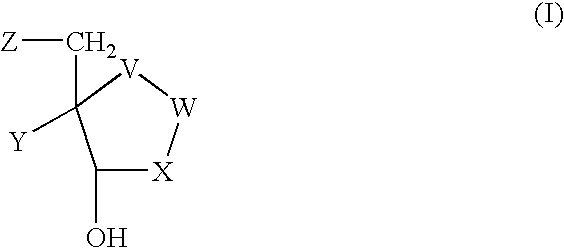
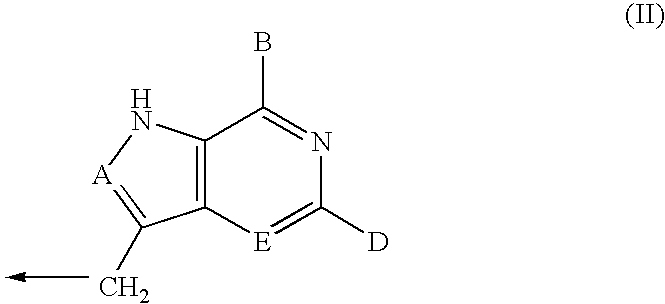
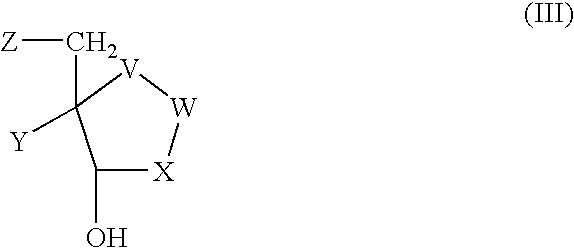
The present invention relates to a new process for the preparation of compounds of general formula (I) which are inhibitors of purinenucleoside phosphorylases (PNP), purine phosphoribosyltransferases (PPRT), 5′-methylthioadenosine phosphorylases (MTAP), 5′-methylthioadenosine nucleosidases (MTAN) and / or nucleoside hydrolases (NH).The present invention relates to a new process for the preparation of compounds of general formula (I) which are inhibitors of purinenucleoside phosphorylases (PNP), purine phosphoribosyltransferases (PPRT), 5′-methylthioadenosine phosphorylases (MTAP), 5′-methylthioadenosine nucleosidases (MTAN) and / or nucleoside hydrolases (NH).
Description
TECHNICAL FIELD [0001] This invention relates to a process for the preparation of certain nucleoside analogues. In particular, the invention relates to a process that includes the reaction of formaldehyde, or a formaldehyde equivalent, with a cyclic amine and a heteroaromatic compound to give methylene linked cyclic amine deazapurines. BACKGROUND [0002] Nucleoside analogues that are potent inhibitors of purine nucleoside phosphorylase (PNP) and purine phosphoribosyltransferases (PPRT) are useful in treating parasitic infections, T-cell malignancies, autoimmune diseases and inflammatory disorders {see e.g. V. L. Schramm, Biochimica et Biophysica Acta, 1587 (2002) 107-117}. The analogues are also useful for immunosupression in organ transplantation. [0003] Related nucleoside analogues that are potent inhibitors of 5′-methylthioadenosine phosphorylase (MTAP) and 5′-methylthioadenosine nucleosidase (MTAN) are useful: [0004] (a) as anti-microbial compounds, and in decreasing the virulenc...
Claims
the structure of the environmentally friendly knitted fabric provided by the present invention; figure 2 Flow chart of the yarn wrapping machine for environmentally friendly knitted fabrics and storage devices; image 3 Is the parameter map of the yarn covering machine
Login to View More
Application Information
Patent Timeline
Application Date:The date an application was filed.
Publication Date:The date a patent or application was officially published.
First Publication Date:The earliest publication date of a patent with the same application number.
Issue Date:Publication date of the patent grant document.
PCT Entry Date:The Entry date of PCT National Phase.
Estimated Expiry Date:The statutory expiry date of a patent right according to the Patent Law, and it is the longest term of protection that the patent right can achieve without the termination of the patent right due to other reasons(Term extension factor has been taken into account ).
Invalid Date:Actual expiry date is based on effective date or publication date of legal transaction data of invalid patent.


 Login to View More
  Login to View More