
Process for separating meta-xylene from a feed of aromatic hydrocarbons by liquid phase adsorption
a technology of aromatic hydrocarbons and adsorption, which is applied in the direction of separation processes, organic chemistry, chemistry apparatus and processes, etc., can solve the problems of a plurality of distillation columns, difficult and expensive separation by distillation, and inability to produce the very pure meta-xylene defined above, and achieve good diffusivity in the adsorbant
- Summary
- Abstract
- Description
- Claims
- Application Information
AI Technical Summary
Benefits of technology
Problems solved by technology
Method used
Image

Examples
example 1
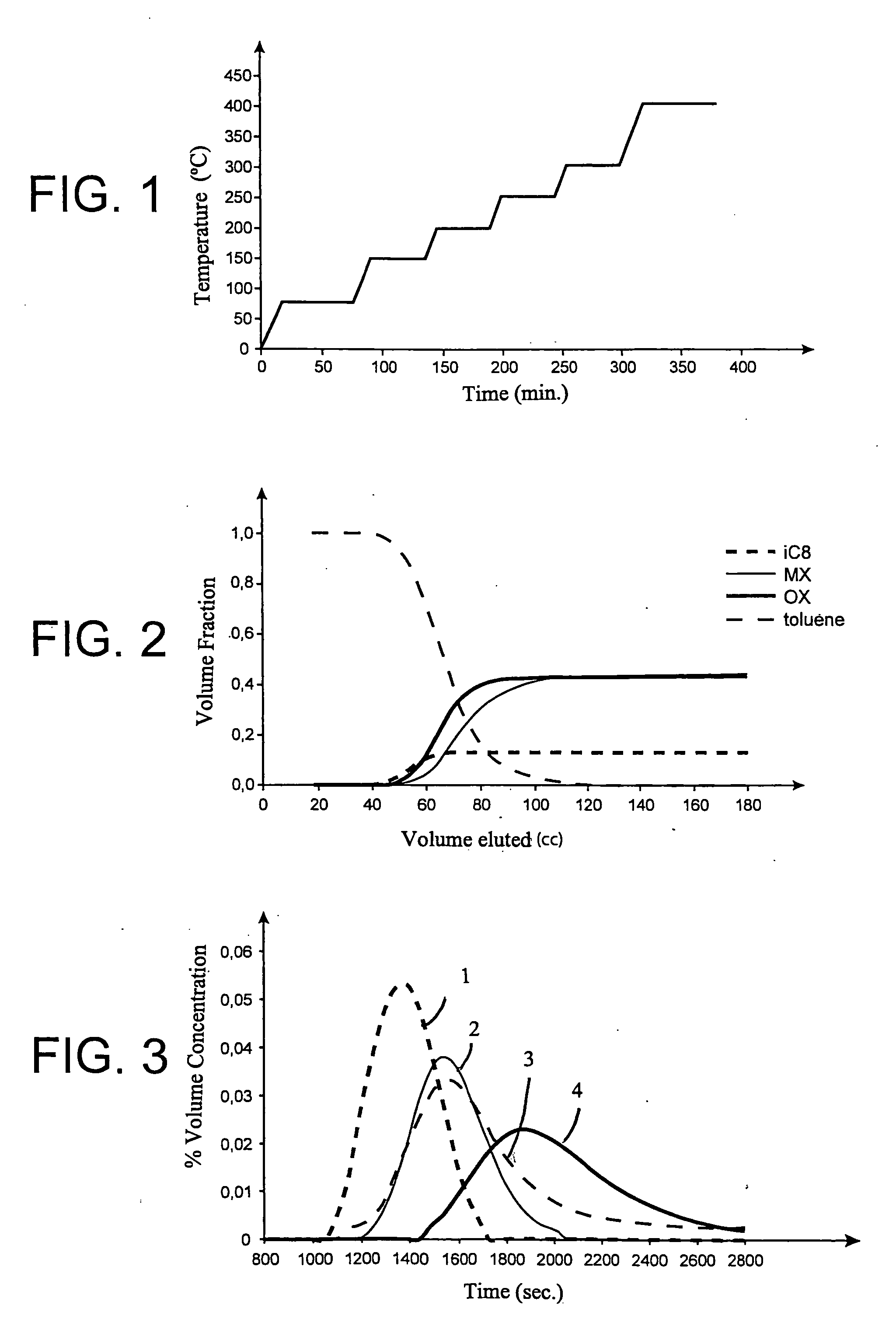
[0082] In this example, the influence of the operating conditions (in this case, the temperature and amount of water in the adsorbant) on the efficacy of separation by adsorption of meta-xylene from a meta-xylene / ortho-xylene mixture was determined using the breakthrough curve technique. The solvent used was toluene and the adsorbant solid was NaY zeolite.
[0083] The quantity of adsorbant used for each test was about 55 g.
[0084] The first test was carried out under the operating conditions of the invention, namely: [0085] with an adsorbant having a loss on ignition at 500° C. of less than 0.05% by weight; and [0086] with an adsorption temperature of 160° C.
[0087] The second test was carried out under prior art operating conditions, namely: [0088] with an adsorbant having a loss on ignition at 500° C. of 2.3% by weight; and [0089] with an adsorption temperature of 120° C.
[0090] The third test was carried out under prior art operating conditions, namely: [0091] with an adsorbant ha...
example 2
[0116] A series of tests was carried out in order to measure the retention time of various solvents. Each solvent was tested independently using the reverse pulse method, as described in U.S. Pat. No. 5,900,523. This method consists of injecting, over 1 minute, a pulse of mixture containing 25% of test solvent and 75% of meta-xylene using pure meta-xylene as the desorbant.
[0117] The operating conditions were as follows: [0118] feed: 25% of test solvent and 75% of meta-xylene; [0119] desorbant: pure meta-xylene; [0120] flow rate: 2 ml / min; [0121] temperature: 160° C.; [0122] adsorbant: NaY zeolite activated using the method described in the test of Example 1; [0123] mass of adsorbant: 55.3 grams; [0124] pulse duration: 1 minute.
[0125] Although the solvents were tested individually, the set of curves has been combined into a single graph, as shown in FIG. 3, to be able to carry out a rapid and effective comparison. The gross and net retention times and selectivities calculated from ...
PUM
| Property | Measurement | Unit |
|---|---|---|
| Temperature | aaaaa | aaaaa |
| Temperature | aaaaa | aaaaa |
| Temperature | aaaaa | aaaaa |
Abstract
Description
Claims
Application Information
 Login to View More