
Statistical modeling for synthesis of detailed facial geometry
a facial geometry and statistical modeling technology, applied in the field of computer graphics and modeling human faces, can solve the problems of tedious and expensive acquisition of high-resolution face models, and the appearance of most face models used in computer vision applications, virtual reality simulations, games, etc., and achieve the effect of smoothness and smoothness
- Summary
- Abstract
- Description
- Claims
- Application Information
AI Technical Summary
Benefits of technology
Problems solved by technology
Method used
Image

Examples
Embodiment Construction
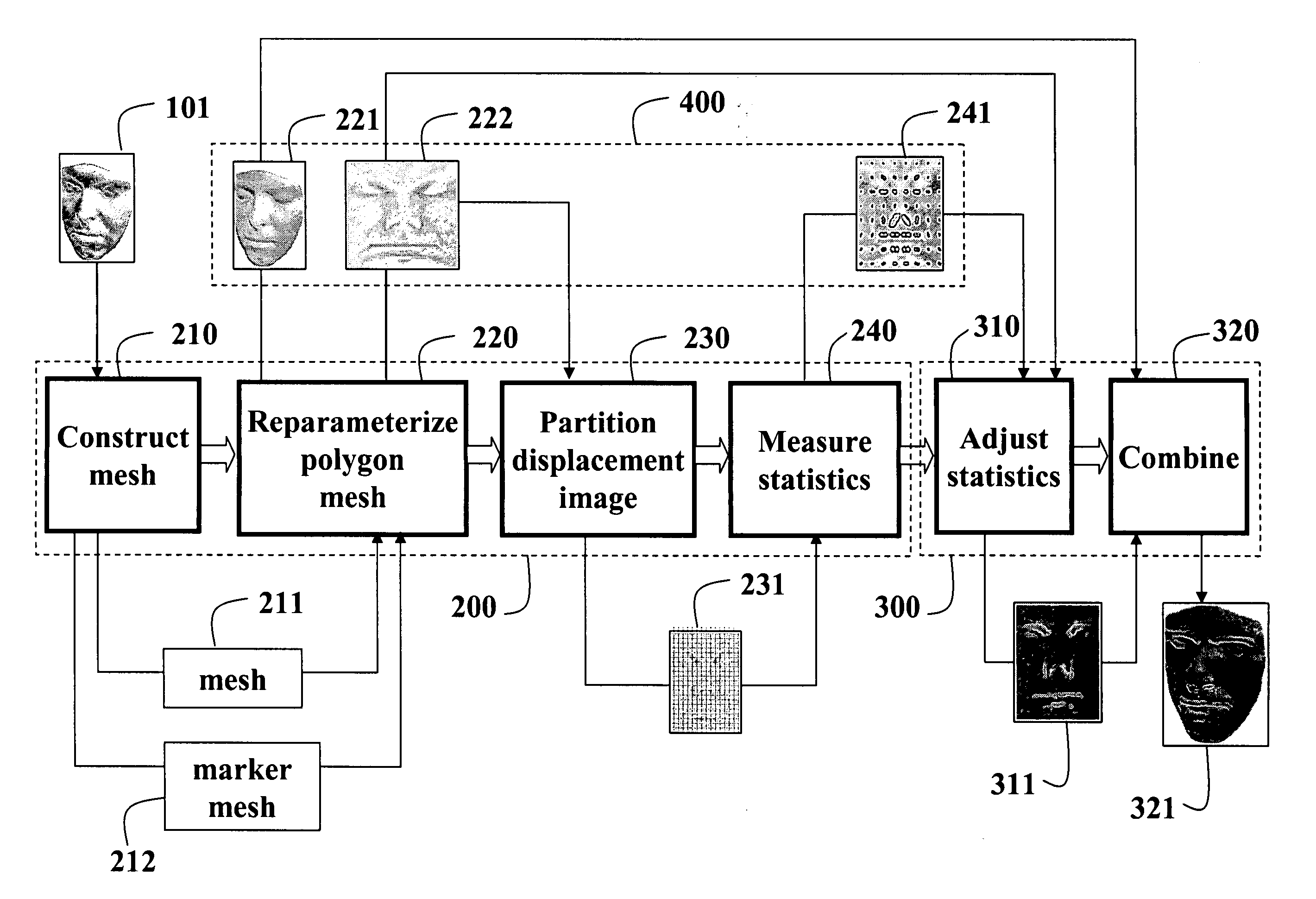
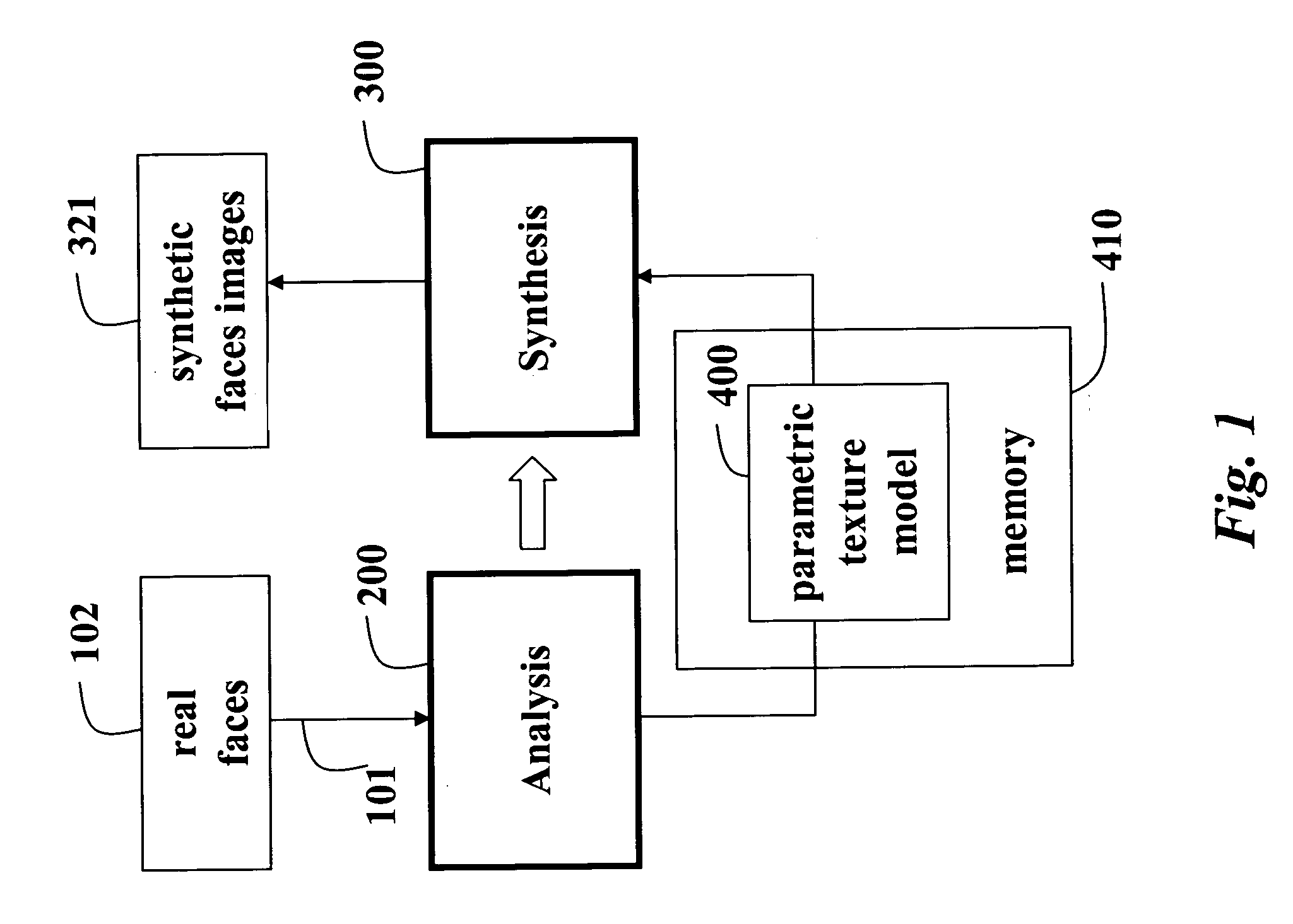
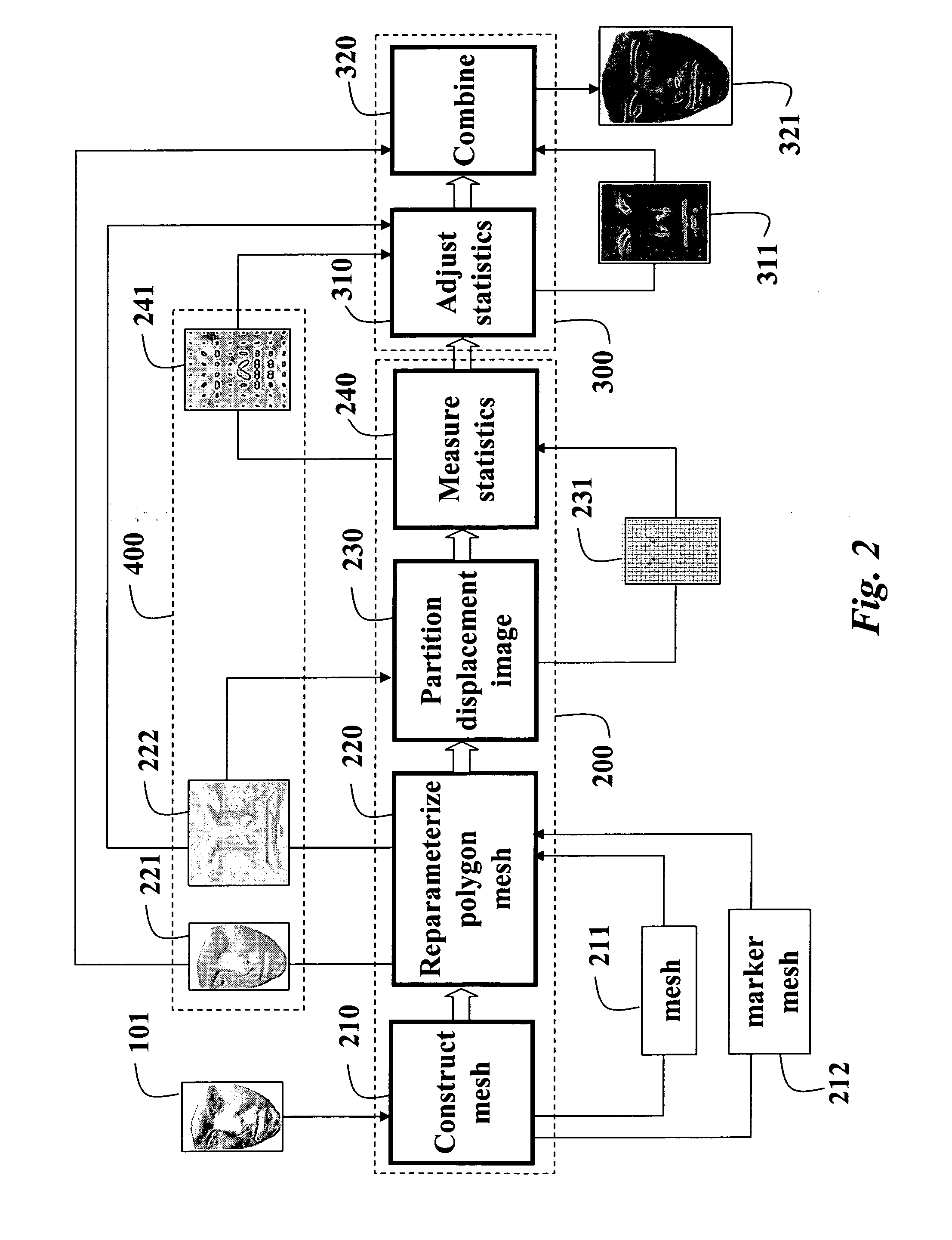
[0030] As shown in FIGS. 1 and 2, our invention provides a method for analyzing, modeling and synthesizing fine details in human faces. Input to the method are a large number of scans 101 of real faces 102. The scans include three-dimensional geometry of the faces, and texture in the form of images. The real faces 102 include age, gender, and race variations. Each scan 101 is analyzed 200 to construct a parametric texture model 400. The model can be stored in a memory 410. The model can then later be used to synthesize 300 images 321 of synthetic faces. The analysis only needs to be performed once for each face scan. The synthesis can be performed any number of times and for different applications.
[0031] Analysis 200 begins with a high-resolution scan 101 of each real face to construct 210 a polygon mesh 211 having, e.g.,
[0032]500,000 triangles. The mesh is reparameterized 220 and separated into a base mesh 221 and a displacement image 222. The displacement image 222 is partitione...
PUM
 Login to View More
 Abstract
Description
Claims
Application Information
 Login to View More