
Location based security data provisioning and management via RFID tags
a technology of security data and location, applied in the field of radio frequency identification (rfid) tags, can solve the problems of physical (or wired) links between end-user devices and wireless networks susceptible to eavesdropping attacks, the cost of an increased vulnerability to attacks, and the inability to detect and respond to eavesdropping attacks
- Summary
- Abstract
- Description
- Claims
- Application Information
AI Technical Summary
Problems solved by technology
Method used
Image

Examples
Embodiment Construction
1.0 Introduction
[0012]Radio frequency identification (RFID) tags are electronic devices that may be affixed to items whose presence is to be detected and / or monitored. A tag may be active (i.e., having an internal power supply such as a battery), passive, or a combination of both (pass-active). The presence of an RFID tag, and therefore the presence of the item to which the tag is affixed, may be checked and monitored by devices known as “readers.” Readers typically transmit radio frequency signals to which the tags respond. Each tag can store a unique identification number and / or a data set (which can be read only, read / write, or write once, read many). The tags respond to the reader transmitted read signals by providing their identification number so that they can be identified.
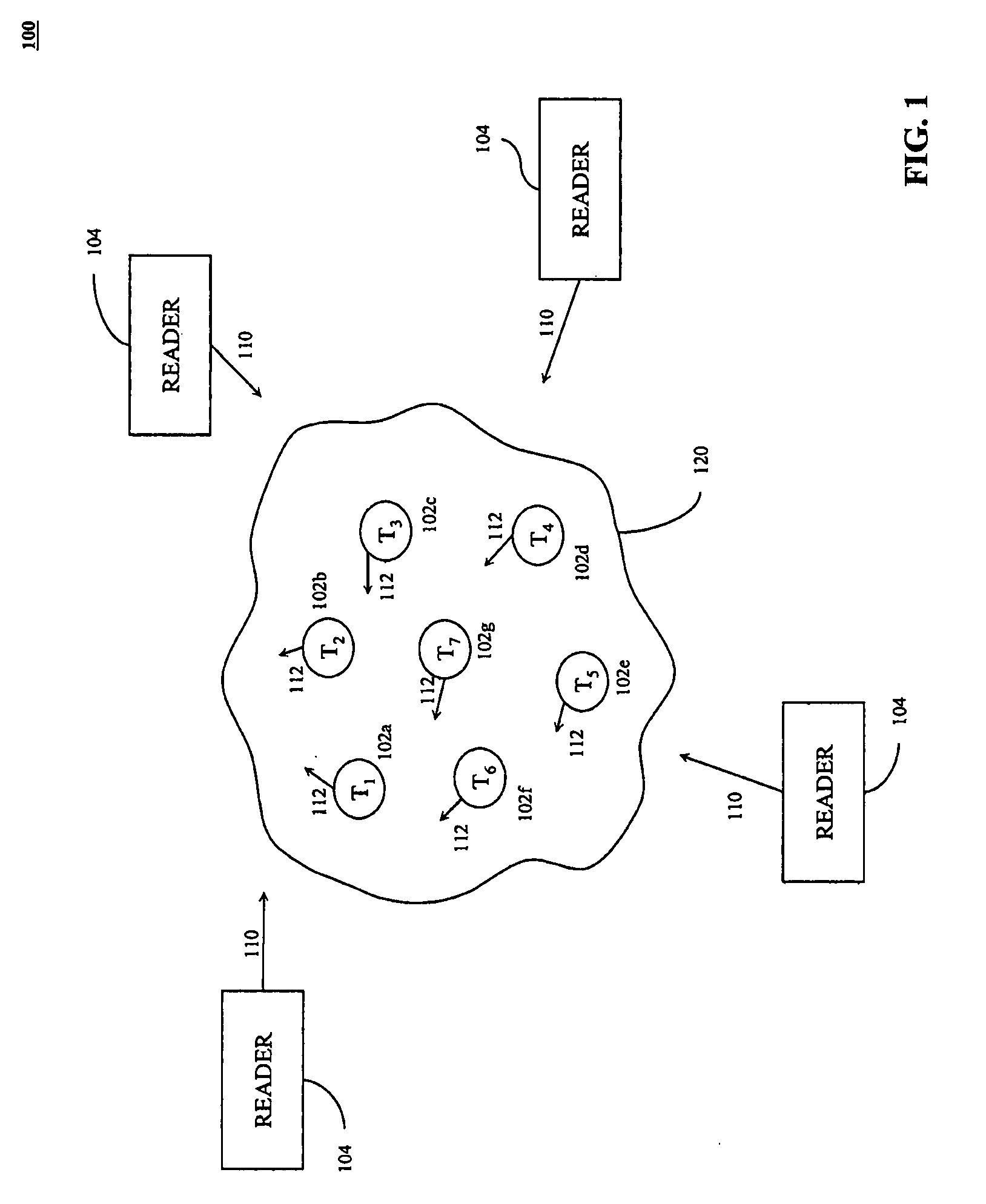
[0013]FIG. 1 illustrates an environment 100 where one or more RFID tag readers 104 communicate with an exemplary population of RFID tags, according to the present invention. As shown in FIG. 1, the populati...
PUM
 Login to View More
 Abstract
Description
Claims
Application Information
 Login to View More