Time continuous pipeline analog-to-digital converter

a technology of analog-to-digital converter and time-continuous pipeline, which is applied in the direction of code conversion, transmission system, instruments, etc., can solve the problems of introducing quantitative errors of adc, affecting the quality of the pipeline, and so on, so as to reduce the noise of the next stage of the pipeline. , to achieve the effect of reducing high-frequency broadband

US20080238754A1Active Publication Date: 2008-10-02NATIONAL INSTRUMENTS
17 Cites 16 Cited by

Patent Information

Authority / Receiving Office
US · United States
Current Assignee / Owner
Publication Date
2008-10-02

Smart Images

  • Figure 1
    Figure 1
  • Figure 2
    Figure 2
  • Figure 3
    Figure 3
Patent Text Reader

Abstract

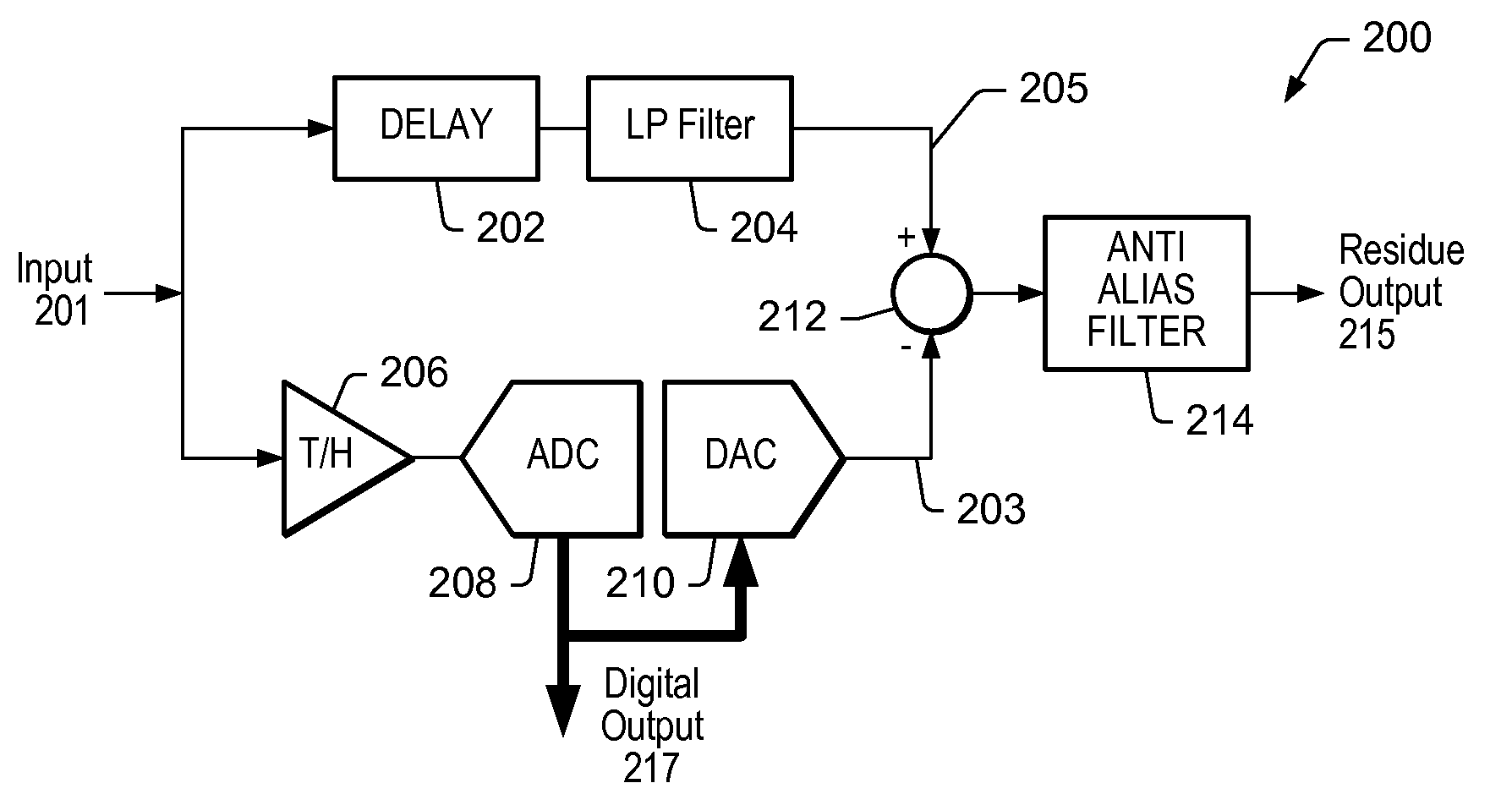
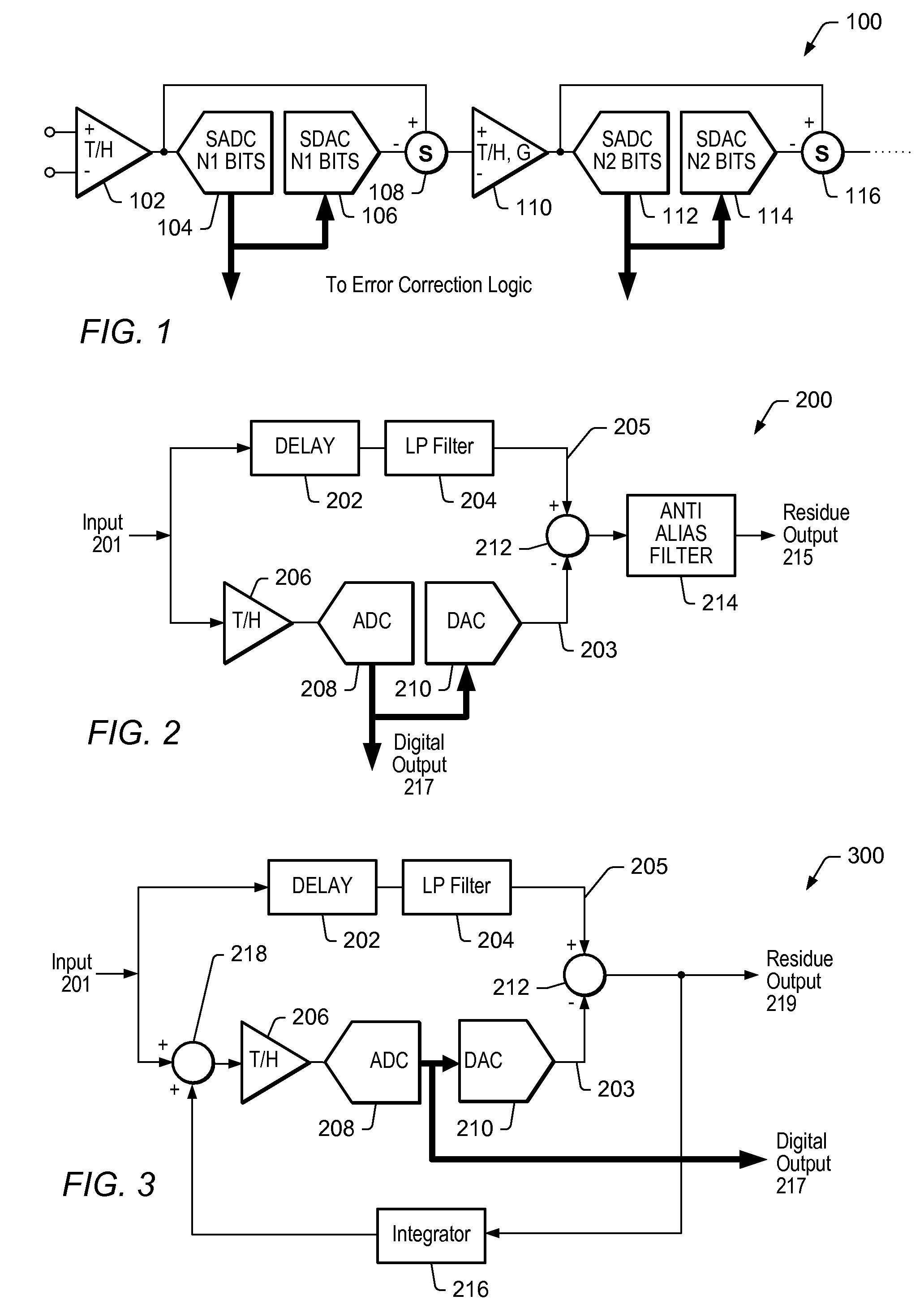
A Sampled Pipeline Subranging Converter (SPSC) may include at least one stage—e.g. at least the input stage—operating in a time-continuous fashion. In the time continuous input stage, the analog input may be processed in two parallel paths. A lower path may comprise a track-and-hold (T / H) element, an Analog-to-Digital-Converter (ADC) and a Digital-to-Analog-Converter (DAC). The T / H element may be optional and may be present if required by the ADC. The signal entering the lower path may be sampled at the desired conversion rate. The time continuous stage(s) may additionally be configured with an upper path that includes a delay element configured to receive the analog input, a Low-Pass (LP) filter coupled to the delay element, and an anti alias filter. The output generated by the DAC may be subtracted from the output of the LP filter, and the resulting difference signal may be provided to the anti alias filter, which in turn may generate the residue (or error) output. The digital output of the time continuous converter may be calculated by combining the digital outputs of the various sections.
Need to check novelty before this filing date? Find Prior Art

Description

BACKGROUND OF THE INVENTION

[0001] 1. Field of the Invention

[0002] This invention relates generally to analog-to-digital converter (ADC) design and, more particularly, to the design of a time continuous pipeline ADC.

[0003] 2. Description of the Related Art

[0004] Scientists and engineers often use measurement systems to perform a variety of functions, including measurement of a physical phenomena or unit under test (UUT), test and analysis of physical phenomena, process monitoring and control, control of mechanical or electrical machinery, data logging, laboratory research, and analytical chemistry, to name a few examples.

[0005] A typical measurement system comprises a computer system, which commonly features a measurement device, or measurement hardware. The measurement device may be a computer-based instrument, a data acquisition device or board, a programmable logic device (PLD), an actuator, or other type of device for acquiring or generating data. The measurement device may be a card ...

Examples

Embodiment Construction

[0027]As used herein, “combining signals” includes but is not limited to adding the signals or portions of the signals together, subtracting the signals or portions of the signals from each other, or multiplying the signals or portions of the signals together, or performing any combination thereof.

[0028]FIG. 2 shows a single stage 200 of a time-continuous implementation (i.e. without a track and hold) of a Sampled Pipeline Subranging Converter (SPSC), equivalent to a single conversion stage in the SPSC. The analog input 201 may be processed in two parallel paths. A lower path may comprise a track-and-hold (T / H) element 206, an Analog-to-Digital-Converter (ADC) 208 and a Digital-to-Analog-Converter (DAC) 210. T / H 206 is optional and may be present if required by ADC 208. The lower path may be sampled at the desired conversion rate. As in the SPSC shown in FIG. 1, DAC 210 may output an analog representation of input signal 201. However, the output signal 203 of DAC 210 may differ from...