Unlock instant, AI-driven research and patent intelligence for your innovation.

System, method, and service for providing a generic raid engine and optimizer

a generic and optimizer technology, applied in the field of data storage, can solve the problems of increasing complexity, increasing development and test costs, and difficult to perform path length optimizations, and achieve the effect of minimizing disk i/o and minimizing memory bus bandwidth

Inactive Publication Date: 2008-10-16
INT BUSINESS MASCH CORP
View PDF16 Cites 19 Cited by
  • Summary
  • Abstract
  • Description
  • Claims
  • Application Information

AI Technical Summary

Benefits of technology

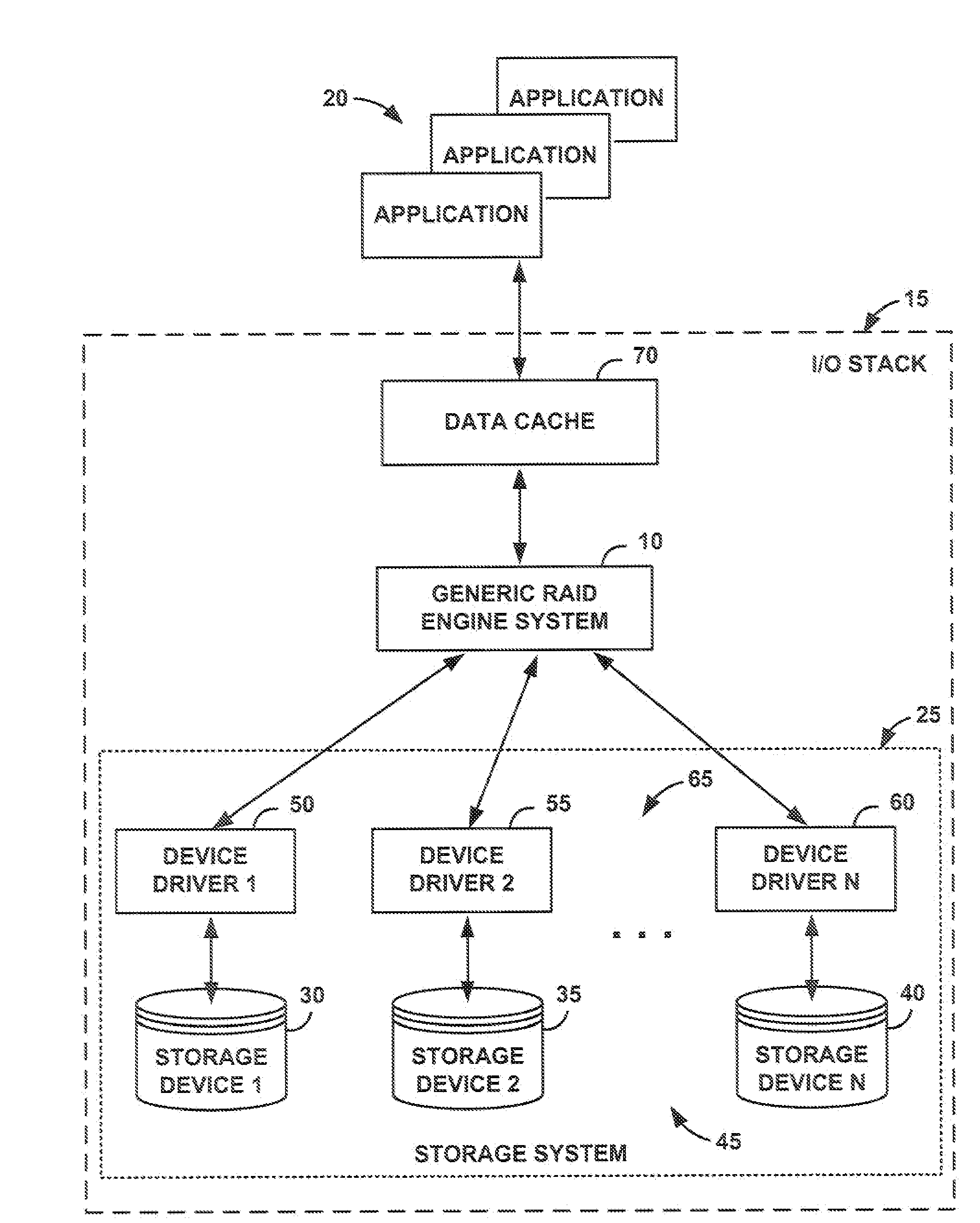
The present invention provides a system, service, computer program product, and associated method for providing a generic RAID engine and optimizer. The system can accept an access request, metadata input, dynamic input, and RAID code input to transform the access request into individual device reads and individual device writes while maintaining RAID code relationships at all times. The system can also select strategies that meet resource optimization objectives. The layout description comprises a description of a rotation, stripe size, and element size of each of a plurality of disks in the storage devices. The resource optimization objectives comprise minimizing disk I / O and minimizing memory bus bandwidth for the access request. The dynamic input comprises a description of a data cache regarding a description of clean pages, dirty pages, and a W-neighborhood of pages to be read or written. The fault configuration comprises a description of known sector failures and disk failures. The transformation of a write request comprises constructing a plurality of affected parity vectors, preparing a failure vector, computing a plurality of inverse matrices, and generating a plurality of sub-plans. The transformation of a read request comprises determining if any faults exist in the disks of the storage system that prevent a successful read. The present system can be embodied in a utility program and provides a method for the user to specify input and invoking the generic RAID code engine utility to execute read and write requests.

Problems solved by technology

However, rolling out new RAID codes is challenging as well as cost prohibitive since the new RAID codes require significant development, testing, and tuning efforts.
Only a few RAID codes were supported in traditional RAID implementations (firmware) for a variety of reasons: firmware complexity, software maintainability, and field upgrade difficulty.
Increased complexity increases development and test costs.
The firmware becomes a collection of special cases making it hard to perform path length optimizations.
In addition, performance tuning becomes difficult, if not prohibitively expensive.
. . ” code blocks makes firmware readability harder, making the firmware more prone to bugs.
Upgrading firmware and drivers is not a task that a storage administrator relishes, given the propensity of upgrades to trigger other problems.
No single RAID code satisfies all aspects of data storage.
Using a single RAID code in this application is challenging.
These datasets typically span many disks, indicating a relatively high probability of simultaneous failures.
Furthermore, while disk capacities are increasing, the hard error rate (HER) due to media deterioration, channel errors, etc., has remains relatively constant.
Combined, these trends raise the frequency of data loss events as data sets grow unless RAID codes with a higher fault tolerance are used.
Consequently, providing various data reliability levels using cheaper but less reliable disks requires a greater variety of RAID codes.
RAIDframe provides no simplification or automation of error handling.
Furthermore, RAIDframe has no ability to automatically tune performance.
Further, tuning of this performance approach is only minimally automatic, if at all.
Non-XOR codes such as LDPC and Reed-Solomon have been developed, but these have not become popular since they offer no special advantage over XOR based codes.
An example of such an error path is, on a read, encountering a read error due to a failed sector or disk.
The need for such a solution has heretofore remained unsatisfied.

Method used

the structure of the environmentally friendly knitted fabric provided by the present invention; figure 2 Flow chart of the yarn wrapping machine for environmentally friendly knitted fabrics and storage devices; image 3 Is the parameter map of the yarn covering machine
View more

Image

Smart Image Click on the blue labels to locate them in the text.
Viewing Examples
Smart Image
  • System, method, and service for providing a generic raid engine and optimizer
  • System, method, and service for providing a generic raid engine and optimizer
  • System, method, and service for providing a generic raid engine and optimizer

Examples

Experimental program
Comparison scheme
Effect test

Embodiment Construction

[0039]The following definitions and explanations provide background information pertaining to the technical field of the present invention, and are intended to facilitate the understanding of the present invention without limiting its scope:

[0040]Element (interchangeably referenced as a page): fixed-size chunks of bits. An element typically comprises one or more consecutive pages on a disk and comprises data pages or parity pages but not both parity pages and data pages.

[0041]Page (interchangeably referenced as an element): fixed-size chunks of bits

[0042]RAID (Redundant Array of Independent Disks): Any of a family of codes using XOR codes to achieve a virtual erasure coded storage volume. Examples of RAID codes comprise RAID 5, EVENODD, generalized EVENODD, X-code, RDP, and WEAVER.

[0043]Strategy: a sub-plan used by the present invention to develop an I / O plan based on metadata input, RAID code input, dynamic input, and one or more read requests or one or more write requests.

[0044]St...

the structure of the environmentally friendly knitted fabric provided by the present invention; figure 2 Flow chart of the yarn wrapping machine for environmentally friendly knitted fabrics and storage devices; image 3 Is the parameter map of the yarn covering machine
Login to View More

PUM

No PUM Login to View More

Abstract

A generic RAID engine system accepts an access request, accepts a metadata input comprising a layout description and, optionally, a plurality of resource optimization objectives, accepts a dynamic input comprising a dynamic state of an I / O stack comprising the generic RAID engine and a fault configuration of a plurality of storage devices in the I / O stack, and accepts RAID code input comprising information about the RAID code used by the I / O stack. The metadata input, the dynamic input, and the RAID code input are utilized to transform the access request into individual device reads and individual device writes such that RAID code relationships for the storage devices are maintained at all times. An optional optimizer module selects strategies that meet the resource optimization objectives.

Description

FIELD OF THE INVENTION[0001]The present invention generally relates to data storage. More specifically, the present invention relates to providing fault tolerance for a storage system comprising RAID coded storage volumes.BACKGROUND OF THE INVENTION[0002]Conventional applications requiring reliable data storage typically use commonly available RAID (redundant array of independent disks) levels to protect against data loss due to media or disk failures. Although conventional RAID technology has proven to be useful, it would be desirable to present additional improvements. With a marked rise in the quantity of stored data and no commensurate improvement in disk reliability, a variety of RAID codes are becoming essential to containing data management costs. However, rolling out new RAID codes is challenging as well as cost prohibitive since the new RAID codes require significant development, testing, and tuning efforts.[0003]Until recently, protecting customer data from loss due to med...

Claims

the structure of the environmentally friendly knitted fabric provided by the present invention; figure 2 Flow chart of the yarn wrapping machine for environmentally friendly knitted fabrics and storage devices; image 3 Is the parameter map of the yarn covering machine
Login to View More

Application Information

Patent Timeline
no application Login to View More
Patent Type & Authority Applications(United States)
IPC IPC(8): G06F13/28G06F12/08H03M13/09G06F11/10
CPCG06F11/1092G06F2211/1059G06F2211/1088
Inventor HE, DINGSHANKENCHAMMANA HOSEKOTE, DEEPAK R.
Owner INT BUSINESS MASCH CORP