
Stripping Liquid for Use in Separating Paper From Plaster/Paper Laminate
- Summary
- Abstract
- Description
- Claims
- Application Information
AI Technical Summary
Benefits of technology
Problems solved by technology
Method used
Image

Examples
example 1
[0074]An aqueous solution containing 10% by mass of disodium malonate was used as the stripping liquid.
[0075]The above stripping liquid was infiltrated into a sponge which was, then, repetitively pushed onto the surfaces of the papers of the plaster / paper laminate for about 10 minutes so that the aqueous solution was infiltrated into the bonding surface between the plaster and the papers. Thereafter, the plaster and the papers were separated from each other by hand.
[0076]The strength of adhesion was almost zero in the bonding surface between the plaster and the paper, and the plaster and the paper could be entirely separated from each other on the bonding surface.
[0077]The amount of the dihydrate adhered to the separated paper was 0% by mass and the amount of the paper adhered to the separated dihydrate was 0% by mass.
example 2
[0078]An aqueous solution of a mixture of 90 parts by mass of an aqueous solution containing 5% by mass of disodium malate and 10 parts by mass of 2-propanol was used as the stripping liquid.
[0079]The plaster / paper laminates were dipped in the above stripping liquid in an atmosphere of 20° C. for 10 seconds, were, thereafter, left to stand for 10 seconds and for 2 hours, and were separated into the plaster and the paper by hand. Both the laminate left to stand for 10 seconds and the laminate left to stand for 2 hours possessed almost no strength of adhesion in the bonding surface between the plaster and the paper, and could be entirely separated into the plaster and the paper on the bonding surface. In both cases, further, the amount of the dihydrate adhered to the separated paper was 0% by mass and the amount of the paper adhered to the separated plaster was 0% by mass.
example 3
[0080]An aqueous solution of a mixture of 99 parts by mass of an aqueous solution containing 10% by mass of trisodium citrate and 1 part by mass of polyoxyethylenelauryl ether (polymerization number of the ethylene oxide of 10) was used as the stripping liquid.
[0081]By using a coating roller impregnated with the above stripping liquid, the stripping liquid was infiltrated into the bonding surface between the plaster and the paper from the surface of the paper of the plaster / paper laminate in an atmosphere of 20° C. In this case, the stripping liquid could be readily infiltrated into the bonding surface between the plaster and the paper.
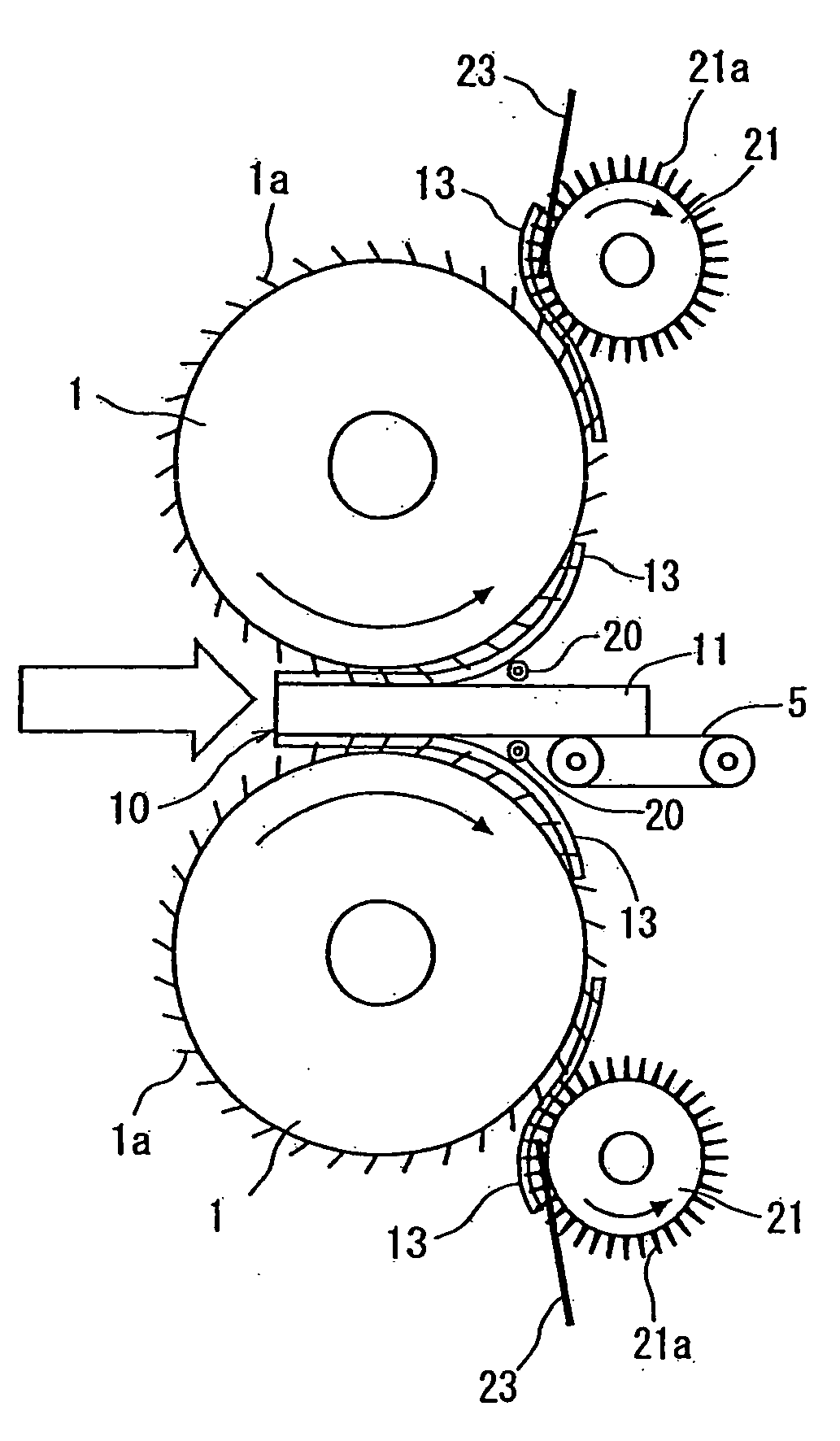
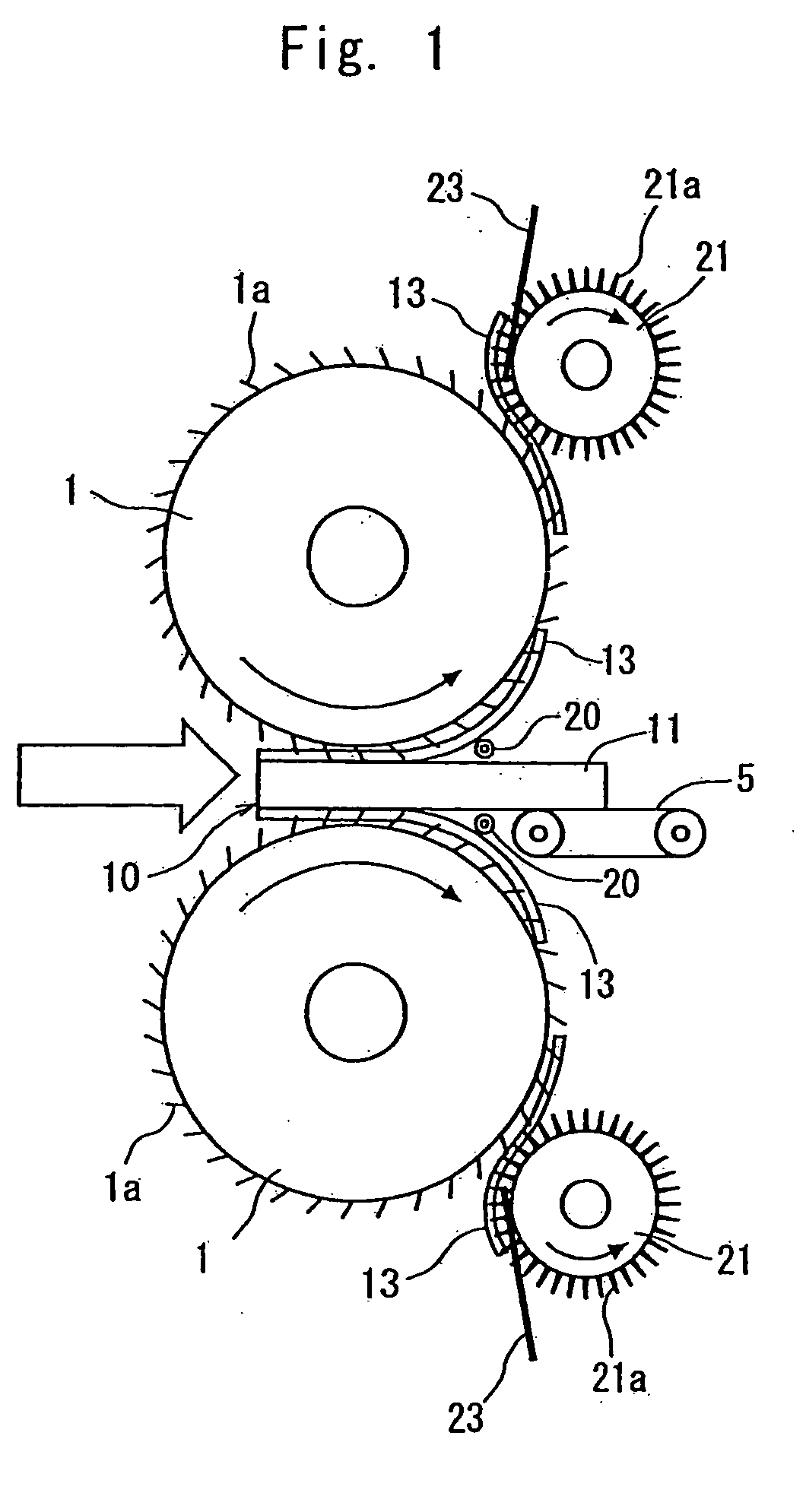
[0082]Next, after 20 seconds have passed, the treated plaster / paper laminate was thrown into between a pair of stripping rollers having sharp needle-like protrusions on the surfaces thereof, and was separated into the plaster and the paper in a manner that the paper portion was caught by the sharp protrusions. The plaster and the paper could be entire...
PUM
| Property | Measurement | Unit |
|---|---|---|
| Solubility (mass) | aaaaa | aaaaa |
Abstract
Description
Claims
Application Information
 Login to View More